









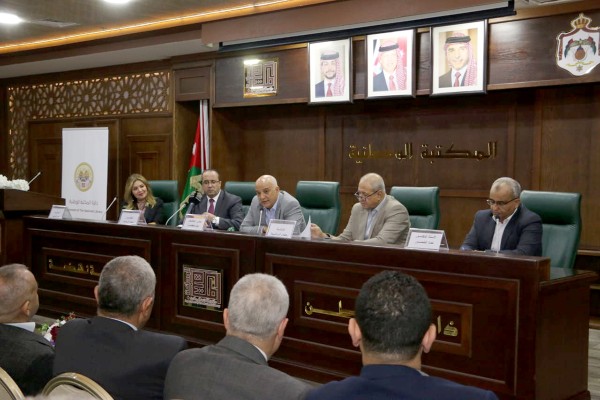
Intellectuals, writers, and academics celebrated the launch of the novel “Is’ida” by novelist Dr. Mohammad Abdul Karim Al-Zyoud on Saturday evening at the National Library Hall in Amman.
The event was sponsored by a representative of the Minister of Culture, the Secretary-General of the Ministry Dr. Nidal Al-Ahmad; former Minister of Government Communication and Director-General of the Jordanian Royal Documentation Center, Dr. Muhannad Mubaidin; novelist and colleague Ramadan Al-Rawashdeh; critic Dr. Imad Al-Dmour; the novelist Al-Zyoud himself; and was moderated by media professional Samar Al-Gharaibeh.
Al-Ahmad praised Al-Zyoud’s new novel, noting that it is a literary and intellectual work that will add value to the Jordanian and Arab library.
Mubaidin pointed out that the novels published by Jordanian writers over the last ten years carry a strong nostalgia for place, and the past of Jordanian rural areas and villages, especially their social and economic dimensions.
He said that the novel “Is’ida” represents a direct portrayal of the transformations in Jordanian rural life during the period 1950-1985. It is a lively narrative where the author confronts deep changes in social and economic structures through times of construction, war, and regional conflicts, foremost among them the Palestinian cause.
The novel tracks the changes in Jordanian society and the effects on the political and economic scenes and the repercussions of regional events. The importance of “Is’ida” lies in its reflection of economic activities, social transformations, the development of education, and the formation of awareness in Jordan during that era.
Al-Rawashdeh noted that the author has left his unique mark on Jordanian novel production through two novels: the first, “Fatima… The Story of Gunpowder and Ears of Grain,” and the second, “Is’ida.” He explained that Al-Zyoud expresses the Jordanian place as part of the generation of Jordanian writers who emerged in the 1990s, representing place and Jordanian identity in their works.
He added that the Jordanian place is strongly present in “Is’ida,” which represents the biography of a Jordanian village, focusing on the important history of Jordan and the village of “Is’ida,” now called Al-Hashmiya, located in Zarqa Governorate.
The novel documents the social and economic transformations experienced by many Jordanian villages from the 1950s to the 1980s and the repercussions of these changes on the village and its community on various levels.
It also covers major political events such as the Palestinian exodus in 1948, the defeat of June 5, 1967, and the great victory achieved by the Jordanian Armed Forces – the Arab Army – in the Battle of Karameh on March 21, 1968, through the story of the martyr Kareem Al-Alyan, a son of the village who went to military service defending his country Jordan.
The novel highlights the intertwined relationship between the two brotherly peoples, Jordanians and Palestinians.
Critic Al-Dmour, who titled his participation “The Novel (Is’ida): Memory of Place and Title of Belonging,” said the novel is built on a narrative act with an alternating division of events, escalating in the construction of time that accompanies the flourishing of the place (Is’ida) and its transformation from a quiet village to a thriving town undergoing clear social, political, and economic changes linked to the 1950s era, and the rapid development witnessed by the village due to technology and its swift impact.
He explained that the novel’s events unfold through the narrator embodied in the character Qasim Al-Saleh, who follows narrative storytelling relations biased towards the past of the place and its temporal flow, consolidating the cultural identity embraced by the place, which the novel’s characters continuously seek.
He noted that readers feel the spirit of the fertile Jordanian place, the sacrifices of Jordanians defending their homeland, and their firm desire for renaissance and development. Every letter of the novel is an artistic formulation of a past time and a lasting civilizational act.
Al-Zyoud tends to historicize by subjecting it to contemporary intellectual production, through which he revives the past in the present, inspired by the fertile space of “Is’ida” with its events, characters, and places according to a narrative imagination that touches the reader’s emotions and grants some of the place’s brilliance and vigor.
He said the narrator in this novel clearly sides with the place; the place is the hero of the novel, and the author, narrator, and hero are the same character, making “Is’ida” carry some autobiographical features of the author and the place’s alterity.
Al-Zyoud thanked the participants and attendees, explaining that “Is’ida” is a story of transformations in Jordanian villages and society and the resulting changes in various dimensions, noting that the novel intertwines literature and history.



Recommended for you
Al-Jaghbeer: The Industrial Sector Leads Economic Growth
Alternative to UNIFIL Forces
Egypt Post: We Have Over 10 Million Customers in Savings Accounts and Offer Daily, Monthly, and Annual Returns
Talib Al-Rifai Chronicles Kuwaiti Art Heritage in "Doukhi.. Tasaseem Al-Saba"
Exhibition City Completes About 80% of Preparations for the Damascus International Fair Launch
Trump Advisor: Disarming Hamas is Central.. Palestinian Authority to Take Over Gaza After Required Reforms