






They came from the world of desert, exile, and separation; responding to my dinner invitation. The night stretched endlessly like a vast desert, and hearts glowed like embers burning beneath ashes.
We conversed long; their talk flowed like the winds in the wilderness, unrestrained and unhindered.
Urwah ibn al-Ward, Sulayk ibn Sulakah, Al-Shanfara, and Taabat Sharran sat before a table topped with Mansaf in Al-Karak, which is known as “Karak wherever you come.” Urwah, the outlaw poet, looked at the guests and the Mansaf and said: “This is the food of generosity and nobility that is never withheld from a hungry person nor refused to a needy one.”
Then Taabat Sharran turned and said: “I smell the scent of history stretching from Moab to Amman; drawing the map of Jordan (the kingdom of generosity, chivalry, and noble men). We answered your invitation carrying with us history, poetry, and freedom.”
Urwah ibn al-Ward addressed him saying:
“I disperse my body into many bodies
And feel the water’s wounds, and the water is cold..
But you, brothers, what do you say about the love of freedom?”
Al-Shanfara replied:
“I endure the length of hunger until I kill it
And I strike its mention off, forgiving, so I astonish
For life is worth suffering for with dignity, not living it in humiliation.”
Taabat Sharran nodded and said:
“We leave life without possessions, so what do we care if we live it without possessions? Life is a gift like the overflowing sea, not like a river whose flood is feared.”
Sulayk ibn Sulakah added in a whisper:
“I scare dogs that lead their dogs..
A meadow when he grazed it with a spear
Life is a constant battle in which only the strongest and fastest survive.”
Urwah ibn al-Ward asked: “And how do you see freedom?”
Al-Shanfara answered:
“On earth there is refuge for the noble from harm
And for those who fear burning, a place to isolate
You must find a homeland on earth that respects your freedom.”
Taabat Sharran said:
“It is to go out armed, so fear never finds its way to your heart.”
Sulayk ibn Sulakah said: “It is to run like the wind so no pursuer catches you, nor any seeker reaches you.”
Urwah ibn al-Ward turned to them and said:
“What do you say about poetry and eloquence today?”
Al-Shanfara sighed and said:
“We left behind poetry like blazing fire, but…”
Taabat Sharran interrupted, saying: “But we have heard in this era someone whose speech flows sweetly, clearly, like the winter torrents of Tihama.”
Sulayk ibn Sulakah nodded in agreement and said: “I heard someone reciting in your tongue, filling the world with poetry and prose, making letters flow like stars in dark nights.”
Urwah ibn al-Ward said: “I have heard his name echoing across the horizons of Moab, like the echo of evenings in the deserts. Who is this man?”
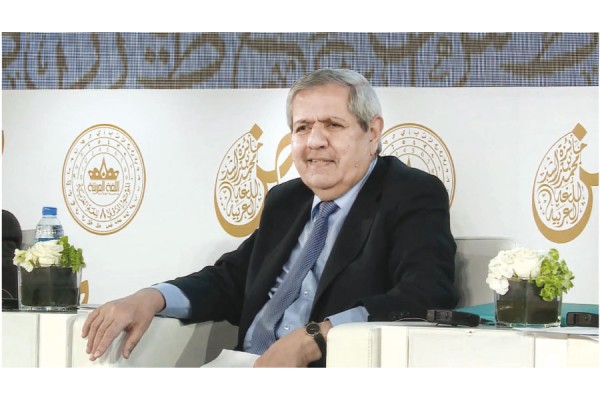
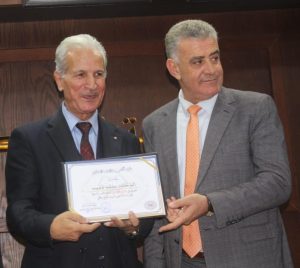
I answered proudly: “He is Dr. Khaled Al-Kurki.. the loyal lover of the Arabic language.”
Urwah ibn al-Ward exclaimed: “Tell us about him.. our curiosity has taken hold of our minds.”
I said: “He is a Jordanian politician and writer, held high positions, was head of the Royal Court, advisor to His Majesty the King, and president of the Jordanian Arabic Language Academy.”
Al-Shanfara said: “Describe him to us.”
I said: “He is nicknamed the guardian of the Arabic language. They say: (Whoever wants to taste poetry should listen to him), his words make you certain that the authentic Arabic language is still alive.”
Taabat Sharran shrugged and said: “This, by God, is eloquence itself.”
Sulayk ibn Sulakah smiled and asked: “Does he not carry in his heart a love for freedom, as we did?”
I said: “Yes, freedom and the Arabic language are inseparable,” and I continued: “He said at the graduation ceremony of the University of Jordan students: (True freedom is that which stems from knowledge, mind, and vision), and he urged them to hold on to freedom.”
Urwah ibn al-Ward was silent for a moment, then said: “This is generosity, to give people their freedom before feeding them their bread.”
Taabat Sharran shouted: “This is the knight.”
Sulayk ibn Sulakah looked toward the distant horizon and asked: “What about the brotherhood and loyalty you mentioned?”
I answered: “He said in the eulogy of the poet Mahmoud Darwish: (Peace to your soul, and peace to our brothers in the cultural movement in Palestine, peace from Jordan, its people, writers, and martyrs).”
A deep silence followed, then Urwah ibn al-Ward said: “By God, this man holds in his heart all the meanings of generosity for which we lived; he unites the brothers as we used to unite the outlaws.”
Al-Shanfara exclaimed: “You have revived in us what was dead of hope.”
Taabat Sharran said: “I wish we lived in his time to be among his brothers.”
Sulayk ibn Sulakah replied: “No, we are now among his brothers in the spirit of language and freedom.”
Urwah ibn al-Ward stood up and said: “I testify that in this era there are men who carry the banner of generosity, freedom, and eloquence as we used to carry it.”
I said: “He is a man who does not separate ink from blood; he is a heart that preserves brothers like lines of an unforgettable poem, and his love for the language is faith. He built glory with knowledge and commitment. He has the simplicity of the people of Moab and the eloquence of the ancient Arabs. He is a sheikh whose memory is preserved. He is a man who loved the Arabic language as the Bedouin loves his water, his camel, and his desert. He took the letter ‘Dad’ as a homeland that no invader can conquer.
The sword may grant a fleeting victory, but the word grants eternal immortality.”



Recommended for you
Talib Al-Rifai Chronicles Kuwaiti Art Heritage in "Doukhi.. Tasaseem Al-Saba"
Exhibition City Completes About 80% of Preparations for the Damascus International Fair Launch
Al-Jaghbeer: The Industrial Sector Leads Economic Growth
Unified Admission Applications Start Tuesday with 640 Students to be Accepted in Medicine
Egypt Post: We Have Over 10 Million Customers in Savings Accounts and Offer Daily, Monthly, and Annual Returns
His Highness Sheikh Isa bin Salman bin Hamad Al Khalifa Receives the United States Ambassador to the Kingdom of Bahrain