







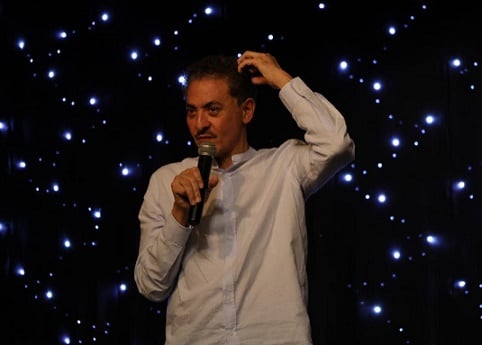
Actor Fathy Abdel Wahab announced he will present a new season of the series “Al-Maddah,” in which he played a genie in its fourth season, expressing pride in roles that require special qualities.
He explained there are two acting approaches: one based on emotion and the other on intellect combined with extraordinary technique and professionalism, used by great stars like Nour El-Sherif and Dr. Yehia El-Fakharany, while Ahmed Zaki used the other approach. Abdel Wahab noted that the character he plays dictates the method he adopts.
He discussed the difference between portraying a character and becoming the character, emphasizing life experience as a key factor. Early in his career, during “Saidi in the American University,” he portrayed the character but was not the character himself; however, with Hamza El-Hanawy in the series “Lams Aktaf,” he became the character.
During a masterclass at Al-Rihani Theater within the Isis Women’s Theater Festival, Abdel Wahab highlighted the director’s role as more important than the actor’s, as the director shapes the overall work and determines the quality of the actor’s performance. He considered himself lucky to have worked with distinguished directors early in his career.
He stated that producing new parts of films like “Saidi in the American University,” “Sahar Al-Layali,” or “Cultural Film” is a production decision for producers, directors, and writers, and he believes it is very difficult due to the objective, cultural, economic, social, and religious circumstances at the time of their original release.
Abdel Wahab explained that the difference between acting in theater, cinema, and television lies only in technique, particularly in theater where special preparations are needed for voice projection to reach the last seat in the hall.
He criticized some cinema and TV directors who view theater as “black and white” and do not attend plays, or whose only theater experience is the play “Illa Khamsa,” leading to a misconception that theater acting is exaggerated. He emphasized the importance of directors watching new theatrical experiences, whether independent, state, or private theater, citing directors Karim El-Shennawy and Hany Khalifa as examples who actively watch successful plays.
He concluded by affirming that Egyptian art is capable of competing and is not inferior in quality to foreign works, stressing that artistic leadership will remain with Egypt due to its rich artistic history spanning more than 130 years across theater, cinema, music, and singing.



Recommended for you
Talib Al-Rifai Chronicles Kuwaiti Art Heritage in "Doukhi.. Tasaseem Al-Saba"
Exhibition City Completes About 80% of Preparations for the Damascus International Fair Launch
Unified Admission Applications Start Tuesday with 640 Students to be Accepted in Medicine
Al-Jaghbeer: The Industrial Sector Leads Economic Growth
Egypt Post: We Have Over 10 Million Customers in Savings Accounts and Offer Daily, Monthly, and Annual Returns
His Highness Sheikh Isa bin Salman bin Hamad Al Khalifa Receives the United States Ambassador to the Kingdom of Bahrain