








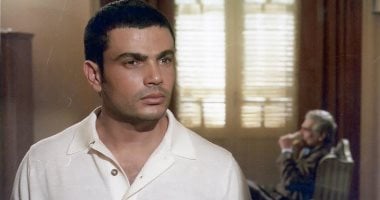
A new year is added to the journey of El-Hadaba Amr Diab, the singer and artist who wrote his name in shining letters and went down in the history of Arabic music. His fame and works have surpassed global boundaries as one of the most prominent legends of Arabic singing, making his artistic career a symbol of renewal and continuity, maintaining his brilliance and artistic sparkle for more than four decades.
Today, El-Hadaba celebrates his 64th birthday; he was born on October 11 in the brave city of Port Said. Over nearly 43 years of his artistic career, which began in 1983, this birthday coincides with the success of his latest album “Ibtidena” (We Started), which achieved remarkable and unique success, confirming his status as a living musical icon in the memory of generations.
Alongside his singing career, during which he released dozens of albums and hundreds of songs, Amr Diab achieved notable success in cinema through his acting experience. Although this experience was not as long as his singing career, it helped enhance his status as a comprehensive artist. Over time, El-Hadaba decided to focus more on singing, where he achieved unparalleled success for many years.
Despite its rarity, Amr Diab’s cinema participations were influential milestones. The last of these was about 32 years ago, specifically in the film “Laugh, Play, Love” (1993), which brought him together with stars Omar Sharif and Yousra, leaving an immortal mark in Egyptian cinema history. Before this work, El-Hadaba participated in three other films, two of which were lead roles and one as a guest star. These experiences added a new dimension to his creativity and confirmed the diversity of his artistic talents.
Amr Diab first appeared in cinema through a film starring Ilham Shaheen and Samah Anwar, released in 1988. This appearance was as himself and his real profession as a nightclub singer, during a period close to his actual work in the clubs of Al-Haram Street. The filmmakers capitalized on El-Hadaba’s success with the album “Mayyal” and the song “Hala Hala,” which achieved amazing success and was a turning point in Diab’s musical journey.
He continued to appear as himself in the film “Al-Afaryet” (The Ghosts), which was his first main cinematic lead role, alongside the box office star of that time, the late Madiha Kamel. In the film, Amr played a singer and social activist defending street children exploited by the “Kat’a” gang in theft, pickpocketing, and drug trafficking. During the film, he sought to help Madiha Kamel find her kidnapped daughter, but the deeper message was to highlight his efforts to save these children from the harshness and dangers of the street, affirming their right to a decent life including food, drink, education, and care. Amr Diab used two of his composed songs with lyrics by the late poet Magdy Al-Naggar to serve the film’s context: “Oudi Ya Belya” and “Haram,” which played an artistic and message role to reinforce the issue.
The film “Ice Cream in Gelim” is one of the most prominent films discussing youth issues in the 1990s and became an icon of Egyptian cinema. During that period, the film was classified as one that expressed a rebellious generation against the frustrating reality and sought to break the restrictions imposed on true talents.
In the film, Amr Diab portrayed an ambitious young man striving to achieve his dream of singing, facing many difficulties and obstacles. Despite the challenges, he did not lose hope but embarked on a tough journey through the streets searching for an opportunity, in a story that largely reflects aspects of his own biography and struggle for stardom.
In this work, El-Hadaba presented a modern artistic vision by supporting the musical modernization approach, seeking to blend Arabic and Western music. This was evident in incorporating new musical styles at the time, such as rap and rai, through the songs “Hello Africa” by Nigerian-Swedish rapper Dr. Alban and “Cheba” by Cheb Khaled. He also highlighted Western music using the violin in some scenes alongside Mozart’s music, reflecting his musical diversity and boldness in experimentation. Amr Diab summarized this idea in a dialogue with his friends Nour and Ziryab, saying: “To reach people and youth, we must present music in the new way they listen to.”
This film is the latest stop in Amr Diab’s cinematic journey so far, marking a significant shift in the nature of roles he previously played. In this film, he portrayed “Adham Labesh,” the leader of Heliopolis, a muscular and respected man feared by many, while his friends see him as a “Robin Hood” figure who uses his influence to protect the weak and support the oppressed.
Alongside El-Hadaba starred the late global star Omar Sharif and the great actress Yousra, giving the work artistic depth and popular weight. The events take place in 1968, following the June defeat, and conclude with the October victory in 1973, parallel to the end of “Adham Labesh” as the neighborhood leader, while the song “Dawamat Al-Hayah” (Whirlpools of Life) plays in the background symbolizing the hero’s journey.
In this film, Amr Diab broke away from his previous traditional roles to deliver a different acting performance, expressing clear artistic and social rebellion, especially in his conflict with the class and social values represented by his father, an intelligence officer. This rebellion is evident in the love relationship he had with the night girl “Esh Esh,” who decided to repent and marry him, leading to a direct clash with his father that threatened his reputation and position at work, revealing an internal conflict between family loyalty and personal choice.



Recommended for you
Talib Al-Rifai Chronicles Kuwaiti Art Heritage in "Doukhi.. Tasaseem Al-Saba"
Exhibition City Completes About 80% of Preparations for the Damascus International Fair Launch
Al-Jaghbeer: The Industrial Sector Leads Economic Growth
Unified Admission Applications Start Tuesday with 640 Students to be Accepted in Medicine
Egypt Post: We Have Over 10 Million Customers in Savings Accounts and Offer Daily, Monthly, and Annual Returns
His Highness Sheikh Isa bin Salman bin Hamad Al Khalifa Receives the United States Ambassador to the Kingdom of Bahrain