









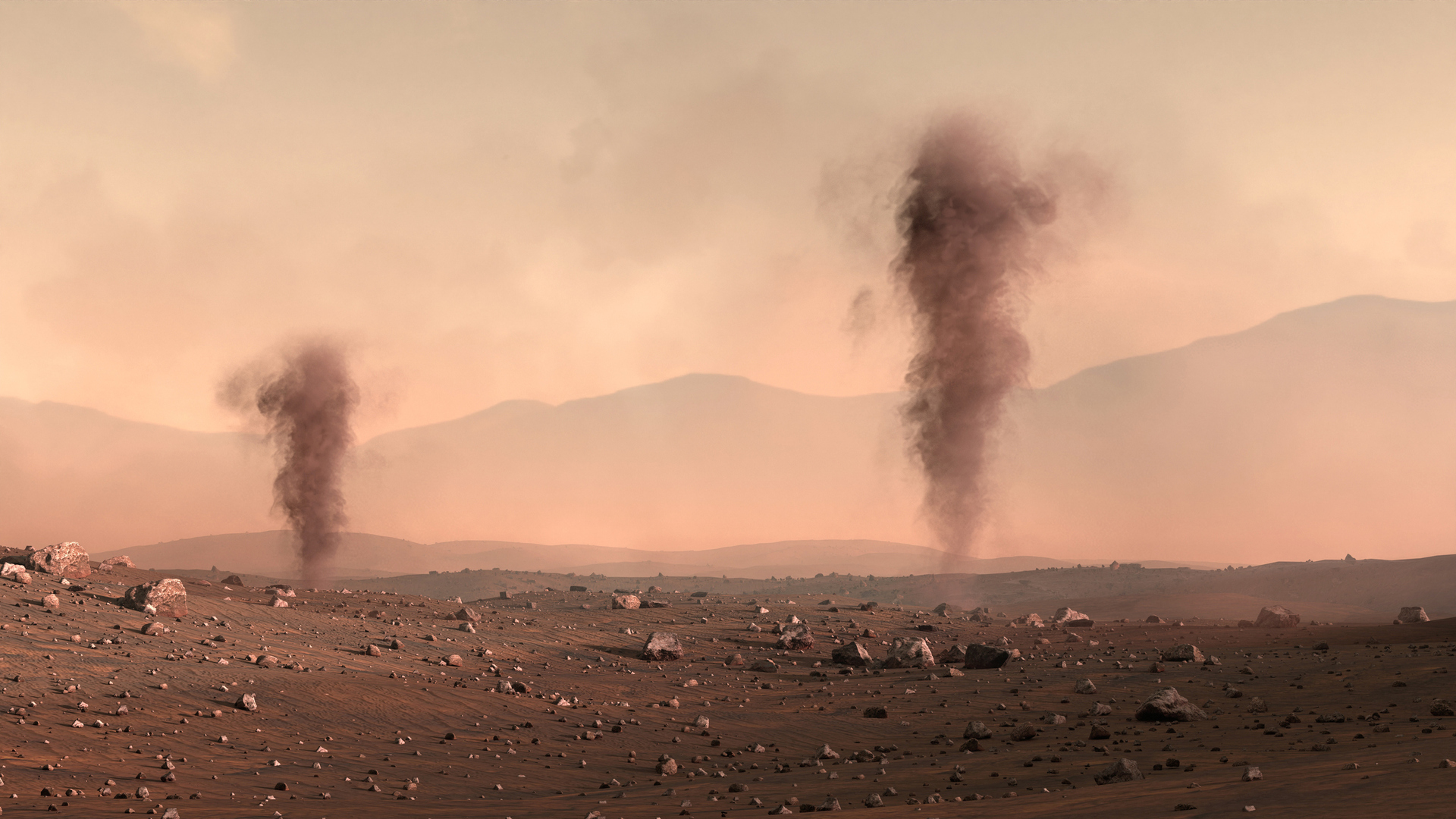
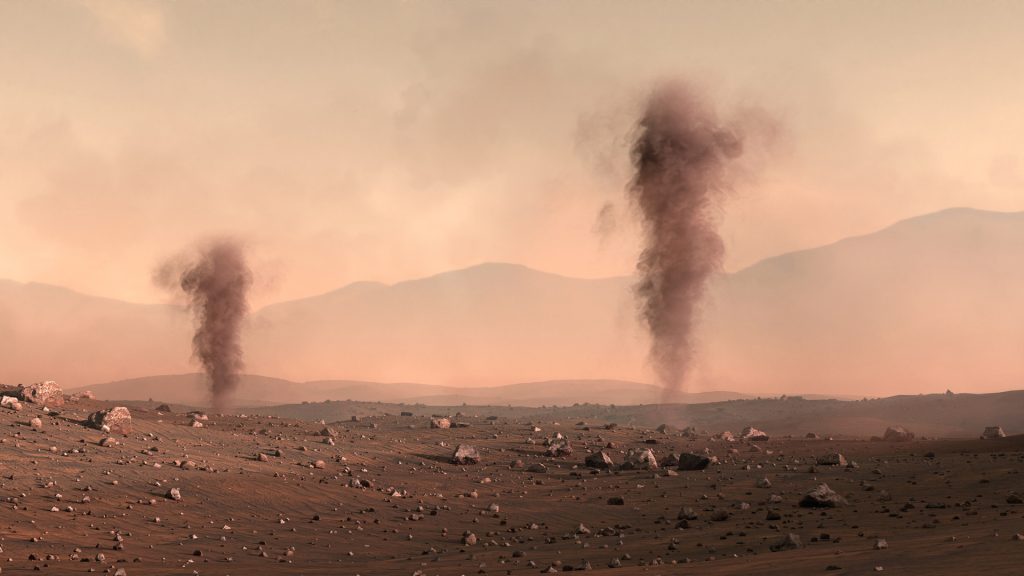
A new study revealed that the swirling dust storms sweeping Mars show that wind speeds on the Red Planet can reach up to 160 kilometers per hour.
Researchers used spacecraft from the European Space Agency—Mars Express, ExoMars, and the Trace Gas Orbiter—to examine 1,039 dust devils as they passed across the Martian surface.
The results showed that the strongest winds on Mars blow much faster than previously thought, and helped initiate the creation of an index of these “dust devils,” which could support further future studies.
This index represents the first time data on the speeds and movement directions of dust devils across Mars have been compiled.
For decades, scientists have observed this phenomenon using orbiters and rovers landing on the planet. But the new study actually tracked their movement to better understand how they travel across the surface.
In this regard, Valentin Beckel from the University of Bern, who led the work, said: “Dust devils make invisible winds visible. By measuring their speed and direction, we began mapping the winds across the entire Martian surface. This was previously impossible because we lacked sufficient data to perform such measurements on a global scale.”
The importance of dust goes beyond understanding winds; it also plays a vital role itself. Dust acts as a shield from the sun during the day, cooling the planet, and retains heat during the evening to keep it warm. It can also be the starting point for cloud formation.
Dust remains on Mars much longer because it is not washed away by rain as it is on Earth. Therefore, scientists are trying to understand how all this dust interacts with the planet’s atmosphere.
The new study used an artificial intelligence system to identify dust devils, then examined images of Mars to locate them. This resulted in the creation of an index containing 1,039 vortices, 373 of which included information about their movement direction.
Scientists discovered these vortices move at speeds up to 158 kilometers per hour, much faster than previously believed.
All this information about Martian winds and other parts of its atmosphere could be a key to future exploration.
Valentin added: “Wind speed and direction data are also very important when planning the arrival of future orbiters and rovers on Mars. Our measurements can help scientists build an understanding of wind conditions at the landing site before arrival, which may help estimate the amount of dust settling on the rover’s solar panels and thus determine the number of self-cleaning cycles needed.”



Recommended for you
Talib Al-Rifai Chronicles Kuwaiti Art Heritage in "Doukhi.. Tasaseem Al-Saba"
Exhibition City Completes About 80% of Preparations for the Damascus International Fair Launch
Al-Jaghbeer: The Industrial Sector Leads Economic Growth
Unified Admission Applications Start Tuesday with 640 Students to be Accepted in Medicine
Egypt Post: We Have Over 10 Million Customers in Savings Accounts and Offer Daily, Monthly, and Annual Returns
His Highness Sheikh Isa bin Salman bin Hamad Al Khalifa Receives the United States Ambassador to the Kingdom of Bahrain