








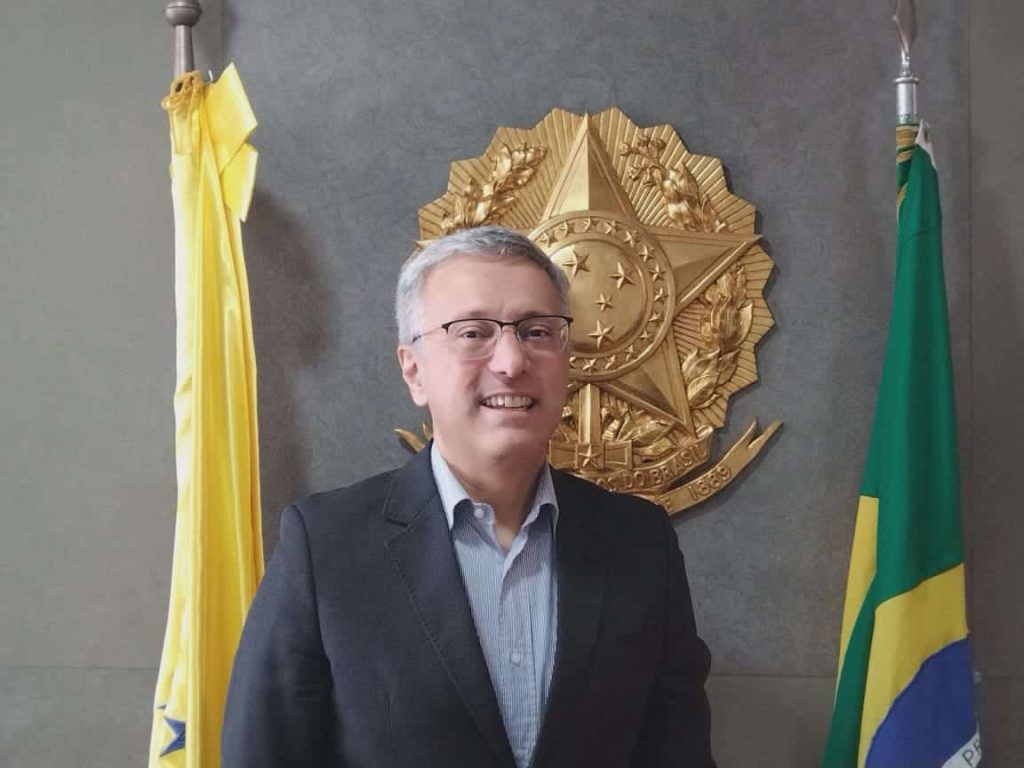
Paulino Franco de Carvalho Neto, the Brazilian ambassador in Cairo, predicted a significant increase in Egypt’s fertilizer exports to Brazil following the implementation of the European Union’s carbon border tax on imports.
In exclusive remarks to “Al-Shorouk,” Neto stated, “Fertilizer exports to Brazil may rise after the EU carbon tax is applied, especially since Egyptian products are competitively priced.”
The EU carbon border mechanism will come into effect in January 2026 and will apply to a wide range of goods, including fertilizers.
Egypt’s exports to Brazil doubled from $500 million in 2023 to $1 billion in 2024, which Neto attributed to the Mercosur agreement, which Egypt joined several years ago, providing for a gradual reduction of customs duties by up to 90%.
Egyptian fertilizer exports to Brazil constitute the largest share of total exports.
Neto said, “Brazil buys from Egypt key goods such as fertilizers, frozen fruits, and several agricultural products. This surge came after signing the Mercosur agreement, which includes Brazil, Argentina, Paraguay, Bolivia, and Egypt, exempting goods from customs duties, which explains the rapid increase in Egypt’s exports to Brazil.”
Brazil’s exports to Egypt also increased sharply last year, reaching $4 billion, mainly food products including meat, sugar, and poultry.
The two countries exchange certain types of cotton; Brazil imports long-staple cotton from Egypt, while Cairo receives short and medium-staple cotton from Brazil.
Neto expects the momentum of trade exchange between the two countries to continue in the coming years, noting a noticeable increase during 2025, though he did not provide specific figures, responding to “Al-Shorouk’s” inquiry: “In 2025, exports will maintain their momentum, but I do not have any numbers currently.”
Currently, economic relations between the two countries are limited to trade exchange, with no Brazilian investments in Egypt. The ambassador said, “We do not invest in Egypt, but we are making huge efforts to attract Brazilian investors. We have here the Brazilian-Arab Chamber of Commerce, headquartered in São Paulo.”
He added, “I expect Brazilian investors to be at Cairo’s doorstep now. They are deeply engaged in studying the matter and very interested in Egypt. I believe they will eventually come, not only to produce goods for the local market, which is already huge with over 100 million people, but also for Africa.” He added that Egypt also has the advantage of proximity and access to Europe, Arab countries, and the Suez Canal, and that Egypt has its various advantages.
He added, “Brazilian interest in Egypt is not limited to government-level relations but also at the private sector level, which drives such matters. This could bring investments due to Egypt’s good geographical location. I mean private companies currently realize the benefits of investing in Egypt.”
When asked if specific Brazilian companies have shown interest in investing in Egypt, he said: “Yes; specifically in pharmaceuticals and food sectors.”
Neto said that Egyptian-Brazilian political relations are very good and have lasted over 100 years, starting in 1924, and diplomatic relations are no less important. President Luiz Inácio Lula da Silva visited Egypt last year, and similarly, President Abdel Fattah El-Sisi visited Brazil in 2024.
Both Brazil and Egypt share views and visions on many issues, such as the Palestinian situation, according to Neto.
The two countries also share membership in the BRICS alliance, with Brazil being one of the founding members.
The Brazilian ambassador in Egypt sees the BRICS bloc playing an important role on the global stage.
He said, “BRICS is a very important bloc because it includes many important countries such as Brazil, Egypt, China, India, Russia, Indonesia, Ethiopia, and Iran, all defending ethical goals and striving to build a new financial system. I believe this group has an important role to play; it may not be like the United Nations, but it is a tool capable of providing a better environment for the world.”
It is worth noting that the U.S. imposed the highest tariffs on Brazil among President Donald Trump’s tariffs, reaching 50%, which led to a shift in Brazilian meat exports to China last month, according to the United Nations Food and Agriculture Organization (FAO) report for September.
The Brazilian ambassador in Egypt commented that his country seeks to diversify the markets receiving its exports and continues consultations with Washington to resolve this issue, “and the two presidents may also hold a meeting for this purpose.”
He said, “Trump’s high tariffs on imports from Brazil came despite the trade deficit in favor of the U.S., due to Brazil’s purchases of equipment and technology from Washington.”
Many newspapers indicated that Trump’s tariffs on Brazil aimed to punish the South American country because of the trial of the former president, Jair Bolsonaro, a Washington ally.



Recommended for you
Talib Al-Rifai Chronicles Kuwaiti Art Heritage in "Doukhi.. Tasaseem Al-Saba"
Exhibition City Completes About 80% of Preparations for the Damascus International Fair Launch
Al-Jaghbeer: The Industrial Sector Leads Economic Growth
Unified Admission Applications Start Tuesday with 640 Students to be Accepted in Medicine
Egypt Post: We Have Over 10 Million Customers in Savings Accounts and Offer Daily, Monthly, and Annual Returns
His Highness Sheikh Isa bin Salman bin Hamad Al Khalifa Receives the United States Ambassador to the Kingdom of Bahrain