









The use of artificial intelligence technologies in the energy sector has become a pivotal factor driving innovation and expanding sustainability projects on an unprecedented scale. These technologies offer a wide range of modern tools previously unavailable to companies in this field, opening new horizons for performance development and achieving tangible results.
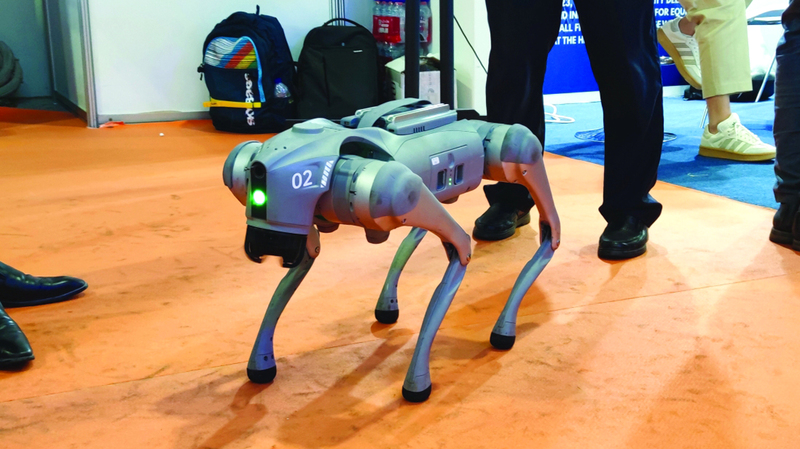
One of the most prominent applications of AI technologies in the energy sector is the reliance on smart “robots” in critical sites, especially for performing hazardous tasks, which increases safety rates and protects workers in those environments.
AI technologies also enhance the concept of predictive maintenance by providing accurate and early data that helps predict faults and thus avoid them before they occur.
Through advanced analysis of data from sensors and drones, AI can detect potential faults in equipment such as solar panels, wind turbines, and power transmission lines. This capability allows maintenance work to be carried out timely, reducing unplanned downtime and limiting costs associated with emergency repairs.
Additionally, AI-powered grids can self-react to faults by automatically rerouting energy to reduce outage duration. These grids also use predictive systems to calculate the required electricity at different times, considering fluctuations in renewable energy production. These accurate forecasts help grid operators achieve a better balance between supply and demand, contributing to grid stability and reducing energy waste.
Regarding the management of renewable energy sites, whether solar or wind power, AI technologies significantly improve performance. These systems rely on computer vision to analyze images captured by drones or satellites to monitor solar panels and turbines and detect any defects such as cracks or dirt. They also increase solar panel productivity by automatically adjusting their angles according to the sun’s movement throughout the day.
Furthermore, Sim John Hyung, Vice Business Manager at Shinil Tech, a technical systems company in the energy sector, said AI technologies currently provide unprecedented capabilities in several areas within the energy sector, especially in enhancing safety elements at work sites. He pointed out that integrating these technologies with smart surveillance cameras contributes to developing more efficient and faster systems for detecting early signs of potential fires and issuing early warnings, allowing quick response actions.
He added that AI offers precise sensors that monitor problems and analyze data in real-time, along with creating centralized databases that help provide effective proactive solutions.
For her part, Rebi Oyika, Business Development Manager at Zion Soft, a technical systems company, said the energy sector has witnessed a remarkable transformation thanks to AI adoption. She highlighted the use of smart robots capable of performing hazardous tasks such as scouting rugged areas, conducting remote maintenance, or monitoring facilities. She confirmed that these technologies provide a higher level of safety and security for workers.
Meanwhile, Eli Adiami, Group Manager for Innovation and Technology Business Development at Gulf Creo, said AI plays a critical role in expanding sustainability projects for companies operating in the energy sector. He noted that these technologies enable companies to collect and analyze data intelligently to reach innovative solutions that reduce waste and improve resource efficiency.


Recommended for you
Talib Al-Rifai Chronicles Kuwaiti Art Heritage in "Doukhi.. Tasaseem Al-Saba"
Exhibition City Completes About 80% of Preparations for the Damascus International Fair Launch
Al-Jaghbeer: The Industrial Sector Leads Economic Growth
Unified Admission Applications Start Tuesday with 640 Students to be Accepted in Medicine
Egypt Post: We Have Over 10 Million Customers in Savings Accounts and Offer Daily, Monthly, and Annual Returns
His Highness Sheikh Isa bin Salman bin Hamad Al Khalifa Receives the United States Ambassador to the Kingdom of Bahrain