








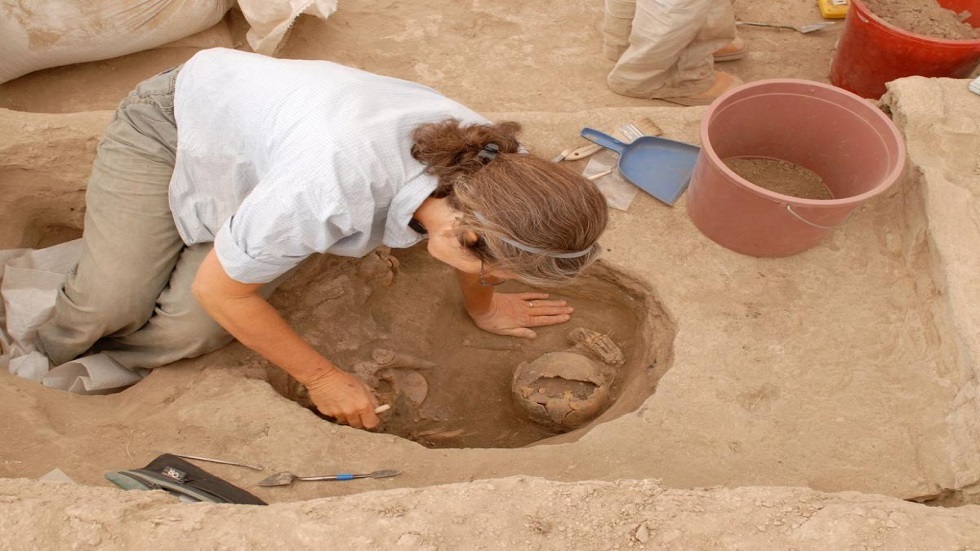
Archaeologists have discovered five charred bread loaves dating back to the 7th and 8th centuries AD at the ancient site of Eirenopolis, known today as Toprak Tepe, in Karaman province, southern Turkey.
The government of Karaman province announced the discovery of five charred bread loaves from the 7th and 8th centuries AD at the ancient site of Eirenopolis, now called Toprak Tepe.
The government stated in its announcement that one of these loaves is of special interest, as it bears a burnt image of Christ on its surface, depicting him as a farmer, with a Greek inscription that reads: “With gratitude, to Saint Jesus.”
Contrary to the traditional image of Christ as the ruler of the universe (Pantocrator) and savior, the discovered loaf shows Christ as a farmer, symbolizing a combination of faith, work, and fertility. Other loaves were decorated with symbols and crosses, suggesting their possible use in early liturgical rituals as Eucharistic bread, which was consecrated for the sacrament of communion.
According to Christian tradition, this bread symbolizes the body of Christ and is considered a sacred tool rather than mere food. These findings also highlight liturgical differences between churches, as the Orthodox Church traditionally used leavened bread as a symbol of life and resurrection, while the Western Church used unleavened wafers.
The Karaman government explained that “these loaves not only reveal liturgical practices in the Byzantine era but also show how deeply religion was integrated into daily life details.”
Despite being charred, the loaves are remarkably well-preserved, making them rare archaeological artifacts that allow the study of ancient baking techniques and their use in religious ceremonies. A researcher commented, “These samples show how ordinary food can become an object of worship, combining nourishment and spirituality.”
Eirenopolis is an ancient Byzantine city located in the Isauria region, historically under the Patriarchate of Constantinople, and holds significant ecclesiastical importance. Ongoing archaeological excavations at Toprak Tepe provide unique material evidence of Christianity’s intertwining with daily life in regional communities, embodying rituals and faith in material culture.
As research continues, archaeologists hope to gain more information about recipes, baking methods, and religious symbols, enabling a deeper understanding of early Christian life in Anatolia and the role of bread as both a cultural and spiritual element.




Recommended for you
Al-Jaghbeer: The Industrial Sector Leads Economic Growth
Egypt Post: We Have Over 10 Million Customers in Savings Accounts and Offer Daily, Monthly, and Annual Returns
Alternative to UNIFIL Forces
Talib Al-Rifai Chronicles Kuwaiti Art Heritage in "Doukhi.. Tasaseem Al-Saba"
Exhibition City Completes About 80% of Preparations for the Damascus International Fair Launch
Trump Advisor: Disarming Hamas is Central.. Palestinian Authority to Take Over Gaza After Required Reforms