









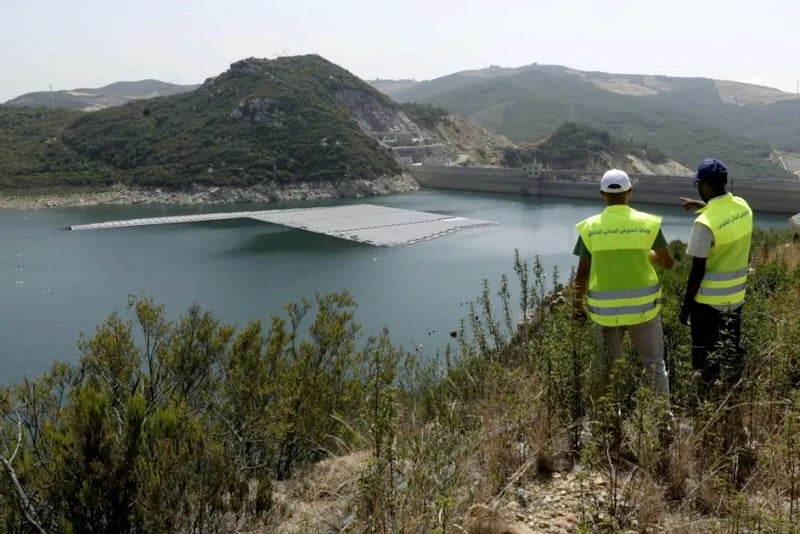
Floating solar panels cover part of the Tangier-Mediterranean dam basin in a unique Moroccan experiment aimed at reducing water evaporation, which intensifies with rising temperatures and contributes to severe water stress.
For the seventh consecutive year, Morocco is experiencing its worst drought in about 40 years, accompanied by rising temperatures, leading to “a strong increase in evaporation during the hot period between April and September, especially at dam reservoirs,” according to the Ministry of Equipment and Water via AFP. This significantly contributes to the decline in reservoir filling rates, which do not exceed 35% in August.
Between autumn 2022 and summer 2023, the average temperature was 1.8 degrees higher than usual, causing a daily loss of approximately 1.5 million cubic meters (more than 600 Olympic swimming pools) of dam water due to evaporation, according to official data.
To tackle this challenge, Morocco launched a unique project at the end of 2024 at the Tangier-Mediterranean dam to “extend its operational life” by covering part of it with solar panels that reduce water exposure to sunlight while simultaneously generating electricity.
At this dam in the northwest of the country, evaporation levels rise from about 3,000 cubic meters per day to 7,000 cubic meters per day between June and August, according to Yassine Wahbi, head of the water resources evaluation and planning department at the Loukkos basin.
In an unusual sight, thousands of solar panels float on part of the dam, while others await deployment on more than 400 platforms designed to withstand climate fluctuations, anchored by cables reaching depths of up to 44 meters.
Upon completion, the project is expected to cover over 22,000 solar panels spanning 10 hectares of the dam’s approximately 123-hectare area, supported by trees planted on its banks to reduce wind strength, which also contributes to evaporation. The electricity generated will cover part of the needs of the adjacent Tangier-Mediterranean port, with a total capacity of 13 megawatts.
The main goal of the project, whose cost has not been disclosed, is to reduce water evaporation by “about 30% according to studies conducted so far,” Wahbi explains. He adds that the annual evaporated water volume at this dam “is estimated at about 1.2 million cubic meters,” equivalent to 1% of the annual water consumption of Tangier city, which has about 1.5 million inhabitants.
Climate expert Mohamed Said Qorouq confirms this is a “pioneering experiment,” but warns it can only cover part of the dams, which span vast areas with varied terrain, and that panels may be damaged if water levels drop. He believes the priority should be to continue “more boldly” transferring surplus water exposed to evaporation from northern dams less affected by drought to central and southern regions.
Currently, Morocco has one water highway transferring surplus water from the Sebou basin (northwest) to Rabat and its surroundings over 67 kilometers.
The project is expected to expand to connect other dams from the north to central Morocco.
However, the Ministry of Equipment confirms that regardless of the expected savings from floating solar panels, it represents “a significant gain amid increasing water scarcity.” Over the past ten years, water resources have declined to an average annual 5 billion cubic meters, compared to 18 billion cubic meters in the 1980s, according to official data.
Feasibility studies are currently underway for two other floating solar panel projects at Lalla Takerkoust dam near Marrakech (central) and Oued Al Makhazine (north), one of the largest dams in the country, according to the Ministry of Equipment.
Globally, France, Indonesia, and Thailand are testing this technology, while China hosts the largest floating solar installations in the world.
However, the main strategy to address water stress in Morocco remains seawater desalination, aiming to reach 1.7 billion cubic meters annually by 2030, compared to about 320 million cubic meters currently.


Recommended for you
Al-Jaghbeer: The Industrial Sector Leads Economic Growth
Egypt Post: We Have Over 10 Million Customers in Savings Accounts and Offer Daily, Monthly, and Annual Returns
Alternative to UNIFIL Forces
Talib Al-Rifai Chronicles Kuwaiti Art Heritage in "Doukhi.. Tasaseem Al-Saba"
Exhibition City Completes About 80% of Preparations for the Damascus International Fair Launch
Trump Advisor: Disarming Hamas is Central.. Palestinian Authority to Take Over Gaza After Required Reforms