







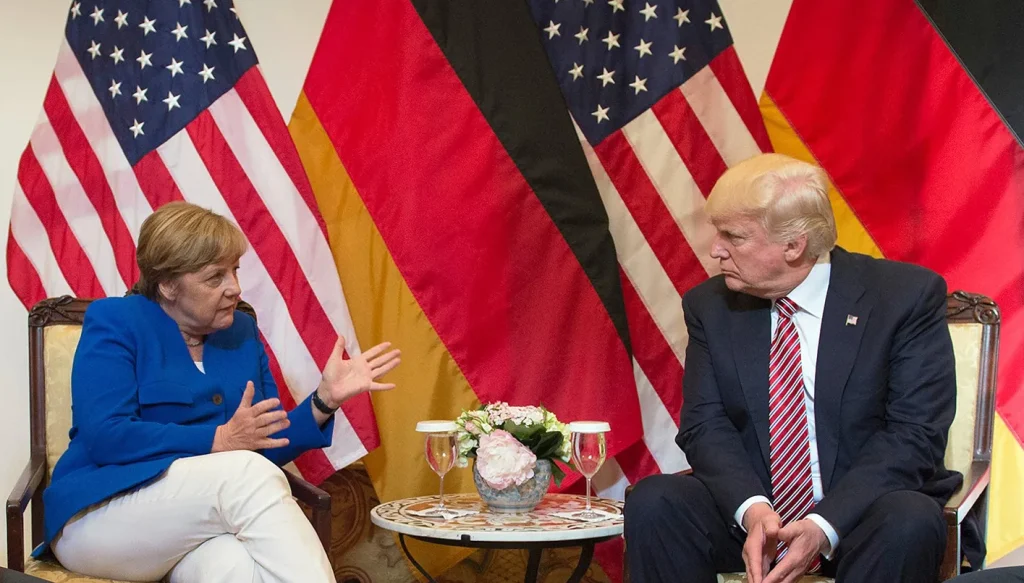
A photo from AP archives showing former US President Donald Trump and former Chancellor Angela Merkel.
Quickly, Eastern European officials responded to a recent media interview with former German Chancellor Angela Merkel (2005-2021). The interview raises several questions about her insistence on “reopening old wounds” from the pre-Russian invasion period of Ukraine.
“She missed the chance to stay quiet… There are types of people – and politicians are people too – who never make mistakes,” said former Lithuanian Foreign Minister Linas Linkevičius. In his view, Merkel’s refusal to allow Ukraine to join NATO in 2008 was the main cause of the war. But Merkel does not only deflect blame from herself; she also places part of it on Eastern Europe.
Polish Prime Minister Donald Tusk was harsher in his response: “The problem with Nord Stream 2 is not that it was blown up. The problem is its construction.” His post on X (formerly Twitter) garnered over two million views in about a day.
Merkel’s remarks came in an interview with a Hungarian media outlet during her visit to Hungary and meeting with pro-Russian Prime Minister Viktor Orbán. Again, Merkel was promoting her memoir “The Freedom.” When she began promoting her book last fall, the same issue and controversy arose.
Merkel said in her interview that in 2021 she wanted a new format to speak directly with Russian President Vladimir Putin, this time on behalf of the entire European Union, instead of the “Minsk” format. She added, “Not everyone supported this (proposal), especially the Baltic states, but Poland was also against it.”
One of Merkel’s problems is that the dissatisfaction of Eastern European countries is not limited to the war-related issue. Gabrielius Landsbergis, former Lithuanian Foreign Minister who served during Merkel’s tenure, reminded her of another event. When Eastern Europe suffered a large refugee wave “caused” by Belarus in 2021 according to Brussels’ accusations, Merkel communicated with Belarusian President Alexander Lukashenko without going through Lithuania. Landsbergis said, “I remember saying that if Lithuania was under attack, perhaps such communications should be coordinated with us first? But it did not seem to make any impression on her.”
In a possible implicit reference that her departure from the political scene worsened matters, Merkel said: “In any case, this (comprehensive communication with Russia) did not happen, I left office, then Putin’s aggression happened.”
At this point, there seems to be some similarity between Merkel and US President Donald Trump in their belief that they have a pivotal influence on the course of events, specifically on Putin’s calculations. No one undermined Merkel’s claim as much as former Kremlin adviser Alexey Cheskanov: “Anyone reasonably informed knew for a long time that the differences between Russia and the West at that moment were very deep.”
Merkel attributed some responsibility for the war to the COVID-19 pandemic as it complicated communication with the Russian president. Merkel might receive a call from French President Emmanuel Macron reminding her of the strange table Putin set up to listen to him, despite the pandemic. He might also remind her, in such a scenario, of the number of times he called his Russian counterpart to persuade him to peace, for example, 11 times in February 2022 alone.
Recommended for you
Al-Jaghbeer: The Industrial Sector Leads Economic Growth
Egypt Post: We Have Over 10 Million Customers in Savings Accounts and Offer Daily, Monthly, and Annual Returns
Alternative to UNIFIL Forces
Talib Al-Rifai Chronicles Kuwaiti Art Heritage in "Doukhi.. Tasaseem Al-Saba"
Exhibition City Completes About 80% of Preparations for the Damascus International Fair Launch
Trump Advisor: Disarming Hamas is Central.. Palestinian Authority to Take Over Gaza After Required Reforms