









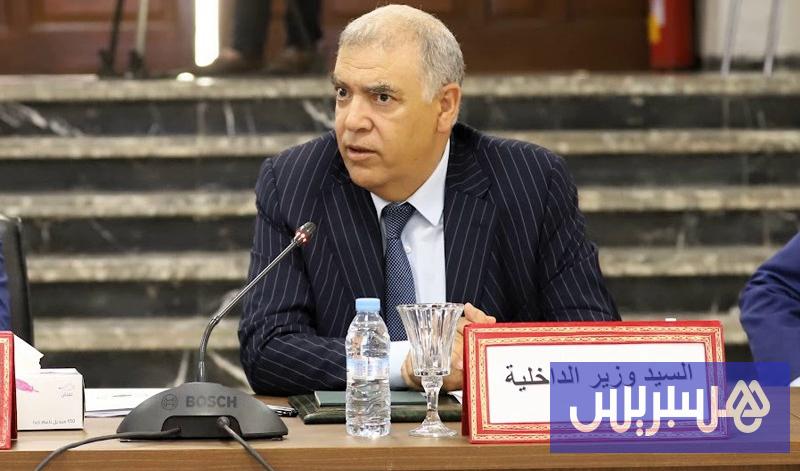
Abdelouafi Laftit, the Interior Minister, directed governors, officials in charge of expenditures, and all stakeholders to “unify efforts” during the preparation of local community budgets for the year 2026. This is to engage in the “strategic project” related to the royal call for transitioning to an integrated territorial development approach that considers the specificities of each region, “to prioritize projects and financial commitments, including agreements with tangible impact.”
The minister explained in a recent circular to the mentioned territorial officials that these commitments particularly concern four “essential” axes: “supporting employment,” “strengthening basic social services, especially in education and healthcare,” “adopting proactive and sustainable management of water resources amid increasing financial stress and climate change,” as well as “launching integrated territorial rehabilitation projects aligned with major national projects.”
According to the circular regarding “preparing and implementing local community budgets for 2026,” spending authorities are required during budget preparation to adhere to the principles of rationalization and credibility and to shift from a management-only budget to an effective budget that directs financial resources toward programming priority projects. It also requires local communities and all stakeholders, including public authorities and elected officials, to respect a set of principles and guidelines during the preparation of the 2026 fiscal year budgets.
Among these principles, the minister emphasized the efficiency and rationality of financial management of local communities. He referred to the entry into force of Law No. 14.25 amending and supplementing Law No. 47.06 related to local community taxes, considering it “a legislative measure taken for rationalization and clarification of the tax base and rates for local community taxes, and establishing appropriate tax governance points for these taxes according to the orientations in Framework Law No. 69.19 related to tax reform, especially Articles 9 and 10.”
In this regard, the government official stated that heads of local councils where the tax on undeveloped urban land applies must “prepare decisions to determine areas according to their level of equipment, according to the procedures stipulated” in the explanatory circular previously issued regarding the implementation of the new law, “and direct these decisions to the relevant provincial or prefectural governor for approval no later than October 30, 2025.”
Afterward, the minister added, “the concerned local councils must hold an extraordinary session in November 2025 to adopt resolutions determining the tax rates, taking into account the data contained in the cards prepared for each neighborhood, village, and sector, and adhering to the legally stipulated minimum and maximum prices.”
To ensure “the prices set by local councils come into effect on January 1, 2026,” the same source called on governors and officials to “urge the heads of the concerned local councils to submit these resolutions for approval no later than December 5, 2025.”
Regarding rationalizing local community operating expenses, Laftit directed controlling budget balances based on the principle of credibility and overcoming all forms of waste and poor programming by setting realistic revenue estimates against rationalizing operating expenses by including the annual cost in the budget without exaggeration. He urged limiting expenditure proposals to essential needs such as transportation, fuel and lubricants, reception, catering, organizing parties, conferences, seminars, maintenance, and other operating expenses.
The official also spoke about “prioritizing mandatory expenses mentioned in regulatory laws,” noting concerning judicial rulings that “appropriations related to those that have exhausted all possible legal appeals must be opened and settled within available financial capabilities.”
“As for arrears related to other necessary expenses, they must be controlled and the related services ensured to avoid any accumulation and guarantee the normal functioning of the public facility,” Laftit continued.
The circular also noted that “the volume of amounts adjudicated against local communities but unpaid until September 2025 remains large.”
Accordingly, the minister considered governors and officials “are called upon to urge spending authorities to include in the 2026 local community budgets the amounts to be paid in execution of judicial rulings issued by the Kingdom’s courts that have exhausted all possible legal appeals.”
Laftit confirmed that, aware of the importance of real estate properties owned by local communities and their pivotal role in the general accounting project for local communities, a circular will be generalized to establish technical committees at the level of provinces and prefectures tasked with preparing a price reference to determine the market value of real estate properties owned by local communities, and the tasks assigned to them will be defined.




Recommended for you
Al-Jaghbeer: The Industrial Sector Leads Economic Growth
Egypt Post: We Have Over 10 Million Customers in Savings Accounts and Offer Daily, Monthly, and Annual Returns
Alternative to UNIFIL Forces
Talib Al-Rifai Chronicles Kuwaiti Art Heritage in "Doukhi.. Tasaseem Al-Saba"
Exhibition City Completes About 80% of Preparations for the Damascus International Fair Launch
Trump Advisor: Disarming Hamas is Central.. Palestinian Authority to Take Over Gaza After Required Reforms