









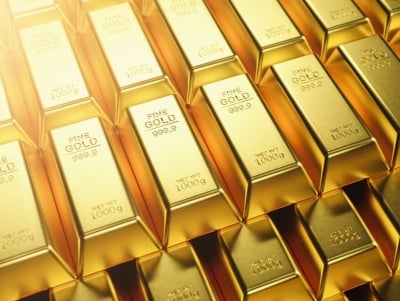
Gold prices rose on Monday, surpassing the $3800 per ounce mark for the first time, supported by a weakening dollar and increased expectations of the US Federal Reserve cutting interest rates during the year.
By 6:30 GMT, spot gold rose 0.9% to $3814.91 per ounce, while US December futures increased 0.8% to $3844, according to Reuters.
The gold market in 2025 has seen exceptional momentum, with prices exceeding $3,000 per ounce at the start of the year and continuing to rise steadily. This reflects gold’s historic role as a safe haven and hedge against inflation amid global economic turmoil.
Several interconnected factors have driven this upward trend:
- The US Dollar Index fell 0.2% against a basket of competing currencies, making dollar-priced gold cheaper for buyers holding other currencies.
- US Commerce Department data showed the Personal Consumption Expenditures Price Index rose 0.3% in August, after a 0.2% increase in July, aligning with economists’ expectations.
Global banks’ forecasts show a clear upward bias:
On the long term (2027-2030), forecasts indicate prices could reach $5,000-$7,000 per ounce under certain economic conditions.
Gold, which yields no income, typically rises when interest rates are low and during periods of economic and geopolitical uncertainty.
Gold has proven resilient during inflation, recessions, currency crises, and financial crashes. It is therefore described as a “comprehensive hedge tool,” not just an inflation hedge. This was also reflected in cautious Asian stock market trading today amid fears of a possible US government shutdown.
Since 2010, central banks have shifted from net sellers to active buyers of gold, now accounting for about 25% of global demand. Russia, China, India, and Turkey lead this trend to diversify reserves, reduce reliance on the dollar, and hedge against sanctions and inflation.
Global gold production has remained stable at around 4,000 metric tons annually for six years due to environmental challenges, declining ore quality, and exploration difficulties. Meanwhile, demand remains strong in investment, jewelry, industrial uses, and large central bank purchases.
Despite gold’s dominance in headlines, silver has outperformed it by about 10% this year, driven by rising industrial demand in renewable energy, electronics, and medicine. Despite its high volatility, silver remains an attractive option for investors.
Regional conflicts, great power rivalries, and trade tensions have pushed investors toward gold. Simultaneously, initiatives to reduce dollar dependence, the expansion of the BRICS alliance, and central bank digital currency experiments enhance gold’s role in the global financial system.
Technical analysis shows gold has broken historical resistance levels after a decade of consolidation, with strong momentum indicators and continuous volume support. Market sentiment has not yet reached peak optimism, indicating room for further gains.
Expectations of interest rate cuts in late 2025 and early 2026 favor gold by lowering holding costs. Loss of confidence in central banks’ ability to control inflation also boosts its appeal.
All indicators confirm that gold is on a sustainable upward path. With ongoing central bank purchases, declining supply, and rising geopolitical tensions, it is poised for further increases beyond 2025. Analysts agree the market remains in a long-term structural uptrend.




Recommended for you
Al-Jaghbeer: The Industrial Sector Leads Economic Growth
Alternative to UNIFIL Forces
Egypt Post: We Have Over 10 Million Customers in Savings Accounts and Offer Daily, Monthly, and Annual Returns
Talib Al-Rifai Chronicles Kuwaiti Art Heritage in "Doukhi.. Tasaseem Al-Saba"
Exhibition City Completes About 80% of Preparations for the Damascus International Fair Launch
Trump Advisor: Disarming Hamas is Central.. Palestinian Authority to Take Over Gaza After Required Reforms