








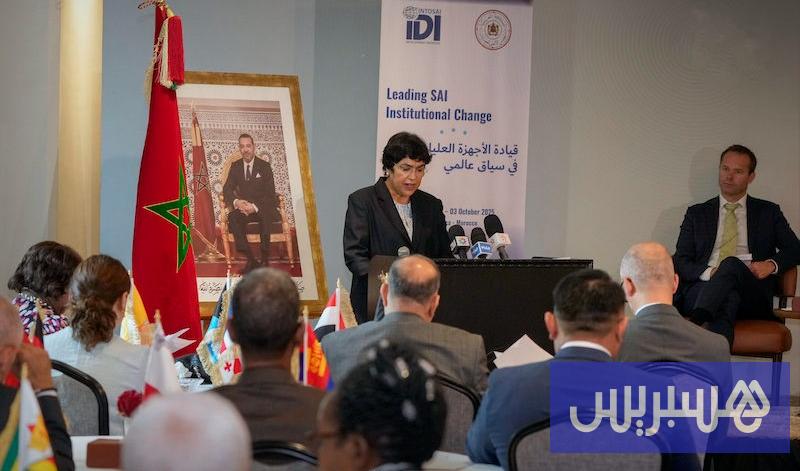
Zineb El Adawi, First President of the Supreme Audit Institution, emphasized today in Casablanca the necessity for supreme public finance oversight bodies to engage in a change process led effectively to continue building strong, flexible, and sustainably impactful supreme audit institutions.
In her speech at the opening of high-level workshops on “Leading Supreme Audit Institutions in a Global Context,” El Adawi stated that “amid increasing global challenges, including financial pressures, digital transformation, climate change, geopolitical crises, and citizens’ urgent and evolving expectations, it has become essential for these supreme audit institutions to gradually transform into effective institutions building a better and more sustainable future.”
She added that real and effective leadership and change management require a clear vision that sets direction and provides a space allowing all staff to participate responsibly in the change project, noting that the true strength of any institution lies in the competence and integrity of its members.
The speaker confirmed that this comprehensive and participatory approach is not only an institutional requirement but also an ethical and moral imperative and a necessary condition to ensure everyone’s engagement, stimulate innovation, and create value. She pointed out that “participatory management and an effective internal communication strategy enable all employees to express their opinions in an atmosphere of responsibility and trust,” adding that “internal communication must be accompanied by effective external communication with relevant stakeholders, as this communication is fundamental to enhancing the impact of supreme audit institutions’ work; through continuous dialogue with parliament, government, civil society, the private sector, and citizens, supreme audit institutions can ensure the implementation of their recommendations and judicial rulings and improve public fund management.”
El Adawi continued: “The change project must prioritize protecting and enhancing the legal and actual independence of oversight bodies, as it is a fundamental condition for effectively exercising public financial oversight.” She explained that independence is not limited to the legal aspect alone but also includes these bodies’ ability to make decisions independently of any external pressures or political or economic influences.
The First President of the Supreme Audit Institution stated that independence ensures the optimal use of public funds, enhances transparency and accountability, and raises citizens’ trust in official institutions, which positively reflects on compliance with laws and public policies and encourages active community participation in development processes in its various dimensions.
She stressed that institutional change policies must include a risk management system that monitors, evaluates, and addresses potential material events that may negatively affect achieving institutional objectives, with appropriate plans to deal with them quickly and effectively.
On his part, Ola Hoeim, Deputy Director General of the INTOSAI Development Initiative, pointed out that these workshops bring together over 30 leaders of supreme audit institutions from around the world over three days, alongside experts from academia and international organizations such as the International Monetary Fund and the World Bank.
Hoeim highlighted in a statement to the Moroccan Press Agency that these meetings provide an opportunity for participants to work together and exchange views on ways to meet upcoming challenges and discuss topics affecting the work of supreme audit, inspection, and auditing bodies in the public sector.
Regarding the INTOSAI Development Initiative, he explained that it works to support supreme audit institutions to enhance their capacities and performance to contribute to greater responsibility and transparency in public finance management.
For his part, Khaled Ahmed Shakshak, Head of the Audit Office in Libya, confirmed the importance of these workshops in bringing together leaders of supreme audit institutions, exchanging visions and experiences in oversight and auditing, and jointly thinking about ways to face common challenges. He added that these workshops represent a suitable space for participants to discuss issues mainly related to leading supreme audit institutions, preserving the independence of these bodies, as well as the opportunities provided by digital transformation in public finance oversight processes.
The INTOSAI Development Initiative, as an independent legal entity, works to strengthen the capacities and independence of supreme audit institutions, alongside reinforcing their importance for public finance.


Recommended for you
Al-Jaghbeer: The Industrial Sector Leads Economic Growth
Alternative to UNIFIL Forces
Egypt Post: We Have Over 10 Million Customers in Savings Accounts and Offer Daily, Monthly, and Annual Returns
Talib Al-Rifai Chronicles Kuwaiti Art Heritage in "Doukhi.. Tasaseem Al-Saba"
Exhibition City Completes About 80% of Preparations for the Damascus International Fair Launch
Trump Advisor: Disarming Hamas is Central.. Palestinian Authority to Take Over Gaza After Required Reforms