








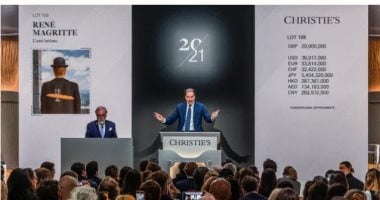
In times of sharp economic shifts, the global art market’s allure is fading in favor of the shine of digital currencies. Recent years have seen a significant decline in art auction revenues, dropping by 33.5% in 2024 to their lowest level in over a decade. This contraction, coinciding with geopolitical turmoil and a global economic slowdown, has prompted elite art collectors to rethink their investment strategies. While masterpieces by renowned artists were once considered safe havens of value, Bitcoin and cryptocurrencies are increasingly attracting attention as more flexible tools to navigate market volatility.
This shift reflects not only a change in investment instruments but also a transformation in the philosophy of collecting itself—from seeking beauty and history to pursuing liquidity and flexibility.
A report published by news.artnet confirmed that Christie’s auction house achieved art sales worth nearly $1.5 billion in the first half of 2025, down 1.9% from the same period last year.
Sotheby’s auction house revenues reached $1.2 billion, a 14% decline compared to the same period last year. This represents an improvement compared to a 31.2% drop between the first halves of 2023 and 2024. In early 2025, Sotheby’s canceled the controversial fee structure implemented in May 2024.
Phillips auction house experienced the largest decline, with sales totaling $190.1 million between January and the end of June—24.5% less than the same period last year.
Philip Hoffman, founder of the Fine Arts Group, said, “This is a temporary period lasting two to three years. I’ve seen five such events in my career.”
According to Hoffman, rising transaction costs discourage the wealthy from buying and selling valuable artworks at auctions, adding, “Clients are thinking more financially than before.”
Latest data collected by veteran art market analyst Michael Moussa, co-founder of the Mei Moussa Art Index, based on results from 58,000 artworks by old masters, impressionists, modern and contemporary artists auctioned since 1970 and resold at Sotheby’s, Christie’s, and Phillips in the first half of 2025, show that over 50% of artworks sold at prices representing negative compound annual returns.
Most auction sales in the second half of 2024 also fell into negative territory. Moussa describes these auction losses as “the worst financial performance year of the 21st century,” adding that “recent huge returns from stocks, gold, and Bitcoin may be the reason behind the art market’s decline.”
During the first half of this year, the S&P 500 index rose by 5.1%, gold by 25.1%, and Bitcoin by 9.1%, according to Yahoo Finance data. By mid-July, the Bitcoin Trust exchange-traded fund (ETF) managed by BlackRock, a financial instrument using investors’ capital to buy Bitcoin, attracted $84 billion in managed funds, according to the Financial Times.
This single fund’s internal investment exceeds Art Basel and UBS’s estimates of the total global art market sales value last year by $26.5 billion.
The recent strong interest in cryptocurrency stocks, technology, and artificial intelligence may indicate where investors believe money can be made more easily.
Some insights into how our algorithm controllers view art can be gleaned from Google’s comprehensive AI look at social status symbols for the wealthy, which includes items such as private jets, luxury cars, exclusive travel experiences, luxury pet services, and even “book shelf wealth” in a curated library—art was not mentioned.
But if owning a Picasso, Warhol, or Amouako Boafo painting no longer easily generates money for wealthy individuals or even grants them much social status, where does this evolving art market scene leave us?
Mark Spiegler, former global director of Art Basel, said that trying to sell art as a financial asset was a disaster. He suggests an alternative future for the art market, urging a “rapid shift” towards selling art as “an attractive pleasure, Instagrammable, for highly intelligent wealthy people who are passionate about culture and complex ideas.”



Recommended for you
Talib Al-Rifai Chronicles Kuwaiti Art Heritage in "Doukhi.. Tasaseem Al-Saba"
Exhibition City Completes About 80% of Preparations for the Damascus International Fair Launch
Al-Jaghbeer: The Industrial Sector Leads Economic Growth
Unified Admission Applications Start Tuesday with 640 Students to be Accepted in Medicine
Egypt Post: We Have Over 10 Million Customers in Savings Accounts and Offer Daily, Monthly, and Annual Returns
His Highness Sheikh Isa bin Salman bin Hamad Al Khalifa Receives the United States Ambassador to the Kingdom of Bahrain