








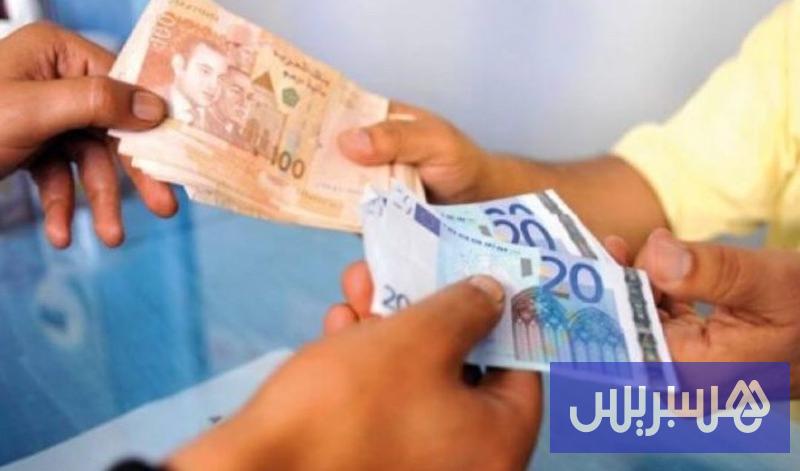
Well-informed sources from Hespress reported that massive inflows of the foreign currency euro have mobilized Moroccan banking groups in the market, after the large surplus of this currency, driven by record transfers from Moroccans abroad and the recovery of tourism and exports, caused imbalances in absorbing more of this liquidity. They explained that trading rooms (Les salles de marché) in banks have completely stopped purchasing the euro.
The same sources confirmed increasing concerns among banks due to their inability to buy euros below the regulatory ceiling, which will eventually force them to resell at a loss. They emphasized that this ceiling is linked to Morocco’s adherence to a managed flexible exchange rate system; the dirham moves within a defined fluctuation range of plus/minus 5 percent, compared to a currency basket dominated by the euro (60 percent) and the dollar (40 percent). They warned that the euro recently approached the lower limit of this range, increasing the risks of continuing to buy.
The sources also revealed growing challenges for banks, whose vaults are filled with euros, as Bank Al-Maghrib has stepped back and limited itself to monitoring the situation, unlike in 2021 and 2022 when it purchased large surpluses of the euro. They explained that the central bank suddenly decided to let the market handle the surplus of the mentioned currency alone, despite the interbank market (Le marché interbancaire) having recorded several complete stoppages (zero transactions), awaiting the currency price to rise again.
Abdelatif Jouahri, Governor of Bank Al-Maghrib, warned after the latest board meeting that the transition from a fixed exchange rate system to a more flexible one in the coming period will involve completely abandoning the peg of the dirham to the euro/dollar basket, allowing the market to determine the dirham’s value according to supply and demand laws. He stressed Morocco’s intention to adopt an inflation targeting system (Ciblage d’inflation), where an inflation target will be set and the exchange rate controlled through interest rates and monetary tools starting January 1, 2027.
The excessive abundance of euros in banks, according to Hespress sources, caused a major problem that hastened the readjustment of exchange rate rules, after the surplus of euros in credit institutions reached saturation. The minimum purchase rule made it impossible to buy below the specified threshold, and the interbank market entered a phase of stagnation despite the huge liquidity of the mentioned currency.
It is noted that since 2018, Morocco began transitioning from a fixed exchange rate system to a more flexible one. This phase started by expanding the dirham’s fluctuation range from plus/minus 0.3 percent to plus/minus 2.5 percent compared to a central price based on a currency basket including the euro and the US dollar, before this range was expanded in March 2020 to plus/minus 5 percent. An interbank exchange market was created to operate independently without current intervention from the central bank.


Recommended for you
Talib Al-Rifai Chronicles Kuwaiti Art Heritage in "Doukhi.. Tasaseem Al-Saba"
Exhibition City Completes About 80% of Preparations for the Damascus International Fair Launch
Al-Jaghbeer: The Industrial Sector Leads Economic Growth
Unified Admission Applications Start Tuesday with 640 Students to be Accepted in Medicine
Egypt Post: We Have Over 10 Million Customers in Savings Accounts and Offer Daily, Monthly, and Annual Returns
His Highness Sheikh Isa bin Salman bin Hamad Al Khalifa Receives the United States Ambassador to the Kingdom of Bahrain