









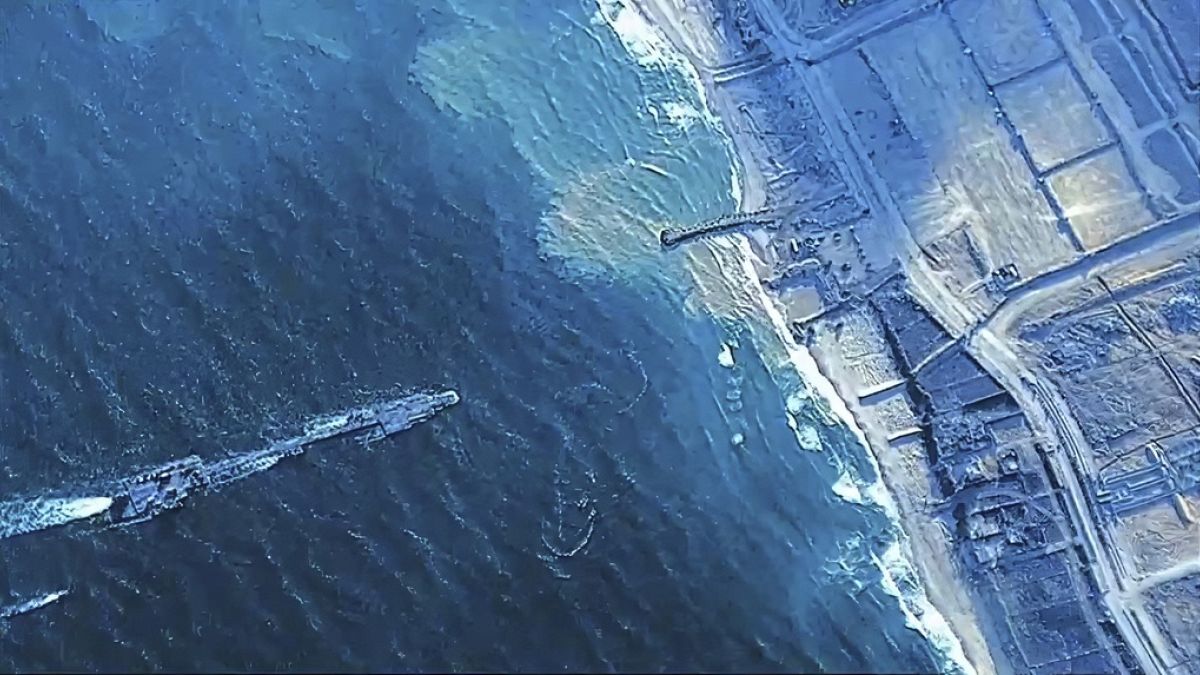
Following the attack, the Israeli Navy shifted from stagnation to restructuring, replacing the old “containment and deterrence” policy with a new approach based on preemptive strikes, layered defense, and operational flexibility, according to The Jerusalem Post.
The newspaper reported that the surprise attack launched by Hamas on October 7, 2023, forced Israel to radically reassess its naval defense system, a transformation described as potentially offering important lessons for the U.S. Navy.
Strategic Shift
The report explained that Hamas fighters who reached Zikim beach in southern Israel exposed unexpected security gaps after targeting Kibbutz Zikim, military facilities, and a power plant near the border.
It added that the Israeli Navy, like other army branches, was unprepared for this type of multi-front attack, although it “managed to prevent a wider disaster.”
According to the article, Hamas has used the sea for years as a channel for smuggling weapons and maneuvering, with its boats blending into Gaza’s civilian fishing fleet and retrieving shipments dropped offshore.
The Israeli military had allowed some limited breaches in restricted waters, believing Hamas would not escalate.
The newspaper noted that this military leniency resembled Israel’s behavior on its northern border with Hezbollah, where limited provocations, including setting up a tent “inside Israeli territory” near the Shebaa Farms, were ignored to avoid open confrontation. But October 7 overturned these assumptions.
Critical Gaps and Doctrine Rebuild
The Israeli Navy moved from stagnation to restructuring, replacing the old “containment and deterrence” policy with a new approach relying on preemptive strikes, layered defense, and operational flexibility.
Before the attack, the naval strategy focused on routine patrols and protecting offshore gas platforms in the north from Hezbollah threats, but this changed drastically after the war.
“Sa’ar 6” ships equipped with the “naval Iron Dome – C-Dome” system now guard those platforms, turning into vital floating fortresses for Israel’s energy security.
A radar fence, drones, and watchtowers were deployed along the Gaza coast to prevent incursions similar to the Zikim attack.
Israeli naval units were redeployed in the Red Sea to counter threats from Houthi drones and missiles, in coordination with the U.S. and other countries sharing the same shipping lanes.
The attack revealed three fundamental gaps in naval doctrine: overreliance on fixed defenses creating a false sense of security, weak integration of intelligence and early warning, and limited effective naval deployment, with only five patrol boats covering Gaza’s coast on the morning of the attack and no missile ships nearby.
Hamas exploited these gaps with a “sudden attack without warning” relying on surprise via boats, drones, or naval commando units.
Lessons for the U.S. Navy
The Jerusalem Post pointed out that the U.S. Navy faces similar challenges, whether in the Red Sea against Houthi drones and missiles or in the Indian and Pacific Oceans where ports and forward bases could face simultaneous attacks disrupting traditional defenses.
Lessons for the U.S. include the need to prepare for massed attacks targeting ports, gas platforms, and energy corridors; employing low-cost defensive means such as electronic warfare, lasers, and high-energy electromagnetic waves alongside costly interception systems; treating maritime infrastructure as strategic points requiring mobile, multi-layered defenses including unmanned vessels; developing resupply and field support mechanisms for ships far from ports to ensure constant readiness; and enhancing naval offensive capabilities toward land to destroy threats before execution, as Israel does against Houthi launch sites.
Partnerships and Alliances
The report explained that maritime cooperation between the U.S. and Israel through exercises like “Intrinsic Defender” and “Noble Dina” focuses on countering drones, naval interception, and tactical integration in the Mediterranean, with participation from European countries such as Greece, Cyprus, Italy, and France, alongside cooperation with Egypt to stop arms smuggling into Gaza despite political complexities.
These trilateral and multilateral cooperation models can serve as templates to establish resilient security networks in the Middle East and the Indian and Pacific Oceans to confront U.S. adversaries, primarily China.
Military ‘Innovation Lab’
The report considered the Israeli Navy as a military innovation lab through its rapid adaptation and disciplined equipment maintenance, enabling it to extend the lifespan of its ships and increase operational efficiency.
This experience represents an important lesson for the U.S. Navy, which faces global deployment burdens and budget constraints.
The newspaper concluded that the October 7 attack proved that naval surprises are not theoretical scenarios but real threats that can occur in the Red Sea, the Gulf, or the South China Sea, with adversaries learning to exploit gaps using low-cost weapons and unconventional tactics.
It emphasized that effective deterrence today requires proactive, flexible, and integrated defenses in partnership with allies like Israel, noting that Tel Aviv’s experience in transforming from a defensive coastal force to a proactive naval power forms a model from which the U.S. can benefit.




Recommended for you
Talib Al-Rifai Chronicles Kuwaiti Art Heritage in "Doukhi.. Tasaseem Al-Saba"
Exhibition City Completes About 80% of Preparations for the Damascus International Fair Launch
Al-Jaghbeer: The Industrial Sector Leads Economic Growth
Unified Admission Applications Start Tuesday with 640 Students to be Accepted in Medicine
Egypt Post: We Have Over 10 Million Customers in Savings Accounts and Offer Daily, Monthly, and Annual Returns
His Highness Sheikh Isa bin Salman bin Hamad Al Khalifa Receives the United States Ambassador to the Kingdom of Bahrain