





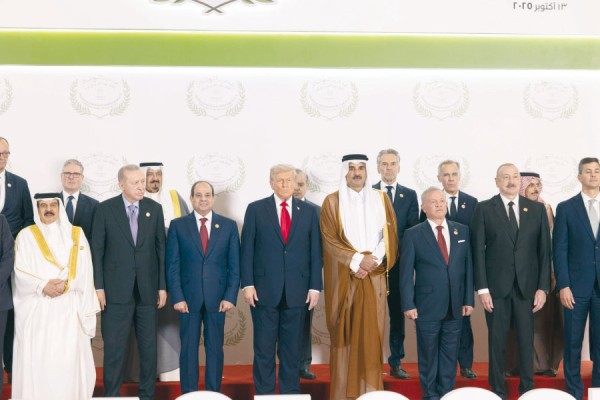
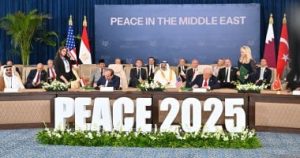
Leaders from the United States, Egypt, Turkey, and Qatar signed the Gaza Peace Agreement in Sharm El-Sheikh, mediated by U.S. President Donald Trump, to establish a ceasefire and exchange hostages and prisoners between Israel and Hamas. President Trump described the event as a “great day for the Middle East.”
During the signing, Trump said the Sharm El-Sheikh summit represents “a great day for the Middle East,” expressing gratitude to the leaders for their efforts to end the war in Gaza.
He added, “At the Sharm El-Sheikh summit, we managed to stop the war in Gaza, and everyone is happy to reach this moment. The Gaza agreement will hold.”
Trump emphasized he does not want a wide war in the Middle East and noted teams in Gaza are working to locate the bodies of Israeli captives.
After signing the document, Trump held a copy with the parties’ signatures and wrote above them: “We seek tolerance, dignity, and equal opportunity for every person to ensure this region is a place where all can achieve their aspirations for peace, security, and economic prosperity, regardless of race, religion, or ethnicity.”
The document added, “We commit to a comprehensive vision of peace, security, and shared prosperity in the region, based on principles of mutual respect and common destiny.”
This announcement follows days of indirect negotiations held away from the public eye in Sharm El-Sheikh, Egypt, involving American, Egyptian, Turkish, and Qatari mediators to end a devastating two-year war on the besieged Gaza Strip.
Trump arrived in Sharm El-Sheikh from Israel, where he addressed the Knesset, speaking of “a historic dawn for a new Middle East” and the end of “a long and painful nightmare” for Israelis and Palestinians.
His speech coincided with the return of the last living hostages from Gaza and hundreds of Palestinian detainees to their homes under a U.S. ceasefire plan between Israel and Hamas.
As the architect of the Gaza ceasefire plan exhausted by a brutal two-year war, Trump co-chaired the Sharm El-Sheikh summit alongside Egyptian President Abdel Fattah el-Sisi, with 31 leaders from countries and international organizations attending. Israeli Prime Minister Benjamin Netanyahu and Hamas representatives did not attend, while Palestinian President Mahmoud Abbas participated and shook hands with Trump.
The mediating countries’ leaders—Trump, el-Sisi, Qatar’s Emir Sheikh Tamim bin Hamad Al Thani, and Turkish President Recep Tayyip Erdoğan—signed the Gaza Agreement as guarantor states aiming to end the war.
In Tel Aviv, a large crowd gathered in the Hostages Square with tears, cheers, and songs to welcome 20 living hostages kidnapped in Hamas’s unprecedented October 7, 2023 attack on southern Israel.
In Ramallah, West Bank, released Palestinian prisoners were welcomed by large crowds, so many that the freed faced difficulty disembarking from the bus that brought them from prison.
According to the agreement, Hamas is to return the bodies of 27 hostages who died during captivity, plus the remains of a soldier killed in 2014 during a previous Gaza war.
In return, Israel released 250 Palestinian prisoners and about 1,700 Palestinians detained in Gaza during the recent Israeli aggression.
On October 7, 2023, Hamas militants and other Palestinian factions kidnapped 251 people in an unprecedented attack on Israel, resulting in 1,219 Israeli deaths, according to a Reuters tally based on official data.
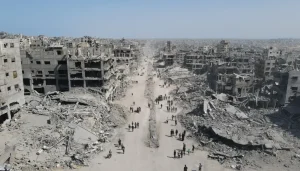
Israel responded with aggression on Gaza, causing at least 67,869 deaths, according to Gaza’s Ministry of Health figures considered reliable by the United Nations.
Trump told the Knesset, “This is not just the end of a war, but the end of an era of death.”
During the day, the International Committee of the Red Cross received 20 hostages in two stages, while Israel released 1,968 Palestinian detainees, according to an official Israeli statement.
Hamas published the names of only 4 hostages handed over to the Red Cross, which returned them to Israel.
The Israeli army stated that “Hamas must comply with the agreement and take necessary measures to ensure the return of all deceased hostages.”
Hamas has not given a clear position on disarmament and demands a full Israeli withdrawal from Palestinian territories, while Israeli forces currently control 53% of Gaza’s area.
A Hamas official said the second phase of negotiations will be “difficult.”
Humanitarian aid trucks began entering the devastated Gaza Strip via Israel, while others awaited at the border with Egypt.

Recommended for you
Al-Jaghbeer: The Industrial Sector Leads Economic Growth
Egypt Post: We Have Over 10 Million Customers in Savings Accounts and Offer Daily, Monthly, and Annual Returns
Alternative to UNIFIL Forces
Talib Al-Rifai Chronicles Kuwaiti Art Heritage in "Doukhi.. Tasaseem Al-Saba"
Exhibition City Completes About 80% of Preparations for the Damascus International Fair Launch
Trump Advisor: Disarming Hamas is Central.. Palestinian Authority to Take Over Gaza After Required Reforms