






From the very moment the Israeli army announced the ceasefire agreement in Gaza had come into effect, displaced people rushed back to their homes.
Catastrophic Conditions
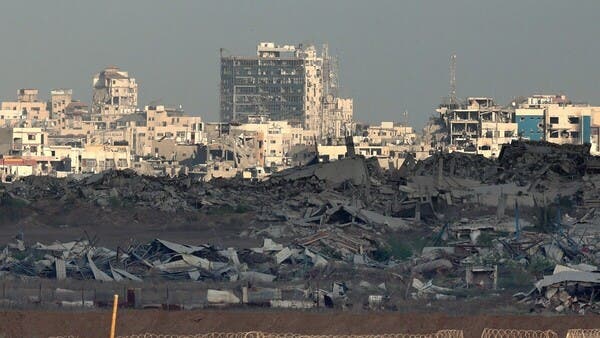
However, the challenges were far from easy. The mayor of Khan Younis, Alaa al-Din al-Batta, confirmed that 85% of the governorate is destroyed.
He added in a press conference broadcast by the municipality’s media office that there are 400,000 tons of rubble that must be removed from the city’s streets, accumulated due to the destruction of homes, buildings, and economic projects. He revealed the launch of 9 field teams to open the streets, all requiring heavy equipment due to the large amount of rubble blocking the roads.
He also noted that 300 kilometers of the city’s water networks are destroyed, and 75% of the sewage network is damaged. He pointed out the leveling and destruction of 206,000 linear meters, or 82% of the total road network, and 296,000 linear meters of the water supply network were completely or partially damaged, leading to their failure, representing 86% of the total network.
Additionally, 36 water wells are completely out of service, with some wells currently operating at partial efficiency. He explained that three central water tanks were destroyed and went out of service.
He clarified that the municipality today is dealing with more than 350,000 tons of waste accumulated in temporary dumps near shelters and displaced people after the waste collection system stopped working due to the central landfill east of Khan Younis ceasing operations because of the war, forcing reliance on temporary dumps among residents.
Al-Batta called on the international community and global organizations to urgently supply the sector’s municipalities with the necessary machinery and equipment, especially in water, sewage, and sanitation sectors, urging immediate intervention to bring in bulldozers and heavy machinery to remove rubble and open streets.
He also demanded supplying municipalities with the fuel needed to operate health and water facilities to prevent worsening the humanitarian crisis due to targeting essential service sectors.
Meanwhile, the spokesperson for the Palestinian Red Crescent, Nibal Farsakh, stated that the rapid delivery of food and medical aid has become an urgent necessity.
She also called via Al Arabiya/Al Hadath to expedite the evacuation of the wounded and sick.
80% of the Gaza Strip Destroyed
It is worth noting that UNRWA media advisor Adnan Abu Hasna confirmed to Al Arabiya/Al Hadath that 80% of the Gaza Strip has been destroyed almost completely or partially.
The spokesperson for Gaza Civil Defense, Mahmoud Basal, announced last night that “approximately 200,000 citizens have returned to the north.”
This came hours after the Israeli army announced on Friday afternoon the ceasefire had come into effect and the repositioning of its forces in several areas of the Strip had ended, according to prior agreements reached in negotiations held in Sharm El-Sheikh, Egypt. The army withdrew from neighborhoods in Gaza City except for the Shujaiya neighborhood and prevented Palestinians from returning to Beit Hanoun and Beit Lahia in the north, as well as Rafah and east Khan Younis in the south.




Recommended for you
Al-Jaghbeer: The Industrial Sector Leads Economic Growth
Alternative to UNIFIL Forces
Egypt Post: We Have Over 10 Million Customers in Savings Accounts and Offer Daily, Monthly, and Annual Returns
Talib Al-Rifai Chronicles Kuwaiti Art Heritage in "Doukhi.. Tasaseem Al-Saba"
Exhibition City Completes About 80% of Preparations for the Damascus International Fair Launch
Trump Advisor: Disarming Hamas is Central.. Palestinian Authority to Take Over Gaza After Required Reforms