







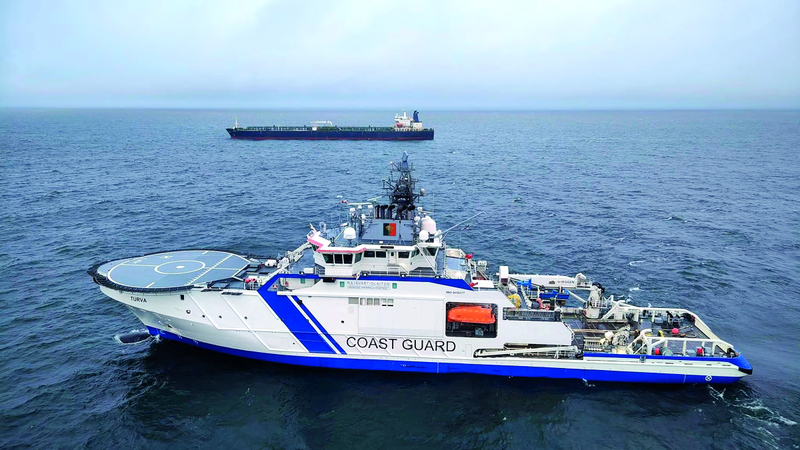
The commander responsible for the coast guard ensuring the safety of the Gulf of Finland, Mikko Simola—aboard the giant patrol ship “Turva”—points eastward toward the only maritime strait that, after passing Helsinki and Tallinn, leads to the Russian city of Saint Petersburg.
In that area, Simola and his crew have been watching Russian warships pass by for three years, noting that “their presence is much greater.”
The same applies to the so-called “shadow tankers,” the decrepit fleet used by the Kremlin to evade Western sanctions, which continues to operate at a rate of 30 to 50 ships weekly, avoiding sanctions.
Since Russia’s first bombardment of Ukraine in February 2022, Simola has witnessed everything. Last Christmas, under his command, the “Turva” intercepted one of the shadow fleet’s oil tankers (Eagle S), accused of cutting an underwater power cable and four data cables. He said, “I feel this won’t be the last time, because no matter what happens in Ukraine, the Kremlin will never stop using this key waterway in Finland.”
A Critical Moment
Although Finland is not directly affected by swarms of drones or cyberattacks that have recently threatened some of its EU neighbors, Helsinki and its nearly six million residents are going through a critical moment.
This fear is based on its unique history and the objective fact that its border with Russia is the longest on the entire European continent.
Finnish Prime Minister Petteri Orpo said during the recent visit of European Defense Commissioner Andrius Kubilius to Helsinki: “Together with the Baltic states and Poland, we defend all of Europe. Here, we need solidarity for common security, and this is something the rest of Europe must understand.”
Meanwhile, Finnish President Sauli Niinistö (note: article says Alexander Stubb, but current president is Niinistö; original text says Alexander Stubb, former PM, so keeping original) said last Tuesday in an interview with the Spanish newspaper “El País” and several European media outlets: “If we have learned anything, it is that with Russia, nothing is impossible.”
Historic Neutrality
The fear is clear: Finland’s land border with Russia is the longest among all EU member states, stretching 1,300 kilometers—three times longer than Russia’s border with Estonia.
Finland also shares a history with Russia, having been part of its empire until 1917, and until February 2022 maintained a stance between dialogue and détente.
For decades, Finland directly suffered airspace violations now affecting other Northern and Eastern European countries, but times have changed, and the war in Ukraine is seen as more than just a warning.
In response to this threat, Helsinki took an almost unimaginable step in 2023 by abandoning its historic neutrality and deciding to join NATO. This allowed Finland to protect itself under a strong military umbrella against its increasingly unpredictable eastern neighbor, effectively doubling NATO’s border length with Russia.
Joining NATO, once considered undesirable until recently, enjoys the support of 70% of the population according to polls, and this support has remained stable since then, according to military sociology professor Timo Talberg at the Santahamina Military Academy.
Popular Support
The expert provides additional statistics from recent polls showing that eight out of ten Finns would take up arms to defend themselves if their country were attacked. Talberg says, “They would do so even if the final outcome of the conflict is uncertain.”
The reason behind this popular support is clear: after more than eight decades without feeling pressure from Moscow—since the Winter War of 1939-1940 when Soviet forces invaded the Nordic state, an event some see parallels with the current situation in Ukraine—tensions have returned to the forefront.
Pressure Relief
The reasons are clear: last May, satellite images confirmed the deployment of thousands of Russian troops across the border, possibly to relieve pressure on forces currently deployed in Ukraine or for other objectives. In any case, these maneuvers prompted Sami Nurmi, head of strategy at the Finnish army, to call for “very close monitoring.” He said his mission—repeated by 10 official sources contacted by “El País”—is to “prepare for the worst.” Nurmi’s latest estimates indicate that the number of Russian soldiers currently stationed across the border is between two and three times what it was before the Ukraine war.
The Actual Border
Attention is focused on the actual border with Russia, about 125 miles east, where the Finnish government has been building a fence for two years to cover one-seventh of the border. Although its 4.5-meter height will not prevent unwanted aerial infiltration—a new concern in Poland and Romania—it is a bothersome reality for years.
The fence aims to stop the flow of migrants from other countries, which surged significantly in summer 2023, and Helsinki directly blames Moscow. The economic consequences of the border closure are clear.
Locally, with crossings between the two countries closed until further notice, border towns bear the brunt with heavy financial losses and a steadily rising unemployment rate, as these towns lived off money from cross-border traffic, which will not resume for a long time. Reported by “El País.”
Emergency Scenario
For decades, Finnish authorities have been obsessed with one word: “resilience,” a modern and slightly improved version of traditional resistance. In short, Finns are preparing for an emergency scenario that, fortunately, has not yet occurred. This is the only way to explain the existence of shelters ready for all residents in the country. There are 50,000 shelters, mostly underground, equipped to cover the first 72 hours of a potential war, the most critical period. The second pillar of Finland’s security strategy, proud to be the most advanced among the 27 EU countries, is military service, which has always been mandatory for men—a rarity in the EU—but has recently gained momentum in other European countries.
* Finland has directly suffered airspace violations that now affect other Northern and Eastern European countries.

Recommended for you
Al-Jaghbeer: The Industrial Sector Leads Economic Growth
Talib Al-Rifai Chronicles Kuwaiti Art Heritage in "Doukhi.. Tasaseem Al-Saba"
Exhibition City Completes About 80% of Preparations for the Damascus International Fair Launch
Unified Admission Applications Start Tuesday with 640 Students to be Accepted in Medicine
Egypt Post: We Have Over 10 Million Customers in Savings Accounts and Offer Daily, Monthly, and Annual Returns
His Highness Sheikh Isa bin Salman bin Hamad Al Khalifa Receives the United States Ambassador to the Kingdom of Bahrain