



The opening of the new parliamentary session of the Turkish Grand National Assembly marked a pivotal moment in the country’s political trajectory, revealing deepening divisions between the ruling power and opposition forces, amid a clear oscillation within the latter between attempts to adapt and popular pressures.
Public Apology
During the inaugural session, President Recep Tayyip Erdogan declared that Turkey is the “homeland of the Kurds,” pledging to protect them from “terrorist exploitation,” hinting at potential repositioning in Syrian policy. This rare speech acknowledging Kurdish identity was seen as an attempt to prepare public opinion for new talks with the Democracy and Equality of Peoples Party “Dem,” considered the political extension of the Kurdish movement in Turkey.
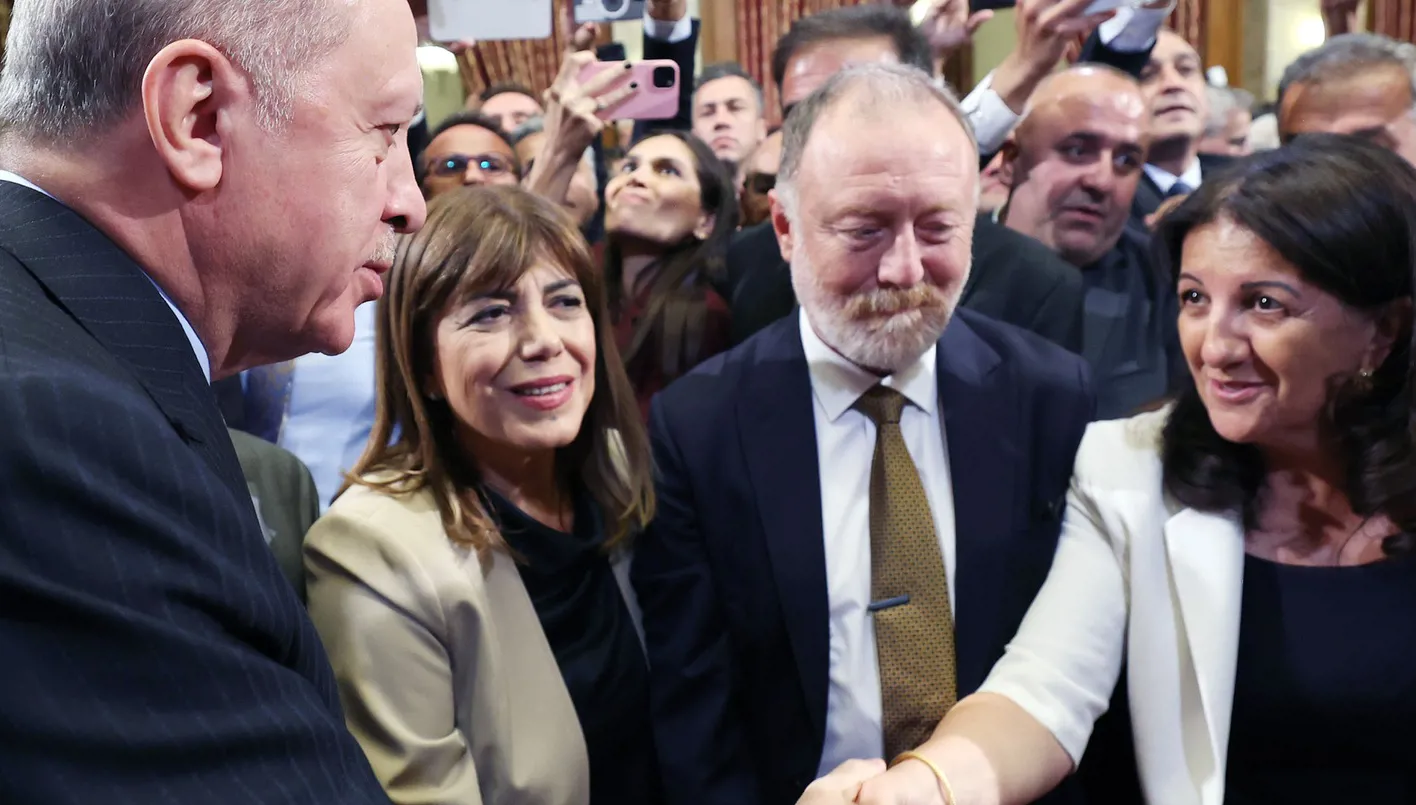
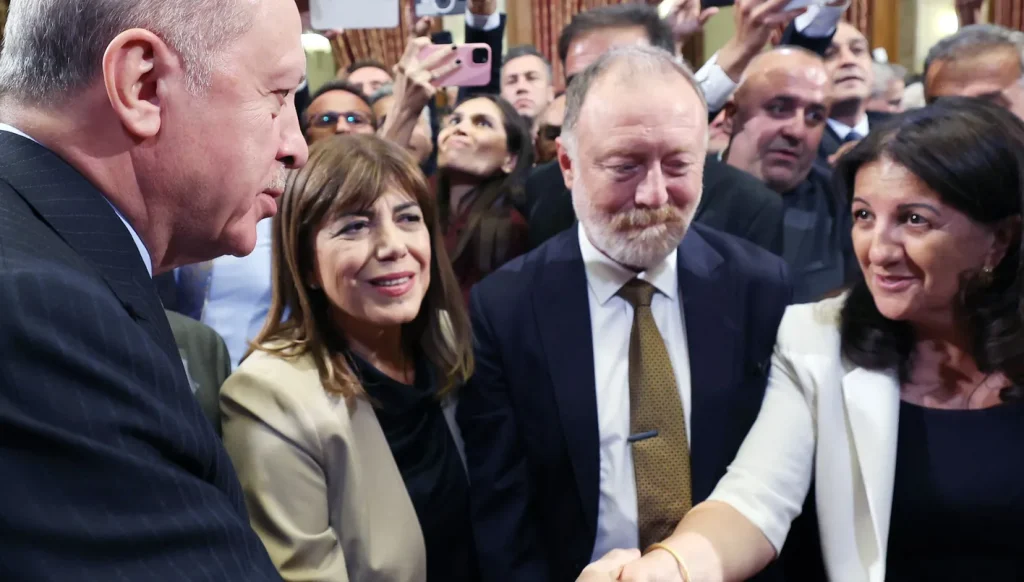
Erdogan initially avoided shaking hands with Dem’s co-chairwoman Tulay Hatimogullari, sparking widespread criticism, but later publicly apologized at the reception, saying, “Forgive us, it was unintentional,” and exchanged dialogue with her in a cautiously welcomed scene.
Dem deputies also shook hands with Devlet Bahceli, repeating a reconciliation scene from 2024 that led to the start of disarmament talks with the Kurdistan Workers’ Party (PKK), initiated by Bahceli, while Dem played the political bridge between Ankara and Kurds adhering to the revolutionary Kurdish movement’s approach.
Meanwhile, the Republican People’s Party (CHP) and the Turkish Workers’ Party (TİP) boycotted the opening session, leaving their seats empty. CHP leader Ozgur Ozel described the boycott as a protest against the “unconstitutional practices” of the authorities, primarily the prosecution of the party’s mayors.
CHP deputies placed bouquets on their vacant seats, while TİP deputies preferred to visit their detained colleague Jan Atalay, whose parliamentary immunity was revoked contrary to the Constitutional Court’s ruling.
Ozel linked the boycott to what he called “Erdogan’s coup-like rhetoric inspired by Trump,” announcing a boycott of all presidential events until “the constitutional order is restored,” while TİP focused on symbolic fieldwork. Its leader, Erkan Bash, said, “This system no longer respects the law – we must build resistance outside parliament.”
The surprising event was the seating of Future Party leader Ahmet Davutoglu and DEVA Party leader Ali Babacan alongside Erdogan for the first time since their split from the Justice and Development Party in 2019, a step considered a political normalization, although doubts remain about Erdogan’s willingness to share power.
Both deputies entered parliament through inclusion on the Republican People’s Party lists in the last parliamentary elections as part of the so-called “Table of Six” alliance.
The Presidency versus Kurdish Constitutional Rights
After nearly a decade of fierce opposition by Dem against Erdogan and siding with CHP in constitutional matters, the images from the opening session signal a shift in political balances and alliance maps within Turkey.
Formally, the meeting of party leaders with their counterparts in the ruling People’s Alliance, led by Erdogan, indicates thawing relations, though the substance of this rapprochement appears more complex, based on Erdogan’s pragmatic principle of mutual benefit (Win-Win).
The Turkish president needs Dem deputies’ votes to pass constitutional amendments allowing him to run for a fourth term, which aligns with Dem’s demands for constitutional rights for Kurds and procedural rights related to the PKK.
Drafting the legal frameworks required for the new settlement process is a key item on the Turkish parliament’s agenda this legislative session. After the PKK announced its self-dissolution and held symbolic disarmament ceremonies, the “National Solidarity, Brotherhood, and Democracy” committee has yet to complete its work, and the timing for discussing laws to give the process a social character and legal foundation remains unclear.
The Turkish government awaits PKK’s ground steps regarding disarmament before moving to the legislative phase. Developments in the Syrian file and the possible integration of the Syrian Democratic Forces (SDF) with the Damascus regime are the main reasons for this delay. The first phase is planned to include a “Return Home” law for integrating organization members, along with amendments to the Execution of Sentences Law (amnesty and enforcement) as part of social and legal integration measures.
Dem Between Pragmatic Gains and Opposition Criticism
Although CHP officially avoided criticizing Dem, many deputies and analysts close to it accused the Kurdish-aligned party of “chasing narrow gains at the expense of national interest.”
The party, which topped the last local elections, views judicial decisions targeting its mayors and elected leaders as a direct threat to the country’s electoral system.
On the other hand, Dem supporters remind their opponents of CHP’s negative stance on previous decisions targeting Dem mayors, including stripping former president Selahattin Demirtas of parliamentary immunity ahead of his imprisonment, with CHP voting in favor.
A Dem leadership source told An-Nahar: “The problem with defenders of democracy is that they see dictatorial steps as a threat only when they target themselves,” adding that the party “is committed to a democratic approach in politics, economy, and society, but this commitment must be universal and for everyone’s benefit.”
The opening of the Turkish parliament in 2025 embodied the deep paradox in Turkey’s political scene: a facade of formal pluralism concealing increasing concentration of power in the president’s hands. Erdogan’s conciliatory messages towards Kurds and former opponents appear as a maneuver to politically isolate CHP from its previous alliances, leaving the opposition’s future dependent on balancing gains and temptations offered by the authorities, and its willingness to work together to end more than a quarter-century of Justice and Development Party and Erdogan’s dominance.

Recommended for you
Talib Al-Rifai Chronicles Kuwaiti Art Heritage in "Doukhi.. Tasaseem Al-Saba"
Exhibition City Completes About 80% of Preparations for the Damascus International Fair Launch
Al-Jaghbeer: The Industrial Sector Leads Economic Growth
Unified Admission Applications Start Tuesday with 640 Students to be Accepted in Medicine
Egypt Post: We Have Over 10 Million Customers in Savings Accounts and Offer Daily, Monthly, and Annual Returns
His Highness Sheikh Isa bin Salman bin Hamad Al Khalifa Receives the United States Ambassador to the Kingdom of Bahrain