







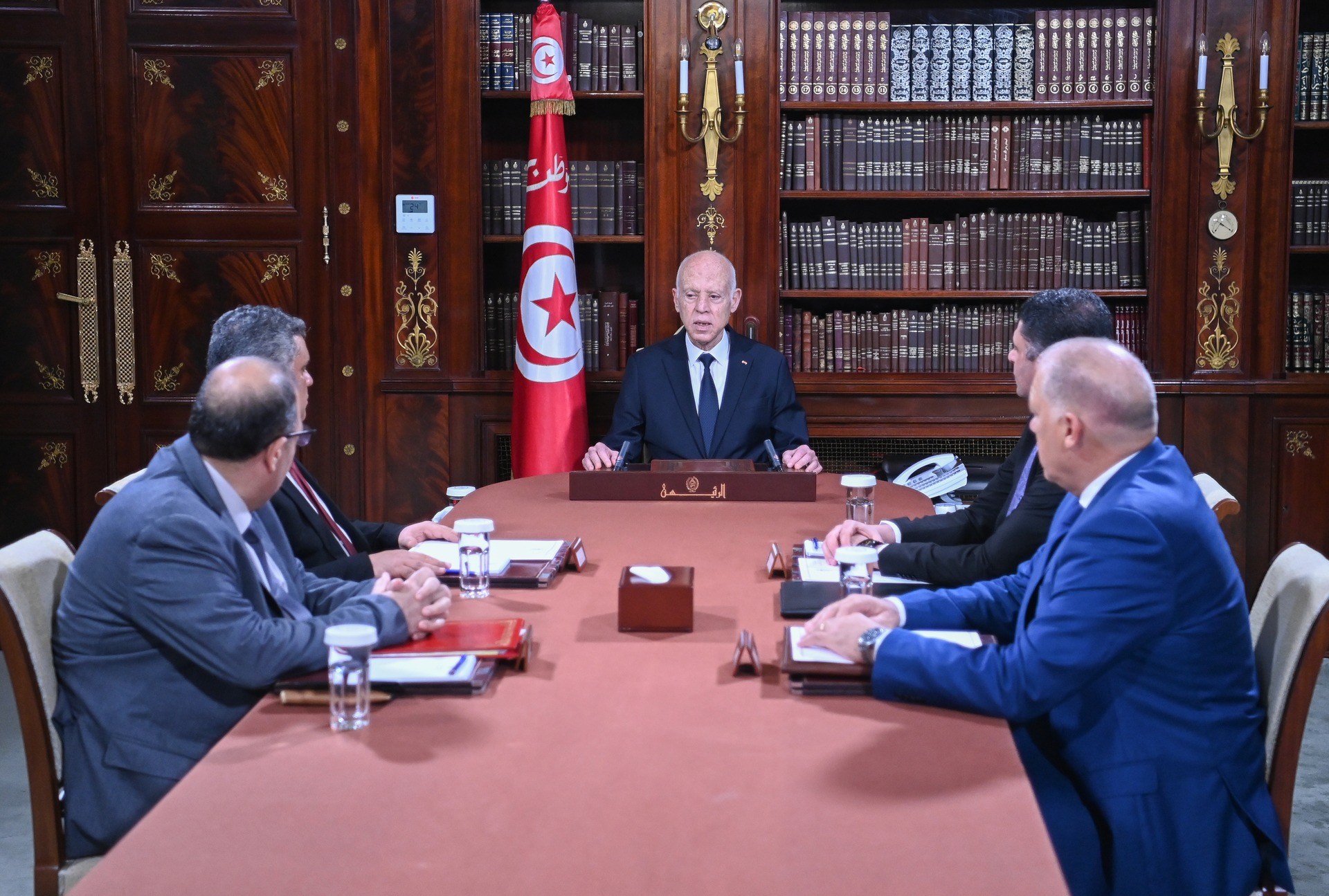
Tunis – In a recent interview, former Tunisian Prime Minister Hichem Mechichi reopened the debate about President Kais Saied’s personal security, affirming that “there was no indication, neither near nor far, of any assassination attempt against him.” He described the previously circulated claims by the president about attempts targeting him as “an attempt to deceive Tunisians because of his fight against corruption.”
The interview, broadcast by Al Jazeera’s podcast platform “Atheer,” reopened the file on the exceptional measures announced by Saied on July 25, 2021, a decisive turning point in the democratic transition after the revolution, which included dismissing Mechichi’s government, freezing parliament, dissolving the Supreme Judicial Council and other constitutional bodies, and imprisoning dozens of opponents.
Several Tunisian politicians agreed with Mechichi’s statements, considering them a confirmation of Saied’s attempts to influence public opinion by repeating narratives about assassination attempts. However, despite the seriousness of these claims, no official investigation results have appeared, nor have any suspects been announced or evidence provided to prove these allegations, according to them.
Mechichi also revisited details related to assassination attempts, recalling the incident of an assassination attempt involving a “poisoned envelope,” which caused a stir in 2021 after the former presidential chief of staff Nadia Akacha announced she was the one who received the envelope at the presidential palace. She later emigrated to France and was sentenced in absentia to 33 years in prison in the so-called State Security Conspiracy Case 2.
Mechichi considered the incident just one example of repeated narratives and vague attempts to target the president, which remained present in his speeches without any tangible impact on the ground or serious judicial follow-up. He confirmed that all technical tests were conducted on the remains of the poisoned envelope, which Akacha claimed had worsened her health when she opened it and that she tore it with a machine, but “there was no trace of any toxic or non-toxic substance.”
According to several opponents and activists, the issue is not just narratives and fabrications but a deliberate strategy to create an image of the president as a victim facing major conspiracies because he fights corruption and exposes hidden networks. This narrative, they believe, helped divert attention away from the economic and social failures accumulated since 2021 and build a political scene based on intimidation and exclusion of opponents.
Political activist and law professor Abdelwahab Maater commented on Mechichi’s statements, considering them “reminders of absurd facts that President Saied has been promoting.” He said the public prosecutor’s office had closed the file regarding assassination attempts without taking any action.
Maater told Al Jazeera Net that Saied’s insistence on these empty narratives reflects a clear desire to mobilize public opinion in his favor. He acts “as if he is a messenger from heaven, targeted because he is a great man fighting corruption.” But reality, according to him, reveals the opposite, “what happened was just a process of creating illusions and selling them to the public. This behavior has turned into an absurd situation leading the country into a political maze instead of providing tangible economic and social solutions.”
In his opinion, these narratives “allowed the president to create a fake social alert, as if his assassination was imminent at any moment. Through them, he tried to derive renewed legitimacy despite the disastrous failure that followed him in key files.” He confirms that this strategy is no longer convincing, especially since Tunisians are experiencing increasing living difficulties and “fabricating an imaginary enemy no longer distracts the street but has become additional evidence of the failure of individual rule.”
For his part, Hichem Al-Ajboni, a leader in the Democratic Current party, told Al Jazeera Net that the issues and files promoted by the Tunisian president remained without practical outcomes, as many accusations issued by him or his advisors did not go beyond media statements.
He reminded that Tunisians are still waiting for what he described as “resounding truths” about major files such as the poisoned envelope incident and the attempt to poison the president, as well as accusations of hoarding huge sums of money or former parliament deputies receiving bribes to pass laws.
According to Al-Ajboni, the absence of any suspects or tangible results from investigations makes these allegations closer to political narratives than judicial facts, which weakens public trust and confirms that the file is nothing but a tool for misleading to create the image of the innocent victim and justify his failure to achieve social or economic accomplishments.
He believes that Saied’s continued creation of imaginary enemies no longer convinces Tunisians but rather increases criticism on social media, where his discourse has shifted from that of a president in a position of responsibility to a person who complains without solutions. He considered that his experience of absolute rule since announcing exceptional measures proved that he did not provide solutions to economic and social crises but limited himself to building a discourse based on demonizing and imprisoning his opponents.
He added that the outcome of his rule since coming to power in 2019 was “zero achievements,” compared to the accumulation of violations in the field of freedoms and the persecution of journalists and opponents. He confirmed that this style of governance cannot provide an exit for Tunisia but deepens its isolation and fuels popular frustration.
Conversely, some of Saied’s supporters criticized Mechichi’s appearance “at this particular time after all this silence,” questioning the purpose of his statements and holding the Tunisian president responsible because he “made the former prime minister and held on to him despite their warnings.”
They confirmed in Facebook posts, “We will not allow the falsification of modern Tunisian history. We know well what you planned and what you are planning and who defended Nadia and Mechichi. Our voice may have been faint, but we will not allow you to play the role of heroes, you and those who still wear the cloak of honesty and sincerity while being more treacherous than you.”



Recommended for you
Talib Al-Rifai Chronicles Kuwaiti Art Heritage in "Doukhi.. Tasaseem Al-Saba"
Al-Jaghbeer: The Industrial Sector Leads Economic Growth
Exhibition City Completes About 80% of Preparations for the Damascus International Fair Launch
Unified Admission Applications Start Tuesday with 640 Students to be Accepted in Medicine
Egypt Post: We Have Over 10 Million Customers in Savings Accounts and Offer Daily, Monthly, and Annual Returns
His Highness Sheikh Isa bin Salman bin Hamad Al Khalifa Receives the United States Ambassador to the Kingdom of Bahrain