








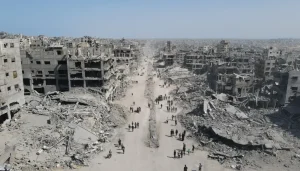
Israel, especially the far-right led by Netanyahu, exploited Hamas’s miscalculation on October 7 and destroyed the Gaza Strip entirely, from infrastructure to housing, leaving no stone or person untouched by its military power. Since World War II, no region has been destroyed to the extent of 90%. For example, 70% of Berlin was destroyed.
Trump’s plan consists of 20 points, the most important being the cessation of war in Gaza, no annexation of the West Bank, establishing a new peace path, and creating a Palestinian state on the 1967 borders. This was agreed upon by Arab leaders with President Trump. The world broadly supported this initiative based on the recognition of the Palestinian state by 159 countries, led by France and Saudi Arabia, with support from Arab countries, especially those affected by instability like Jordan.
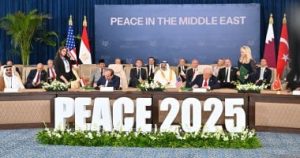
Implementing the agreement’s terms is a priority for the US administration, especially President Donald Trump, who thinks more rationally about Israel’s interests than its leaders. Israel guarantees all terms of the agreement alongside some Arab countries acting as mediators, such as Egypt and Qatar. Egypt hosts an international conference in Sharm El-Sheikh attended by Trump, Arab leaders, and some Islamic world leaders to officially sign the agreement, granting it permanence and full guarantee of implementation without obstacles.
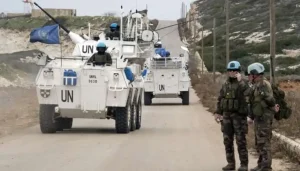
The first phase involves releasing prisoners and hostages. The first breach by Israel concerns those with life sentences; instead of releasing 250 as agreed, Israel wants to release 195 prisoners. Withdrawal to the yellow line on maps is also planned. The US administration is highly interested in sending 200 soldiers to the Israeli border with Gaza to monitor the ceasefire and bring peace to the Middle East.
The fear lies in the second phase, which involves disarming Hamas. There are no guarantees, especially for Netanyahu and Hamas, both fearing delays by Hamas after police leave the streets of areas Israel withdrew from. The transfer of authority may face challenges. Hamas’s options are very limited, and they must act rationally and realistically after the human losses exceeding 300,000 citizens, including martyrs and wounded.
President Trump’s goal at the Sharm El-Sheikh conference was to invite as many regional leaders as possible, cooperating with the Egyptian presidency, aiming to showcase himself as the man of peace who ended a conflict lasting over 77 years since 1948. This highlights him globally as the peace maker resolving this dispute, marking this achievement in history after missing out on the Nobel Peace Prize.
The conference is under Egyptian-American sponsorship with over 20 state leaders invited by the organizers. This is not just about the Gaza agreement but an attempt to bring peace to the region and explore a new path to end the conflict forever by establishing an independent Palestinian state. Although a long process, this conference marks the real start toward serious, effective peace granting Palestinians the right to self-determination.
Egypt and many Arab countries seek a UN Security Council resolution on two points: documenting the Gaza agreement to protect the state’s role in the second phase and reconstruction, and documenting Trump’s plan to grant it binding international legitimacy, responding to global conscience awakening regarding Gaza, succeeding in ceasefire, and preventing displacement, which alone is sufficient for now.

Recommended for you
Talib Al-Rifai Chronicles Kuwaiti Art Heritage in "Doukhi.. Tasaseem Al-Saba"
Exhibition City Completes About 80% of Preparations for the Damascus International Fair Launch
Al-Jaghbeer: The Industrial Sector Leads Economic Growth
Unified Admission Applications Start Tuesday with 640 Students to be Accepted in Medicine
Egypt Post: We Have Over 10 Million Customers in Savings Accounts and Offer Daily, Monthly, and Annual Returns
His Highness Sheikh Isa bin Salman bin Hamad Al Khalifa Receives the United States Ambassador to the Kingdom of Bahrain