










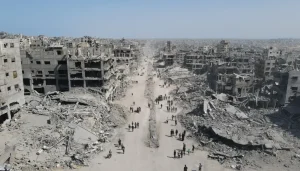
A man prepares bread in front of damaged buildings northwest of Khan Younis, southern Gaza Strip. (AFP)
The optimistic atmosphere conveyed by US President Donald Trump about the potential success of the American plan in Gaza contrasts sharply with Israeli Prime Minister Benjamin Netanyahu’s focus on a single interpretation of the plan that demands disarming Hamas and relinquishing control of the Gaza Strip.
After the first day of indirect negotiations between Hamas and an Israeli delegation at the Egyptian resort of Sharm El-Sheikh, Trump expressed his belief that “Hamas has agreed on very important matters.” He also listed the countries that have approved the American plan, including Arab states, Turkey, Israel, “and I even received a very strong signal from Iran” indicating their desire to finalize the Gaza agreement.
Netanyahu, in an interview with an American news website on the occasion of the two-year anniversary of the Gaza war, asserted that he “has crushed Hamas even though it has not yet been defeated,” pledging to “continue operations until that goal is achieved,” which he repeats as essential to ending the war.
Even Trump’s optimism has limits, as he mentions “red lines: if certain things are not achieved, we will not proceed,” referring to Hamas’s agreement to other provisions in the twenty-point plan, including disarmament and relinquishing authority. These two points are subjects Hamas has requested to negotiate, along with the borders to which the Israeli army should withdraw.
Regarding these three points, Arab officials who met Trump in New York on the sidelines of the 80th session of the UN General Assembly confirm that the American plan presented to them spoke a different language than that announced by Trump on September 29, after Netanyahu insisted on amendments to accept the plan.
In the original plan, according to the British magazine The Economist, there was a brief paragraph calling on Hamas to “fully commit to destroying and ceasing the manufacture of any offensive military infrastructure.” In the amended plan, the movement must surrender not only “offensive” structures but all its “military and terrorist equipment,” a phrase that could apply to weapons ranging from rocket launchers to pistols.
Nevertheless, when Trump exerts his influence to implement the plan he announced himself, he holds leverage to overcome the reservations of both parties. When he posts a photo of a demonstration by families of Israeli prisoners on his Truth Social platform and receives Israeli-American prisoner Idan Alexander at this time, he sends a clear message to Netanyahu that the time has come to release the remaining prisoners held by Hamas and to stop the war.
On the other hand, Trump can no longer ignore the displeasure of Arab countries friendly to the United States following the Israeli strike on Qatar on September 9, compounded by European anger over the ongoing war, which translates into expanding the isolation around Israel.
Despite the pressures Trump exerts, Amos Harel, a writer for the Israeli newspaper Haaretz, cautiously states in an article on Monday that “it is still not possible to rule out Netanyahu’s success in sabotaging the deal, even if it appears to be at a very advanced stage.”
If that happens, the perennial question arises: Will Trump confront Netanyahu?

Recommended for you
Talib Al-Rifai Chronicles Kuwaiti Art Heritage in "Doukhi.. Tasaseem Al-Saba"
Exhibition City Completes About 80% of Preparations for the Damascus International Fair Launch
Al-Jaghbeer: The Industrial Sector Leads Economic Growth
Unified Admission Applications Start Tuesday with 640 Students to be Accepted in Medicine
Egypt Post: We Have Over 10 Million Customers in Savings Accounts and Offer Daily, Monthly, and Annual Returns
His Highness Sheikh Isa bin Salman bin Hamad Al Khalifa Receives the United States Ambassador to the Kingdom of Bahrain