









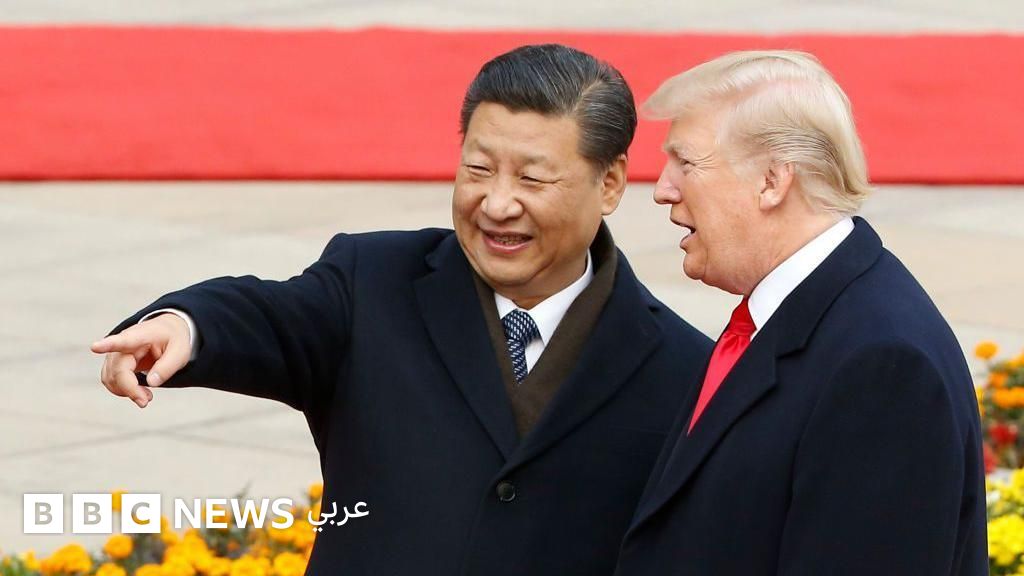
US President Donald Trump announced that he will impose an additional 100% tariff on imports from China starting next month.
Trump said on social media that the United States will also impose “export controls” on critical software.
Earlier on Friday, Trump responded to Beijing’s announcement this week tightening rules on rare earth metal exports, accusing China of becoming “very hostile” and trying to “keep the world hostage.”
Trump threatened to withdraw from a meeting with Chinese President Xi Jinping, scheduled in South Korea. He later said he did not cancel the meeting because he was not aware they were “going to hold it.”
He told reporters at the White House: “I will be there anyway.”
Trump’s remarks caused financial markets to fall, with the S&P 500 index closing down 2.7%, its largest drop since April.
China dominates the production of rare earth metals and some other key materials, which are essential components in cars, smartphones, and many other products.
China had previously announced tightening export controls in response to Trump’s tariff hikes on Chinese goods earlier this year, which caused widespread dissatisfaction among many US companies relying on these materials, with Ford Motor Company even temporarily halting production.
In addition to tightening rules on rare earth exports, China has opened an investigation into anti-competitive practices by the American technology company Qualcomm, which could hinder its acquisition of another chip manufacturer.
Although Qualcomm is headquartered in the US, a large part of its business is concentrated in China.
Beijing also announced new port fees on ships linked to the US, including those owned or managed by American companies.
On Friday, Trump posted on social media: “Very strange things are happening in China! They are becoming more hostile.”
The trade relations between the two countries had seen a fragile thaw since last May after agreeing to cancel triple-digit tariffs (over 100%) on goods exchanged between them, which nearly halted trade.
However, this led to additional US tariffs of 30% on Chinese goods compared to the start of the year, while Beijing imposed new 10% tariffs on its imports of American goods.
Since then, officials from both countries have held a series of talks covering issues including the TikTok app, agricultural purchases, rare earth metals trade, and advanced technology such as semiconductors.
The two sides were expected to meet again this month at a summit in South Korea.
Jonathan Zein, a China affairs expert and fellow at the Brookings Institution, said the Chinese president’s recent measures were an attempt to “shape the course” of upcoming talks, noting that the latest directive on rare earth metals has not yet come into effect.
Zein added: “Xi Jinping is looking for a way to take the initiative,” while the Trump administration is forced to play a guessing game or “whack-a-mole” and deal with issues as they arise.
He said he did not believe China was worried about such a retaliatory US response.
He emphasized that what China has learned from imposing tariffs on Liberation Day and the subsequent escalation followed by periods of easing is that the Chinese side has “a greater capacity to endure pain.” “From their perspective, the Trump administration has backed down.”
In previous rounds of trade talks, China pushed for easing US restrictions on semiconductors. It is also interested in securing more stable tariff policies to facilitate its companies selling products in the US.
The Chinese president has previously used his country’s dominance in rare earth metal production as leverage against the US.
But the Chinese export rules announced this week target foreign arms manufacturers, including American companies, making them extremely risky, according to Gracelin Pascaran, director of the Critical Minerals Security Program at the Center for Strategic and International Studies in Washington.
Gracelin said, “Nothing motivates America to act more than targeting our defense industry. But it is forced to negotiate because our options are limited, and in an era of rising geopolitical tensions and potential conflicts, we need to build our defense industrial base.”
Although a meeting between Trump and Xi now seems unlikely, Gracelin believes it is not necessarily “completely ruled out.”
She added that there is still time and room for talks. China’s new rules will not come into effect until December.
She said, “Negotiations are likely imminent. Over time, it will be determined who will conduct them and where.”


Recommended for you
Talib Al-Rifai Chronicles Kuwaiti Art Heritage in "Doukhi.. Tasaseem Al-Saba"
Exhibition City Completes About 80% of Preparations for the Damascus International Fair Launch
Al-Jaghbeer: The Industrial Sector Leads Economic Growth
Unified Admission Applications Start Tuesday with 640 Students to be Accepted in Medicine
Egypt Post: We Have Over 10 Million Customers in Savings Accounts and Offer Daily, Monthly, and Annual Returns
His Highness Sheikh Isa bin Salman bin Hamad Al Khalifa Receives the United States Ambassador to the Kingdom of Bahrain