









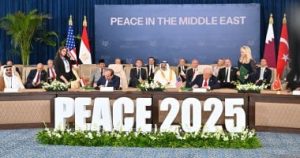
I can almost guarantee that even the most optimistic in the world did not expect just a few days ago that an international peace summit could be held in Sharm El-Sheikh, co-chaired by President Abdel Fattah El-Sisi and US President Donald Trump, with the participation of leaders from twenty countries, or that the war in Gaza could be halted and the first phase of Trump’s plan signed.
The scene just days ago was extremely bleak: an Israeli invasion of Gaza City, excessive targeting of civilians, and a hardline Israeli rhetoric speaking of a crushing victory desired by Netanyahu, alongside racist incitement from the Israeli right that fueled further flames. Even with the announcement of the US peace plan, optimism was cautious. But once negotiations were announced in Sharm El-Sheikh and Egyptian intensive moves to end the war gradually revealed, the agreement was completed and a wave of relief spread worldwide.
No one exaggerates when saying that all threads of the Palestinian cause converge in the hands of the Egyptian state apparatus, foremost among them the Egyptian General Intelligence Service, which holds the most accurate assessment of the situation on the ground regarding the Palestinian issue among all intelligence agencies worldwide, as well as its deep understanding of the Israeli negotiator’s mentality. Therefore, the success of the negotiations held under its auspices was not surprising at all.
This is not flattery of the Egyptian role, even if this is the right time and place and moment to say so, but these lines come within a deeper analytical vision of the dimensions and limits of Egypt’s role in repairing the fractures in the Middle East after the storm and its aftermath that continued over two years.
In this context, the Sharm El-Sheikh summit should not be seen as an ordinary or transient official event, but as a clear success for Egypt in imposing its vision to resolve the region’s crises, foremost among them the Israeli-Palestinian conflict.
The symbolism starts from the place and the city that hosted the final decisive negotiations and has hosted many peace summits throughout its history. The implications extend to the start of a new phase in the region that will witness the reining in of the rampant Israeli power and the declaration of the collapse of Netanyahu’s plan, which he claimed was a redraw of the Middle East map.
From the symbolism of the place, one must pause at the revival of peace that the Israeli right-wing government led by Benjamin Netanyahu sought to bury forever during two years of fierce war on Gaza, which expanded to affect more than one country in the region.
The participation of leaders from more than twenty countries, led by US President Trump, in the Sharm El-Sheikh peace summit is a clear recognition that the only way to remove the widespread tension in the Middle East can only be through the Egyptian vision based on comprehensive and just peace and the two-state solution, with the conviction that Israeli arrogance will only exacerbate crises.
The countless successes achieved by Cairo, which has faced extensive attacks and doubts over two years, including some unpatriotic protests outside its embassies abroad, require a detailed analysis of the Egyptian position and its development since the outbreak of the Al-Aqsa storm and the subsequent brutal Israeli attack on Gaza, attempts to displace Gaza’s population and liquidate the Palestinian cause forever, up to Israel’s grand delusions and Netanyahu’s announcement of redrawing the Middle East after wars extending from Lebanon to Syria, Yemen, and Iran, and an attack targeting Hamas leaders in Doha.
Cairo early declared its red lines and strong loyalties that it did not retreat from: no displacement, no liquidation of the Palestinian cause, no Israeli occupation of Gaza, and no presence of the occupation army at Rafah crossing. It was not strange amid all this that Egypt’s voice through President Abdel Fattah El-Sisi was the strongest at the Arab summit in Baghdad, the Arab Islamic summit in Doha, and all international forums.
Egypt’s messages were not limited to condemnation and denunciation but peaked by describing Israel as the enemy and warning the Israeli people of the dangers threatening peace agreements due to the reckless behavior of its right-wing government.
For two years, Cairo rejected attempts to drag it into side battles and dealt with Israeli provocations with intelligence and depth, but it strongly conveyed the message to all concerned; Egypt is committed to peace but prepared for all scenarios, will not concede its red lines, and will not accept attempts to liquidate the Palestinian cause.
Officially, the Foreign Ministry’s discourse, led by Minister Badr Abdel Aati, appeared balanced and deep; it continuously focused on holding the occupation responsible for the outbreak of the situation in the region. The Foreign Ministry’s statements over two years of war in Gaza deserve detailed study.
On the relief level, Egypt has been pressing strongly for the withdrawal of the Israeli army from the Palestinian side of Rafah crossing to fully reopen it. The convoys of dignity from Egypt to Gaza continued during the toughest hours.
Faced with Egypt’s firm stance, US decision-making circles gradually realized that there is no solution to the Middle East situation except through Cairo, and that pressures, no matter how strong, would be ineffective with Egypt’s complete rejection of displacement. Therefore, it was not strange that President Trump sought a full retreat from displacement and complied with Egypt’s and the region’s influential forces’ desire to rebuild Gaza to ensure the success of his initiative in the Middle East.
Egypt, no matter the internal and external burdens it endures, rises like a giant on major issues to defend its nation. Ask history about it from Ain Jalut to October 6, and if history is not enough, try to understand the lessons of geography.


Recommended for you
Talib Al-Rifai Chronicles Kuwaiti Art Heritage in "Doukhi.. Tasaseem Al-Saba"
Exhibition City Completes About 80% of Preparations for the Damascus International Fair Launch
Al-Jaghbeer: The Industrial Sector Leads Economic Growth
Unified Admission Applications Start Tuesday with 640 Students to be Accepted in Medicine
Egypt Post: We Have Over 10 Million Customers in Savings Accounts and Offer Daily, Monthly, and Annual Returns
His Highness Sheikh Isa bin Salman bin Hamad Al Khalifa Receives the United States Ambassador to the Kingdom of Bahrain