









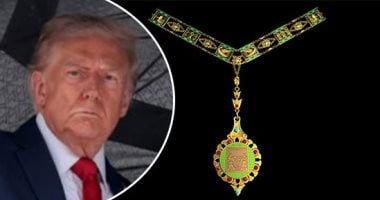
Egypt holds a significant position among nations, reflected in the awards and honors it bestows. Recently, President Abdel Fattah El-Sisi decided to award the Nile Necklace to U.S. President Donald Trump, recognizing his prominent contributions to peace efforts, notably his pivotal role in halting the war on Gaza. This article explores the necklace’s history, status, and cultural significance.
The Nile Necklace is Egypt’s highest civil honor, established initially in 1915 during the reign of Sultan Hussein Kamel. After the declaration of the republic on June 18, 1953, the system of orders was reorganized, and the Nile Necklace became the highest state honor awarded to those who rendered great services to Egypt or humanity, according to Law No. 528 of 1953, later replaced by Law No. 12 of 1972.
The official presidency website confirms that awarding the necklace is the prerogative of the President of the Republic. It is given to heads of state, crown princes, vice presidents, as well as Egyptians and foreigners who have provided invaluable services to Egypt or humanity. Upon the recipient’s death, a military salute or ‘honor guard’ is performed in recognition of the necklace’s high value.
The Nile Necklace is a collar made of gold or gold-plated silver, consisting of three square units bearing Pharaonic symbols: the first symbolizes protection of the state from evil, the second represents the goodness and happiness brought by the Nile, and the third signifies wealth and permanence. Circular gold flowers adorned with turquoise and ruby connect the units. Hanging from the collar is a hexagonal pendant decorated with flowers in the ancient Egyptian style, also set with turquoise and ruby. At its center is a prominent symbol of the Nile, representing the unification of the North (papyrus) and South (lotus). This visual design gives the necklace a clear symbolic meaning: protection, growth, permanence, and the unity of Egypt’s land through its life artery.
The current legal framework (Law No. 12 of 1972) states that the necklace is gifted or awarded by presidential decree and is the highest rank in the system of civil orders and medals. The presidency confirms that recipients are treated with the highest protocols of honor and receive a military salute upon death.
Historically, the necklace has been awarded to a constellation of Egyptian and international figures. Among Egyptians are writer Naguib Mahfouz (Nobel Prize in Literature 1988), scientist Ahmed Zewail (Nobel Prize in Chemistry 1999), and heart surgeon Magdi Yacoub. Internationally, it has been awarded to leaders, kings, and presidents including former U.S. President Jimmy Carter, Nelson Mandela, Queen Elizabeth II, and Josip Broz Tito, as well as Arab leaders like King Salman bin Abdulaziz and Sultan Qaboos bin Said.
The origins of the Nile Order/Necklace date back to the monarchy era (1915) as part of the kingdom’s system of orders, before being re-established in the republic as the highest state honor. It was one of the principal orders of the kingdom until 1953, then re-established as the highest honor in the republic, with changes in legal frameworks but retaining the name and symbolism connected to the Nile as a unifying identity.
The order is usually awarded in official ceremonies announced by presidential statements, often gifted to heads of state during official visits or to individuals whose contributions deeply impacted Egypt or humanity. The gifting moment is part of diplomatic language and messages; it is read as a major sign of appreciation, a message of friendship and alliance, or a celebration of distinguished Egyptian scientific and cultural achievements recognized worldwide (as in Nobel laureates’ cases).
The value of the necklace is inseparable from the Nile symbol itself; in Egyptian consciousness, the Nile is the ‘lifeblood’ and the cause of civilization and valley unification. This is visually embodied by the necklace’s lotus and papyrus symbols and conceptually by protection, growth, and permanence. Thus, awarding the necklace is not only a personal honor but also an inclusion of the honoree’s name in a symbolic chain referring to both ancient and modern Egyptian identity. This meaning deepens when awarded to prominent Egyptian scientific and literary figures, making the medal a tangible witness to a historic recognition of a global Egyptian achievement. Conversely, when gifted to foreign leaders during official visits, it is read as a diplomatic salute and a message of appreciation for bilateral relations or roles connected to Egypt’s strategic interests.




Recommended for you
Talib Al-Rifai Chronicles Kuwaiti Art Heritage in "Doukhi.. Tasaseem Al-Saba"
Exhibition City Completes About 80% of Preparations for the Damascus International Fair Launch
Al-Jaghbeer: The Industrial Sector Leads Economic Growth
Unified Admission Applications Start Tuesday with 640 Students to be Accepted in Medicine
Egypt Post: We Have Over 10 Million Customers in Savings Accounts and Offer Daily, Monthly, and Annual Returns
His Highness Sheikh Isa bin Salman bin Hamad Al Khalifa Receives the United States Ambassador to the Kingdom of Bahrain