








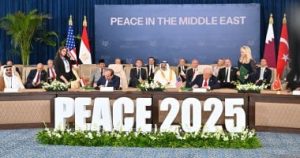
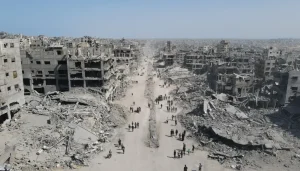
Several world leaders expressed their happiness following the announcement of a peace agreement between Israel and Hamas at the Sharm El-Sheikh resort, a step described as “historic” to end more than two years of devastating war in the Gaza Strip, which claimed the lives of over 67,000 people, mostly civilians including women and children, and caused widespread infrastructure destruction and an unprecedented humanitarian crisis.
The agreement came at the end of the third day of indirect negotiations hosted by the Sharm El-Sheikh resort, forming the first phase of the peace plan announced by U.S. President Donald Trump.
The agreement stipulates the immediate release of all 48 detainees held by Hamas in Gaza, in exchange for Israel releasing a number of Palestinian prisoners, and the withdrawal of Israeli forces to agreed lines, paving the way for a comprehensive and permanent ceasefire.
In Washington, President Trump announced the agreement via a post on his “Truth Social” platform, describing it as a “major step towards lasting peace in the Middle East,” thanking Egypt, Qatar, and Turkey for their active roles in achieving this “diplomatic breakthrough.”
In Brussels, European Commission President Ursula von der Leyen welcomed the agreement in a post on “X,” emphasizing that “all parties must fully comply with the terms of the agreement, ensure the safe release of all hostages, and establish a permanent ceasefire.” She added, “The time has come to end the suffering. The European Union will continue to support the rapid and safe delivery of humanitarian aid to Gaza and will be ready to assist in reconstruction when the time comes.” Von der Leyen also expressed gratitude to President Trump and the three mediating countries for their efforts.
UN Secretary-General António Guterres praised the agreement, calling on all parties to fully adhere to its terms, saying, “All hostages must be released with dignity, a permanent ceasefire must be secured. Fighting must end permanently, and humanitarian aid and essential commercial goods must enter Gaza without obstacles; the suffering must end.”
Guterres confirmed that “the scale of the humanitarian disaster in Gaza is indescribable,” explaining that the war left more than 67,000 dead and tens of thousands wounded, as well as millions displaced living in tragic conditions due to the collapse of basic services. He pledged that the United Nations will support the implementation of the agreement and intensify humanitarian aid within the sector.
In Rome, Italian Prime Minister Giorgia Meloni described the agreement as “exceptional news,” praising President Trump’s “tireless efforts” to end the conflict in Gaza.
Spanish Prime Minister Pedro Sánchez welcomed the agreement but stressed that “the real work begins now to ensure lasting peace,” calling for “honest dialogue, assistance to civilians, and looking to the future to prevent the repetition of tragedies.”
In Paris, French President Emmanuel Macron expressed “great hope” for Palestinians, hostages, and their families, saying, “This agreement must represent the end of the war and the beginning of a permanent political solution. France is ready to contribute to this path and will discuss it with our international partners.”
British Prime Minister Keir Starmer said the news was “a moment of deep relief felt by peoples worldwide,” thanking Egypt, Qatar, and Turkey for their “continued diplomatic efforts.” He called on all parties to “fully implement their commitments,” affirming that Britain “will remain engaged to support immediate steps to ensure the implementation of the Trump plan.”
In Canada, Prime Minister Mark Carney congratulated the U.S. President on his “decisive leadership,” praising the role of the mediating countries. He said in a post on “X”: “After years of severe suffering, peace has finally become possible.”
In Australia, Prime Minister Anthony Albanese welcomed the agreement, urging all parties to commit fully to the plan and implement it, emphasizing that “Gaza’s path to recovery and peace is long, and Australia will contribute to supporting reconstruction and stabilization efforts.”
Malaysian Prime Minister Anwar Ibrahim also expressed his country’s welcome of the progress made in the Sharm El-Sheikh talks, affirming “full solidarity” with the Palestinian people in their “pursuit of justice, dignity, and building an independent state,” calling on all parties to work towards “comprehensive and lasting peace.”
UN estimates indicate that rebuilding the Gaza Strip will require many years and hundreds of billions of dollars, given that over 70% of homes and economic facilities were destroyed, and basic infrastructure such as electricity, water, and sewage systems are nearly completely halted.
Observers see this agreement as a shift in international sentiment reflecting the peoples’ desire to end the cycle of violence and start a genuine peace process in the Middle East. The international community, through ongoing reactions, confirms that this agreement represents a historic moment that may open the door to a comprehensive political settlement, restoring hope for both Palestinians and Israelis and ending one of the bloodiest conflicts of the 21st century.
Symbolic celebrations were observed in many countries, including illuminating prominent landmarks with the colors of the Palestinian flag, while humanitarian and religious organizations worldwide welcomed what they considered a “last chance to save lives and restore hope to the region.”
Meanwhile, international relief organizations called for the agreement to be translated into immediate actions for a permanent ceasefire, lifting the siege, and facilitating the entry of aid into Gaza, stressing that “global relief will not be complete without achieving justice for civilians and ensuring the tragedy does not repeat.”

Recommended for you
Talib Al-Rifai Chronicles Kuwaiti Art Heritage in "Doukhi.. Tasaseem Al-Saba"
Exhibition City Completes About 80% of Preparations for the Damascus International Fair Launch
Unified Admission Applications Start Tuesday with 640 Students to be Accepted in Medicine
Al-Jaghbeer: The Industrial Sector Leads Economic Growth
Egypt Post: We Have Over 10 Million Customers in Savings Accounts and Offer Daily, Monthly, and Annual Returns
His Highness Sheikh Isa bin Salman bin Hamad Al Khalifa Receives the United States Ambassador to the Kingdom of Bahrain