







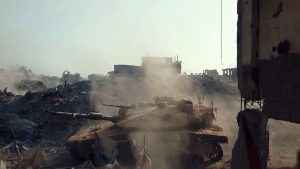



As the third year of the war of extermination and starvation begins, US President Donald Trump achieved a long-awaited breakthrough by reaching an agreement to stop the war in Gaza, marking a historic moment that embodies the triumph of the will for peace over the logic of war.
There is no doubt that the acceptance by Israel and Hamas of an agreement supported politically by Arab countries and regional powers indicates the end of the nightmare of war and is not merely a short-term truce. This agreement will remain a “moment when history held its breath,” but many unresolved issues require lengthy discussion and hard work.
The 20-point peace plan proposed by the Trump administration attempts to strike a delicate balance between creating conditions for a ceasefire and negotiating a permanent settlement to the war. The US administration could no longer ignore the humanitarian consequences of the Gaza war, so Trump applied a shock therapy approach to both parties.
He lost patience and was annoyed with Israeli Prime Minister Benjamin Netanyahu, who had no choice but to engage in the process and accept it reluctantly. Trump also threatened Hamas with “complete elimination,” and the movement faced intense pressure forcing it to partially accept the agreement and enter negotiations in Sharm El-Sheikh.
However, ambiguity about the second phase raises questions about whether both sides will commit for the long haul, noting that the agreement Trump announced late Wednesday night was devoid of details.
It left many questions unresolved, as was the case with previous peace attempts. There is a lack of real guarantees regarding Trump and Israel’s commitment to the agreements and the possibility of later repudiation.
Trump may have realized these issues are contentious, which is why he indicated they would be left for a later stage of negotiations. Recent moves show that Trump’s motives go beyond mere foreign policy calculations, highlighting a personal desire to be recorded as a peace hero and receive international recognition, though not this year, as the evaluation depends on 2024 achievements.
Sources indicated that regarding the delivery of Israeli detainees, Hamas agreed to a “compromise” proposed by mediators concerning the delivery of the dead bodies, with teams from several countries including Egypt, the United States, and Turkey participating in the search and identification of the bodies. The Israeli delegation, after consultations with Netanyahu, agreed to this, and Hamas and the factions’ delegation participating in the negotiations did not oppose this step.
Whether this path will ultimately pave the way for the establishment of a Palestinian state remains uncertain. Palestinians fear a repeat of the same experience during the previous agreement signed in Doha last January, which Israel renounced in March of the same year. The January 2025 agreement stipulated a temporary truce starting on the morning of the 19th of that month.
It included prisoner exchanges, humanitarian relief, and limited field arrangements as a first phase, with negotiations to begin on the second and third phases, which would conclude the exchange file, post-war arrangements, and reconstruction. However, Israel violated the first phase amid accusations over the lists of released prisoners and the sequence of delivery, then returned to war again.
According to several analysts, the agreement should not be limited to a temporary halt of attacks or merely reducing their intensity and allowing a small amount of humanitarian aid into Gaza, but it should lead to ending all hostilities and lifting the siege completely.
Essential supplies including food, medicine, fuel, and reconstruction materials must flow without restrictions, coinciding with the withdrawal of the Israeli army from Gaza and urgent moves to rebuild and repair essential infrastructure throughout the Strip.
But the ceasefire agreement in Gaza must mark the beginning of achieving peace in the region and the start of a political solution based on the two-state solution. With continued support from mediators and the international community, hope remains that the agreement will usher in a new era of calm and reconstruction in Gaza.
A mix of joy and tears celebrating the ceasefire
Sharm El-Sheikh Agreement: A Significant and Active Arab Role

Recommended for you
Talib Al-Rifai Chronicles Kuwaiti Art Heritage in "Doukhi.. Tasaseem Al-Saba"
Exhibition City Completes About 80% of Preparations for the Damascus International Fair Launch
Al-Jaghbeer: The Industrial Sector Leads Economic Growth
Unified Admission Applications Start Tuesday with 640 Students to be Accepted in Medicine
Egypt Post: We Have Over 10 Million Customers in Savings Accounts and Offer Daily, Monthly, and Annual Returns
His Highness Sheikh Isa bin Salman bin Hamad Al Khalifa Receives the United States Ambassador to the Kingdom of Bahrain