









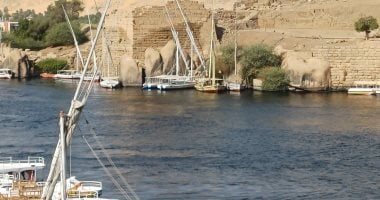
On the enchanting island of Aswan in the middle of the Nile, some archaeological relics still tell the genius of the ancient Egyptians in understanding nature and utilizing its resources. Among the temples and tombs adorning the island, a unique artifact known as the “Nilometer” stands out. It is one of the oldest measuring tools in human history, dating back nearly seven thousand years, and has witnessed the relationship of Egyptians with the eternal river from the dawn of history until the establishment of the modern state.
The Nilometer is a term used for rocks and stone blocks that ancient Egyptians used to determine the water level of the Nile, especially during flood and drought seasons. This measure was extremely important in the lives of Egyptians, as it helped them determine planting seasons and calculate taxes imposed on farmers based on the amount of water reaching their lands. Priests monitored these measures daily and recorded the rise or fall of water levels in precise records, considering the Nile flood as the lifeblood of ancient Egypt.
The forms of the Nilometer varied over the ages, from carved marks on the riverbank to deep wells and stepped stone staircases leading to the river level. The water level was read by the chief priest, who possessed precise scientific knowledge of water sciences and astronomy. This process was linked to religious beliefs, as Egyptians believed that the increase in Nile waters was a gift from the god “Hapi,” symbolizing goodness and fertility.
The ancient Egyptians continued to use these measures on Aswan Island, known as the “Nilometer,” throughout different eras. Its use extended through successive periods after the Pharaonic times and continued until the Islamic era.
With the beginning of the modern era, scientific and engineering control of the Nile waters began. In the 11th century AD, the Fatimid Caliph Al-Hakim bi-Amr Allah summoned the Arab scientist “Ibn al-Haytham” to Egypt to regulate the Nile flood. After many centuries, Muhammad Ali Pasha established the modern state and built the first dams and bridges. Then Khedive Abbas Helmy II laid the foundation stone for the Aswan Reservoir in 1899, which was officially opened in 1902 as the first major engineering project to control the Nile waters.
With the construction of the High Dam during the era of the late President Gamal Abdel Nasser between 1964 and 1971, the era of natural Nile flooding practically ended. The Nile measures became relics of the past, telling the story of a nation that lived on the riverbanks for thousands of years.
Archaeologist Nasr Salama, former Director General of Aswan and Nubia Antiquities, told “Youm7” that the Nile water measures were among the most important inventions in ancient Egyptian history, as they determined the country’s economic and agricultural fate. If the water level rose significantly, it meant a flood threatening lands and homes; if it dropped, it meant drought and famine. Therefore, these measures represented an early warning system for the lives of ancient Egyptians and continued in use until the 20th century before stopping with the construction of modern dams and reservoirs.
Salama added that the Nile measures today are rare evidence of the ancient Egyptians’ brilliance in water sciences and engineering, confirming that the Aswan Island measure still retains much of its original form and is an important tourist attraction that draws researchers and those interested in ancient Egyptian science and history.
Thus, the “Nilometer” remains a witness to a civilization that preceded its time by thousands of years, bequeathing to the world the first tools of measurement and scientific study of nature, making the Nile a symbol of life, history, and Egyptian identity forever.




Recommended for you
Talib Al-Rifai Chronicles Kuwaiti Art Heritage in "Doukhi.. Tasaseem Al-Saba"
Exhibition City Completes About 80% of Preparations for the Damascus International Fair Launch
Al-Jaghbeer: The Industrial Sector Leads Economic Growth
Unified Admission Applications Start Tuesday with 640 Students to be Accepted in Medicine
Egypt Post: We Have Over 10 Million Customers in Savings Accounts and Offer Daily, Monthly, and Annual Returns
His Highness Sheikh Isa bin Salman bin Hamad Al Khalifa Receives the United States Ambassador to the Kingdom of Bahrain