








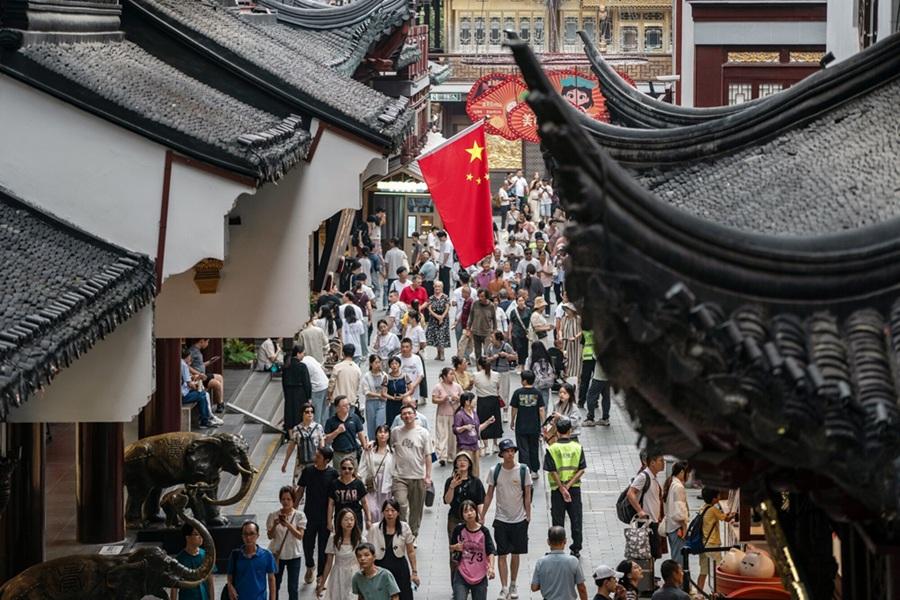
Visitors at Yu Garden during China’s National Day in Shanghai (Bloomberg/Archive)
The latest signs of excessive competition, also known as “retrenchment,” have emerged in China’s tourism sector, raising concerns about growing deflationary pressures on the overall economy.
During the official Golden Week holiday from October 1 to 8, total domestic tourism trips reached 888 million, generating revenues of 809.01 billion yuan ($113.63 billion), according to official data released Thursday. This represents increases of 1.8% and 7.6% respectively compared to last year, according to CNBC’s calculations.
However, these gains slowed compared to the Golden Week holiday from May 1 to 5 earlier this year, when domestic trips and tourism revenues grew by 6.4% and 8% respectively. In fact, the average spending per domestic tourism trip during Golden Week was about 3% lower than in 2019 before the pandemic, according to Goldman Sachs on Thursday.
Mix Shi, founder of the “Bushpacker” hostel group in Chengdu, said the Golden Week was a “golden weakness point.”
Although the three hostels he owns in the city were fully booked, Shi said he had to cut nightly prices by about 60% because neighboring hotels lowered their prices even more.
Shi said, “Huge amounts of money have flowed into the hotel sector recently,” noting that “the competition is crazy, and some great places are sold at very low prices. It’s great for travelers because there are more options, but it’s a painful blow for hostels.”
Chengdu, the capital of Sichuan province in southwest China, ranked second after Nanjing, the capital of Jiangsu province in eastern China, in tourism spending during the holiday on the Meituan online booking platform.
Among domestic and international visitors to hostels in mainland China, Chengdu’s popularity more than doubled compared to last year’s Golden Week, ranking second after Shanghai, according to HostelWorld. However, average bed prices dropped by more than 20% in both cities, reaching 165.70 yuan ($23.27) in Shanghai and 80.99 yuan in Chengdu.
While most locals only get a few paid vacation days annually, China has encouraged companies to grant workers more days off and extend official holidays to boost consumption.
This year’s Golden Week was one day longer than usual as it coincided with the Mid-Autumn Festival, which follows the lunar calendar. The festival fell on October 6 this year, compared to September 17 last year.
AJ Wang, owner of Hotel X and Observatory Hill House restaurant in the northeastern coastal city of Qingdao, said, “The Mid-Autumn Festival is a family reunion festival.”
He added, “The real Golden Week, in terms of revenue generation, ends on the sixth of the month,” noting he had to cut prices by 60% after that date due to lower demand. Official domestic tourism revenues during Golden Week alone rose 15.4% compared to 2024, but when adding last year’s Mid-Autumn Festival revenue figures, the comparative revenue growth slowed to 7.6%, according to CNBC’s calculations.
Sasa Yao, who runs a hostel and restaurant in the southern city of Guangzhou, said, “Everyone is working harder, spending more, but profit margins remain thin.”
Yao added that his restaurant’s daily sales rose from a usual 3,000 yuan to up to 10,000 yuan during Golden Week, with an average customer spend of only 30 yuan.
Yao said, “We were busier than ever and broke our revenue record. There are only four of us running things, so by the end of the week, we were so tired that when I said, ‘Let’s celebrate with a late-night meal!’ everyone said, ‘Can we celebrate by sleeping instead?’
In Chengdu, famous for giant pandas and spicy cuisine, Shi said travelers tend to book rooms only a day or two in advance rather than a week or two, making accommodation prices unpredictable.
China’s extensive network of high-speed trains and airports – where flights are sometimes cheaper than train tickets – has made impulse travel relatively easy. Large price fluctuations and difficulties booking tickets for the first or last day of official holidays push travelers to delay trips as much as possible to save money.
Many tourists chose to travel just before or after the Golden Week this year, according to Chinese travel booking site Trip.com.
The site noted that hotel prices in late September were about 20% lower than during Golden Week, while mid-holiday flight prices were over 30% cheaper than at the start of the holiday.
Alibaba-owned travel booking site Fliggy reported that average spending per travel booking rose 14.6% compared to the previous year and noted that much cheaper flights began on the weekend following the holiday, such as a Shanghai to Hong Kong flight for under 400 yuan ($56).
Official figures also indicated an increase in road trips, with the holiday averaging 304 million trips per day, mostly by car.
Assistant professor Bruce Pang said, “Golden Week unleashed a wave of activity across China: breaking travel records, booming business activities, and new spending trends, all factors that gave a strong boost to domestic demand.”


Recommended for you
Talib Al-Rifai Chronicles Kuwaiti Art Heritage in "Doukhi.. Tasaseem Al-Saba"
Exhibition City Completes About 80% of Preparations for the Damascus International Fair Launch
Al-Jaghbeer: The Industrial Sector Leads Economic Growth
Unified Admission Applications Start Tuesday with 640 Students to be Accepted in Medicine
Egypt Post: We Have Over 10 Million Customers in Savings Accounts and Offer Daily, Monthly, and Annual Returns
His Highness Sheikh Isa bin Salman bin Hamad Al Khalifa Receives the United States Ambassador to the Kingdom of Bahrain