









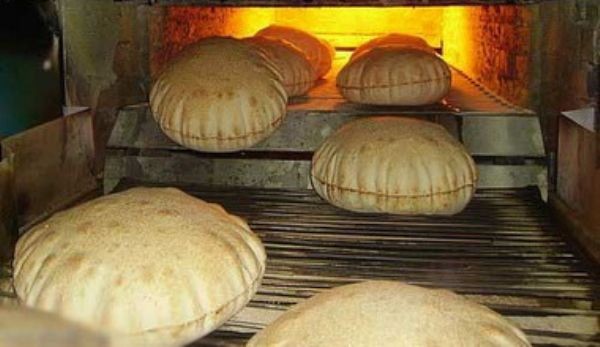
The Ministry of Industry, Trade and Supply confirmed that its monitoring of bakeries and mills continues to ensure the provision of bread to citizens at the specified prices without any violations and in a manner that guarantees the proper use of subsidized flour.
The ministry stated in a Thursday statement that the purpose of supporting wheat sold to bakeries for flour production is to stabilize the bread prices set by the government, which are 32 qirsh for large bread “kamaj”, 35 qirsh for sliced bread, and 40 qirsh for small bread.
It pointed out that bakeries are required to provide large-sized bread until 8 p.m., while being allowed to produce other varieties, leaving the choice to the buyer.
The ministry indicated that the total amount allocated to support wheat and fodder materials (barley and bran) for the current year is about 228 million Jordanian dinars, including 139 million dinars to stabilize bread prices, 70 million to support barley, and 19 million to support bran. The support for stabilizing bread prices includes selling flour at subsidized prices to bakeries as well as direct monthly financial allocations to stone bakeries benefiting from the support, numbering 1050 bakeries under specific controls and conditions including their subsidized flour withdrawals.
It noted that the cost of a ton of wheat currently reaches 252 dinars and is sold to mills at 139 dinars to stabilize bread prices, with a subsidy difference of 113 dinars per ton of wheat.
The ministry pointed out that during the first nine months of the current year, more than 100 violations were recorded in bakeries as a result of continuous monitoring and follow-up of their work, and all were referred to the judiciary. The violations included failure to provide large Arabic bread, selling at prices higher than the official set price, failure to announce prices, non-compliance with announced prices, and violations of bakery establishment instructions.
It explained that the Industry and Trade Law stipulates fines of up to 3,000 dinars and imprisonment for up to six months, or both penalties together, in case of committing such violations.
It added that the ban on issuing new bakery licenses is due to the large number of bakeries in the kingdom, exceeding 2100 bakeries both stone and automated. Exceptions to establish new bakeries are granted only in very specific cases, especially in remote areas where there are no bakeries, taking into account population density and distance from other bakeries.
It said that the allocations of subsidized flour for bakeries are continuously reviewed to control their usage through sensory inspection of bakeries and examining consumption bills for electricity, water, and other inputs, in addition to the population density within the bakery’s area.
It pointed out that the license of any bakery that is found to have stopped working for an unreasonable period is canceled, and thus its allocations of subsidized flour are stopped.
Regarding monitoring mills, the ministry explained that the mills department at the Inventory Management Directorate follows up the work of 17 mills distributed across regions through the presence of a ministry employee (inspector) at each mill to monitor the mill’s operations. This employee follows up on the quantities of wheat received by the mill by collecting shipment and release samples on approved forms and matching them with the computerized truck monitoring system, with a required 100% match rate.



Recommended for you
Talib Al-Rifai Chronicles Kuwaiti Art Heritage in "Doukhi.. Tasaseem Al-Saba"
Exhibition City Completes About 80% of Preparations for the Damascus International Fair Launch
Al-Jaghbeer: The Industrial Sector Leads Economic Growth
Unified Admission Applications Start Tuesday with 640 Students to be Accepted in Medicine
Egypt Post: We Have Over 10 Million Customers in Savings Accounts and Offer Daily, Monthly, and Annual Returns
His Highness Sheikh Isa bin Salman bin Hamad Al Khalifa Receives the United States Ambassador to the Kingdom of Bahrain