





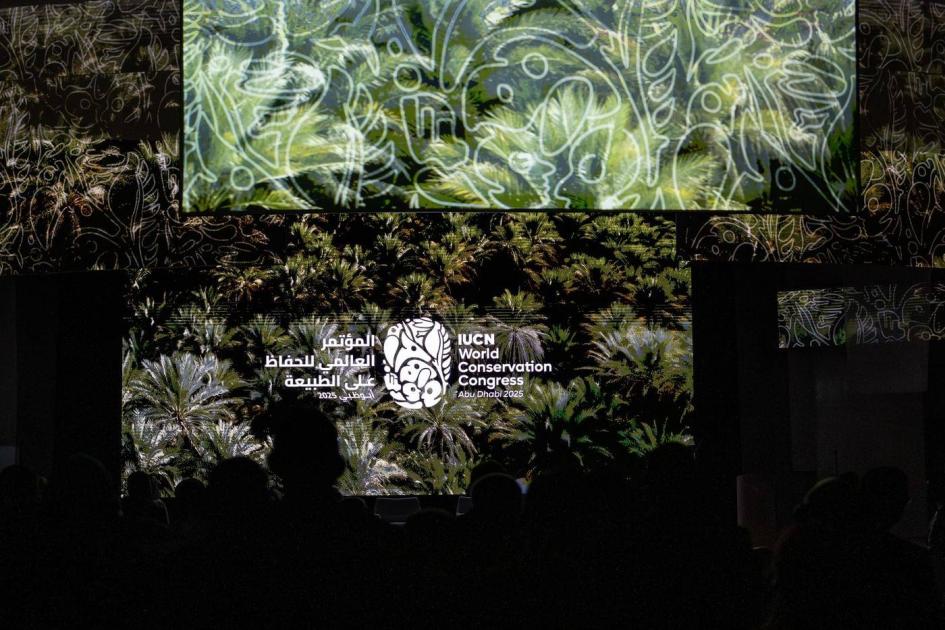
Emirati companies presented innovative projects at the Global Nature Conservation Conference, reflecting the UAE’s commitment to environmental protection and sustainability, emphasizing the private sector’s role in developing future solutions to preserve natural resources and support ecological balance.
Yassine Ait Kaci, co-founder of the “ELYX” Foundation and the Future of Culture Soft Power Agency in the UAE, stated that the foundation is showcasing the “Archipel” project, which represents a fictional world filled with islands inspired by real stories. He added that these stories led to the creation of a set of carbon credits in the Mediterranean region, which were traded in financial markets last summer.
Meanwhile, Taha Ghaznawi, CEO of Products and Technical Services at the Emirati company “Nabat”, explained that the company offers a unique experience through a series of screens displaying a tank containing real mangroves, relying on technology as an effective tool to support environmental conservation efforts.
A new collaboration was announced with the “Yas Sea World Research and Rescue” center to implement a pioneering project to monitor marine life and seagrass.
“Terra”, the sustainability center at Expo Dubai City, showcased the ability of cities to enhance urban biodiversity in arid environments and presented a practical model for how natural life can thrive in harsh urban areas. It highlighted its educational and community initiatives aimed at restoring ecological balance within cities, including the “100 Cells” program, which transforms schools into miniature ecosystems supporting bee pollinators.
Dr. Julia De Masi, Associate Professor in the Department of Science and Engineering at Sorbonne University Abu Dhabi and lead researcher at the Sorbonne AI Center, said the university participates in the conference’s official sessions by organizing a panel discussion on sustainability and climate change challenges, focusing on the relationship between science and policy. She explained that the panel particularly focuses on the role of mangrove trees, which are of great importance for the UAE’s climate future, with participation from international experts in mangrove biology, related policies, and the role of technology in restoring these ecosystems and monitoring policy implementation.
She pointed out that the university organizes a workshop in collaboration with the “Archipel” project highlighting the role of technology in biodiversity monitoring, with participation from international experts on cetaceans off the UAE coasts and experts from “M42”, alongside its involvement in discussions with other pavilions about the role of the next generation in preserving the natural environment and instilling values of environmental protection in new generations to ensure the sustainability of the UAE’s natural beauty.
(WAM)


Recommended for you
Al-Jaghbeer: The Industrial Sector Leads Economic Growth
Talib Al-Rifai Chronicles Kuwaiti Art Heritage in "Doukhi.. Tasaseem Al-Saba"
Exhibition City Completes About 80% of Preparations for the Damascus International Fair Launch
Unified Admission Applications Start Tuesday with 640 Students to be Accepted in Medicine
Egypt Post: We Have Over 10 Million Customers in Savings Accounts and Offer Daily, Monthly, and Annual Returns
His Highness Sheikh Isa bin Salman bin Hamad Al Khalifa Receives the United States Ambassador to the Kingdom of Bahrain