






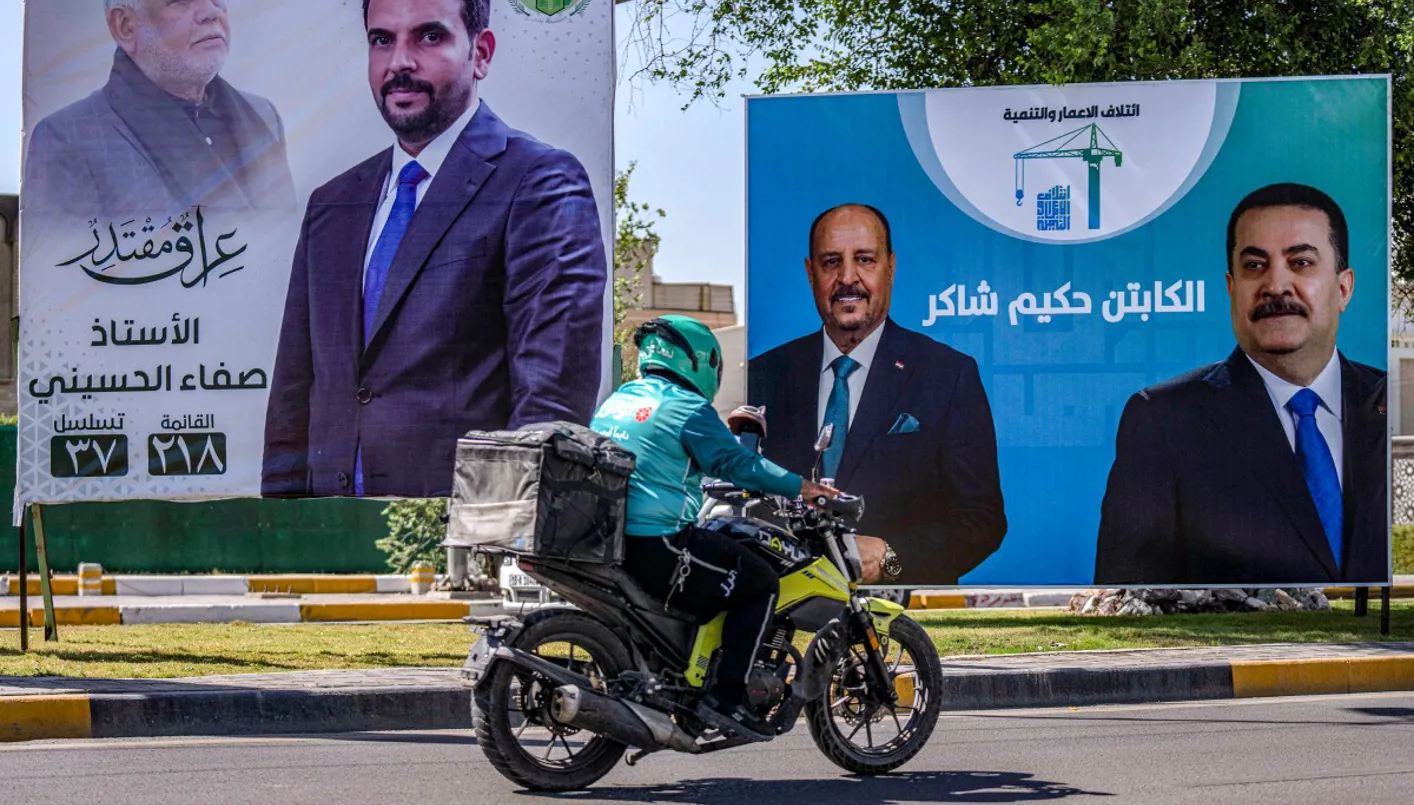
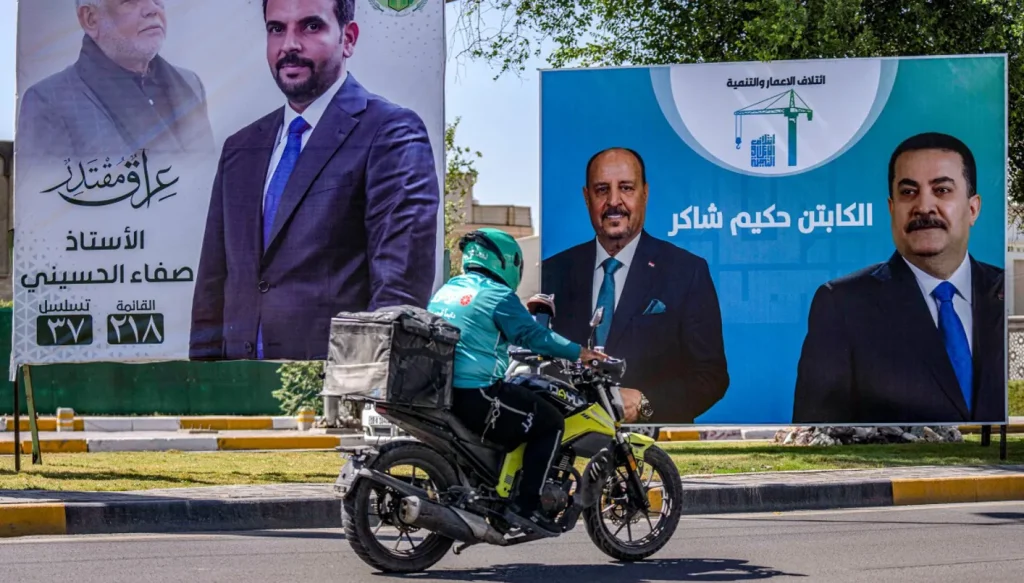
Election billboards for candidates and competing blocs in the upcoming Iraqi parliamentary elections. (AFP)
As the date for the upcoming parliamentary elections, scheduled for November 11, approaches, political stances within Iraqi political forces are accelerating, preparing the ground for a decisive electoral battle that could redraw the balances within the political scene. While the “Reconstruction and Development” coalition raises its expectations of securing a “second term” for Prime Minister Mohammed Shia’ Al-Sudani, other voices inside and outside the Shia house downplay the chances of this scenario, warning of internal divisions and hidden conflicts that could disrupt post-election arrangements.
Reconstruction and Development: Close to a Second Term
Firas Al-Muslimawi, spokesperson for the “Reconstruction and Development” bloc, believes that the service activity of Al-Sudani’s government, which has completed “9,000 projects across Iraq,” qualifies it to top the results of the upcoming elections.
Al-Muslimawi told “An-Nahar” that he expects the participation rate to exceed 50%, contrary to expectations betting on not exceeding 30% due to possible popular boycott driven by religious and civil currents.
He added that his coalition will be the top electoral list in Iraq, expecting the bloc to win between 80 and 90 parliamentary seats, making Al-Sudani, according to him, the closest to achieving a “second term.”
A Difficult Task
However, MP Jawad Al-Yasiri believes that the “Shia-Shia division” within the Coordination Framework will make the task of selecting the next prime minister “highly complicated.”
Al-Yasiri explained to “An-Nahar” that there is a clear divergence in positions and political visions as the elections approach, pointing to fierce competition among political wings within the Coordination Framework over leadership and managing the next phase, which will negatively affect the unity of position regarding nominating the next prime minister or agreeing on a selection mechanism.
He added that “the continuation of division within the Shia house will weaken the negotiating position and make forming the next government a more difficult and complex task than ever before.”
The PUK Awaits Election Results
Meanwhile, MP Mohammed Khalil from the Kurdistan Democratic Party (KDP) rules out a “second term for Al-Sudani,” expressing his belief that the upcoming elections will produce “a change in political equations.”
In contrast, party leader Wafa Mohammed points out that the electoral chances of the PUK are based on “its struggle history,” in addition to the successes achieved by Masrour Barzani’s government in the region through major vital projects during the past period.
Mohammed told “An-Nahar” that the KDP always achieves the highest votes in the Kurdistan Region areas, noting that alliances will be determined after the elections with any party that meets the constitutional and legal demands of the region.
Badr Proposes a Candidate for Prime Minister
The Badr parliamentary bloc is preparing to participate with a separate list in the elections.
Badr bloc leader Moein Al-Kadhimi explained that the Coordination Framework will not get less than “180 seats in the worst scenarios,” hinting that the next prime minister could be from Badr.
According to an informed source inside the Badr Organization, the organization’s leader Hadi Al-Amiri is pushing the bloc’s number one candidate in Baghdad, Mohammed Al-Ghaban, for the prime ministership, while the other candidate will be Qasim Al-Araji, Iraq’s National Security Advisor, who has good relations with Iran and officials in the US administration.
Meetings and Electoral Coordination
Last Monday, the Coordination Framework held a meeting discussing several files, most notably the elections, according to a statement from the framework.
The statement explained that the meeting, held at the office of the head of the Wisdom Movement, Ammar Al-Hakim, discussed regional developments and efforts to calm Gaza, and their reflections on regional and internal security, as well as ways to proceed with holding the elections on their scheduled date.
The following day, the city of Erbil witnessed a meeting between Kurdistan Democratic Party leader Masoud Barzani and Mr. Al-Hakim, in a movement linked to the heated electoral race.
Recommended for you
Talib Al-Rifai Chronicles Kuwaiti Art Heritage in "Doukhi.. Tasaseem Al-Saba"
Exhibition City Completes About 80% of Preparations for the Damascus International Fair Launch
Al-Jaghbeer: The Industrial Sector Leads Economic Growth
Unified Admission Applications Start Tuesday with 640 Students to be Accepted in Medicine
Egypt Post: We Have Over 10 Million Customers in Savings Accounts and Offer Daily, Monthly, and Annual Returns
His Highness Sheikh Isa bin Salman bin Hamad Al Khalifa Receives the United States Ambassador to the Kingdom of Bahrain