








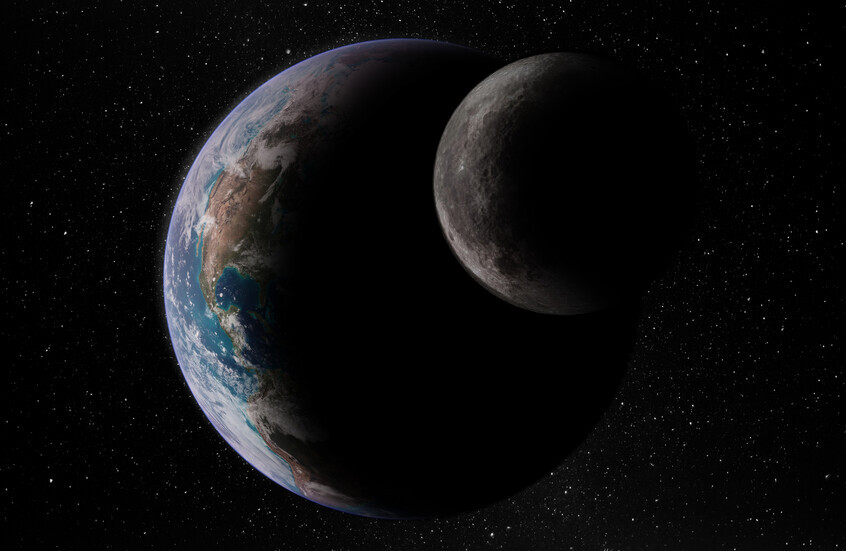
By reflecting laser beams off the mirrors left by astronauts on the Moon’s surface, scientists can measure the distance between the two celestial bodies with unprecedented accuracy.
Behind this slow and steady movement lies a fascinating scientific story related to the phenomenon of tides. The Moon’s gravity does not affect all parts of the Earth equally; its strength varies from one side to another. This difference causes two tidal bulges in the oceans, one on the side of the Earth facing the Moon and the other on the opposite side (the far side of the Earth from the Moon).
As the Earth rotates on its axis, these water bulges slightly lead the Moon’s position due to the planet’s relatively fast movement. This slight lead creates a gentle gravitational pull that pulls the Moon forward in its orbit, increasing its speed and gradually expanding its orbit.
This process is similar to a baseball player hitting the ball harder, causing it to fly higher into the sky.
This continuous movement has important consequences for our planet. As the Moon’s momentum increases, the Earth’s rotation slows down to compensate for this increase, leading to a very slight lengthening of the day. Scientific evidence from fossil studies indicates that the day lasted only 23.5 hours 70 million years ago, during the age of the dinosaurs.
Going back 4.5 billion years, the Moon was much closer to the Earth, having formed as a binary system after a massive celestial body collided with Earth. The Moon appeared larger in the sky of the early Earth. In the distant future, this trend may cause the Earth’s rotation to slow until it synchronizes with the Moon’s orbit, but the Sun’s future expansion will prevent this process from completing.
Despite the enormity of these cosmic changes, they are very slow and do not affect our daily lives. The length of the day will remain 24 hours, and Earth’s inhabitants will enjoy tidal phenomena and eclipses for millions of years to come. These slow astronomical processes remind us of the universe’s grandeur and the precision of its laws, revealing a continuous story of interaction between the Earth and its slowly receding Moon, which remains a witness to the wonders of the never-ending cosmos.



Recommended for you
Talib Al-Rifai Chronicles Kuwaiti Art Heritage in "Doukhi.. Tasaseem Al-Saba"
Exhibition City Completes About 80% of Preparations for the Damascus International Fair Launch
Al-Jaghbeer: The Industrial Sector Leads Economic Growth
Unified Admission Applications Start Tuesday with 640 Students to be Accepted in Medicine
Egypt Post: We Have Over 10 Million Customers in Savings Accounts and Offer Daily, Monthly, and Annual Returns
His Highness Sheikh Isa bin Salman bin Hamad Al Khalifa Receives the United States Ambassador to the Kingdom of Bahrain