










In today’s British press roundup, The Telegraph publishes an article predicting the failure of Donald Trump’s peace plan in Gaza, The Guardian warns Europe about the consequences of the decline of democracy in the United States, and The Times covers last week’s Russian drone attack on Denmark.
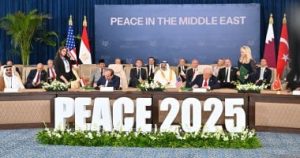
Starting with The Telegraph, Con Coughlin writes that the real obstacle to the success of Donald Trump’s latest peace plan in Gaza is not Hamas but the Palestinian leadership in the West Bank, according to the author.
The writer states that if Hamas agrees to Trump’s plan with its twenty points, its supporters will be pardoned, and the movement will have no role in future negotiations about establishing a Palestinian state.
Consequently, this task will shift to the Palestinian Authority, run by veterans of the PLO, who, according to the author, will be as stubborn as Hamas when it comes to agreeing on a peace settlement with Israel.
He noted that despite Palestinian Authority President Mahmoud Abbas welcoming Trump’s plan, “we still have to see how serious Mahmoud Abbas is about engaging in the dialogue the American president wants.”
He added: “If history is a guide, the signs are not good.”
The writer reminded that Jerusalem’s Mufti Amin al-Husseini rejected the UN’s 1947 two-state solution proposal. According to the author, successive generations of Palestinian leaders have rejected all attempts to establish an independent Palestinian state.
The Telegraph states that even if Trump succeeds in excluding Hamas from any future negotiations, there is no hope that Palestinian leaders described as “moderates” like Mahmoud Abbas will make a positive contribution to the peace process.
Coughlin said the first challenge facing Mahmoud Abbas is to remove doubts about his legitimacy and that his victory in upcoming elections is not guaranteed, even with Hamas banned from participation.
He pointed out that the biggest problem facing Trump and other supporters of diplomatic efforts to break the deadlock in the Palestinian issue lies in Mahmoud Abbas’s “unrealistic” expectations, according to the author, such as his desire for the Palestinian Authority to govern Gaza after the war, which the writer sees as a direct challenge to Trump’s plan to form a “Peace Council.”
The writer concluded by saying that even with Hamas excluded, the Trump administration must realize that finding Palestinian leaders genuinely committed to resolving the conflict will not be an easy task.
The Guardian addressed the internal situation in the United States under Trump. The article’s author, Alexander Hirst, criticized the current American president, describing his rule as fascist.
The writer pointed out that the Trump administration deployed the US Army and National Guard against the will of state governors.
He said the administration also exerted “pressure on legislatures to disenfranchise opposing voters by unusual means.”
The author also accused the current administration of imposing “book censorship” and “intimidating the media.”
Hirst said that last year, “while Trump and his backers dismantled American democratic institutions, European discourse finally shifted from denial to bargaining.”
The writer saw that European leaders’ reluctance to openly discuss this issue with voters stems from fear that “Trump’s alienation, even slightly, could lead to abandoning American support for Ukraine.”
He added: “There was almost no room for high-level, public dialogue about what to do when the American government in the foreseeable future is in the hands of actors hostile to the essence of the European Union and its core values.”
Hirst said: “In Trump’s first term, we heard that his words should be taken seriously but not literally. That was wrong then and is wrong now.”
Now, according to The Guardian article, “when Trump says, ‘I hate my opponent and don’t want good for him,’ we in Europe must take his words literally.”
The author considered that the “extreme authoritarian agenda” pursued by the Trump administration concerns Europe, noting that the US “uses the criminal justice system to retaliate against opponents on the president’s orders.”
He pointed out that this necessarily affects European democracy. The author accused the Trump administration of engaging in a cultural war against Europe by promoting “forces seeking to destroy it in its current form.”
The Times recalled the flight of Russian drones over military areas, bases, and airports last week, including the capital Copenhagen, which disrupted air traffic.
The article’s author, Edward Lucas, noted that Denmark was rapidly rearming and is one of Ukraine’s strongest supporters, which “fuels Russia’s anger.” However, he added that Denmark was “asleep at the wheel” when it came to its internal security.
The writer said Denmark delayed taking serious security measures after banning all drone flights, calling up reservists, and bringing in specialized air defense units from neighboring countries and Ukraine.
The author added that such measures are “very costly, unsustainable, very limited, and very late.”
Lucas continued: “Russia will simply wait or try again or adapt its tactics,” noting that investigators believe the drones were launched from commercial ships in international territorial waters. He added: “If so, their crews and owners have completely escaped punishment.”
The author said the Europeans’ plan to build a drone wall seems good, but, he added, it might be easy to circumvent.
He saw that the “eastern NATO guard is ineffective,” composed of air defense capabilities “put together hastily, costly, and unable to reliably handle the threat.”
The Times writer said, “We need real deterrence, not fake defense.”
He continued: “While we hesitate, the initiative remains in Vladimir Putin’s hands, who can change the pace, scope, intensity, and targets of attacks, amplify them with cyber warfare, and combine them with other tactics such as propaganda.”
He added: “Expect Kremlin-backed messages like: Stop supporting Ukraine and your life will return to normal.”
The writer repeated Danish Prime Minister Mette Frederiksen’s phrase during the attack: “This may be just the beginning.”
The author said: “Russia’s behavior will not change until we stop it. This requires difficult and risky steps from all parties.”
He recalled the Danish Prime Minister’s praise for her country’s Ukrainian allies’ expertise, “strong and battle-hardened in defense battles,” concluding: “We need their offensive game too.”


Recommended for you
Talib Al-Rifai Chronicles Kuwaiti Art Heritage in "Doukhi.. Tasaseem Al-Saba"
Exhibition City Completes About 80% of Preparations for the Damascus International Fair Launch
Al-Jaghbeer: The Industrial Sector Leads Economic Growth
Unified Admission Applications Start Tuesday with 640 Students to be Accepted in Medicine
Egypt Post: We Have Over 10 Million Customers in Savings Accounts and Offer Daily, Monthly, and Annual Returns
His Highness Sheikh Isa bin Salman bin Hamad Al Khalifa Receives the United States Ambassador to the Kingdom of Bahrain