






Hamas, which was severely weakened during the war according to observers, has sought to reaffirm its strong position in the Gaza Strip since the ceasefire took effect, killing at least 32 people in a security campaign against groups that challenged its authority.
The movement appeared to have received U.S. approval to undertake a temporary security role in the devastated territory.
Two security sources in Gaza said Hamas has gradually redeployed its men in the streets since the ceasefire began on Friday, exercising caution in case it collapses suddenly.
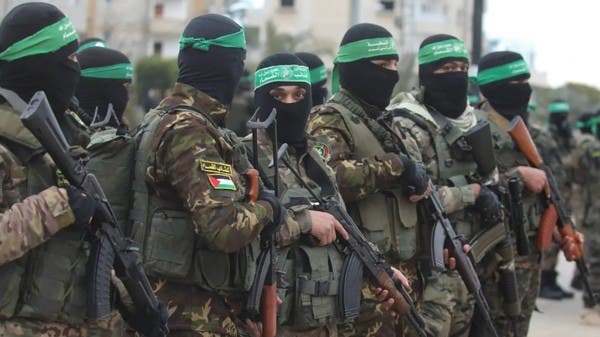
On Monday, Hamas deployed members of the Izz ad-Din al-Qassam Brigades, its military wing, during the release of the remaining living prisoners it had held for two years after an attack that sparked the war.
This served as a reminder of one of the biggest challenges facing U.S. President Donald Trump’s efforts to establish a sustainable Gaza agreement amid demands by the U.S., Israel, and other countries to disarm Hamas.
Reuters footage showed dozens of Hamas fighters lined up at a hospital in southern Gaza, one wearing the “Shadow Unit” badge, which Hamas sources say is responsible for guarding prisoners.
One Gaza security official said that since the ceasefire, Hamas forces killed 32 members of a “gang belonging to a family in Gaza City,” while six of its members were also killed.
Later on Monday, a video circulated on social media showing several masked gunmen, some wearing green headbands similar to those worn by Hamas, firing automatic weapons at at least seven men after forcing them to kneel in the street.
Posts identified the video as filmed in Gaza today. Civilian onlookers shouted “Allahu Akbar” and described the victims as “collaborators.”
The events, date, and location of the video have not yet been verified. Hamas has not yet responded.
Last month, Hamas-led authorities said they executed three men accused of collaborating with Israel. The public execution video was posted on social media.
Temporary Role?
Trump’s plan envisions Hamas stepping down from power in Gaza, disarmed, and governed by a Palestinian committee under international supervision. The plan also calls for deploying an international stabilization mission to train and support Palestinian police forces.
But Trump hinted in remarks made en route to the Middle East that Hamas had been given the green light to temporarily perform police duties in the territory.
Responding to a reporter’s question about reports that Hamas targets its opponents and sees itself as a police force, Trump said, “They really want to stop problems and they are open in this regard and we gave them approval for a period of time.”
After the ceasefire took effect, Ismail Thawabta, director of the Hamas-run Gaza Government Media Office, told Reuters the movement would not allow a security vacuum and would maintain the safety of people and property.
Hamas ruled out discussing its arsenal and said it would be ready to hand over weapons to a future Palestinian state. It added it does not seek a role in the authority that will govern Gaza in the future but that this must be agreed upon by Palestinians without foreign control.
Conflict with Opponents
As the war dragged on, Hamas faced increasing internal challenges to its control of Gaza from groups long at odds with it and linked to local clans.
Israeli Prime Minister Benjamin Netanyahu said this year that Israel arms clans opposing Hamas without specifying which ones.
Residents in Gaza and Hamas sources say clashes in Gaza City mainly occurred between Hamas and members of the Daghmash family.
A Hamas security official did not specify the clan or family targeted by the movement in Gaza City, nor did he disclose whether they were suspected of receiving Israeli support.
One of the most prominent anti-Hamas clan leaders is Yasser Abu Shab in the Rafah area, which Israel has not yet withdrawn from.
A source close to Abu Shab told Reuters this year that the group attracted hundreds of gunmen due to offering attractive salaries.
Hamas describes Abu Shab as a collaborator with Israel, which he denies.
The Gaza security official said separate clashes led to “the liquidation of one of the most dangerous criminal agents and wanted men, who was the right-hand man of the agent/Yasser Abu Shab, where he was liquidated and killed. Currently, efforts are underway to personally eliminate Abu Shab soon.”
Abu Shab has not yet responded to questions about the security official’s statements. The reported killing of his aide has not been independently verified.
Hossam Al-Astal, also an opponent of Hamas in Khan Yunis in areas controlled by Israel, sharply criticized the movement in a recorded message on Sunday, saying its role and rule would end in the territory once it hands over the prisoners.
Observers said Hamas’s actions aim to deter groups that collaborated with Israel and contributed to insecurity during the war, and also seek to show the necessity of including its security personnel in any new Gaza government, a move Israel would reject.


Recommended for you
Al-Jaghbeer: The Industrial Sector Leads Economic Growth
Egypt Post: We Have Over 10 Million Customers in Savings Accounts and Offer Daily, Monthly, and Annual Returns
Alternative to UNIFIL Forces
Talib Al-Rifai Chronicles Kuwaiti Art Heritage in "Doukhi.. Tasaseem Al-Saba"
Exhibition City Completes About 80% of Preparations for the Damascus International Fair Launch
Trump Advisor: Disarming Hamas is Central.. Palestinian Authority to Take Over Gaza After Required Reforms