






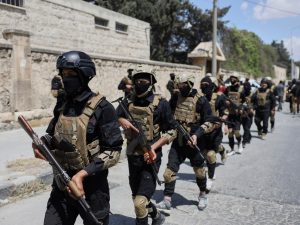




Pakistan expands its “nuclear umbrella” to include Saudi Arabia.
The Hebrew website indicated that Egypt is “dissatisfied” with the joint defense agreement signed on September 17 during Pakistani Prime Minister Shehbaz Sharif’s visit to Riyadh, suggesting that this rapprochement could “actually hinder” the implementation of the idea of creating something like an “Islamic NATO,” which Egypt has called for since 2015.
The report added that the signing of the agreement sparked controversy in Egypt over why Riyadh prefers Pakistan as a defense partner instead of Cairo, especially following the Arab Islamic Summit held in Doha on September 16, where Egyptian President Abdel Fattah el-Sisi called for establishing a mechanism to coordinate security and defense issues among Arab and Islamic countries.
The site quoted an anonymous Facebook post dated September 18: “The Kingdom must provide a convincing justification for ignoring discussions of the Joint Arab Defense Agreement at the Doha Summit,” pointing to Saudi Arabia’s refusal to discuss the idea of a “Unified Arab Army” proposed by Egypt in 2015. The report also included other comments questioning: “Why didn’t the Saudis sign an agreement with Egypt?” and “Why don’t they build a strong Saudi army?”
According to the report, the mutual strategic defense treaty signed by Riyadh and Islamabad stipulates that any aggression against either party is considered aggression against both, aiming to enhance mutual deterrence and military cooperation. The agreement is based on nearly eight decades of bilateral relations, which included mutual support at several historical junctures, most notably Pakistan sending forces to the Kingdom after the Iranian Revolution in 1979.
“Natsiv Net” noted that this development comes amid escalating regional tensions, especially after Israeli airstrikes targeted Hamas leaders in Doha on September 9, sparking widespread Arab anger and renewed calls to strengthen collective security, with increasing Arab public opinion leaning towards self-reliance in defense matters instead of dependence on American alliances.
Egyptian Experts: The Agreement is a Natural Extension of Deep Strategic Relations
Conversely, Egyptian experts offered a different reading of the agreement, noting that it does not marginalize any party but rather represents a natural development in deep strategic relations between Saudi Arabia and Pakistan.
Major General Osama Kabeer, advisor at the Egyptian Command and Staff College, described the agreement as “an extension of the close relations between the two countries” and a “qualitative leap in military and security cooperation paths,” affirming that its text, which considers “any aggression against one party as aggression against the other,” reflects a shared commitment to enhancing regional security.
General Kabeer told RT Arabic that relations between Saudi Arabia and Pakistan extend over more than seven decades, with Saudi Arabia being the first country to recognize Pakistan after its independence in August 1947. In 1951, a “Friendship Treaty” was signed laying the foundations for strategic, political, military, and economic cooperation.
He pointed out that military cooperation notably developed since 1967, with Saudi forces training with the Pakistani army, and more than 8,000 Saudi soldiers trained so far. The two countries also enhanced cooperation through a 1982 agreement stipulating the “sending of Pakistani armed forces elements and providing military training” in Saudi Arabia, resulting in regular joint exercises such as “Samsam.”
The military expert confirmed that this step comes amid escalating regional tensions and multiple centers of power, as the region witnesses a race to build new defense systems and alliances beyond traditional frameworks.
Call for a Broader Military Alliance Including Egypt and Turkey
General Kabeer saw an opportunity to expand this alliance to include other Arab and Islamic countries, especially Egypt and Turkey, considering them among the most prominent military powers in the Arab and Islamic world. He said, “Why not form a large military alliance between Egypt, Saudi Arabia, Pakistan, and Turkey amid escalating threats?” Considering such an alliance “would change the geopolitical balance map in the Middle East and South Asia and strengthen the Islamic alliance’s power against regional threats.”
The Agreement as a Strategic Geopolitical Shift
Meanwhile, international law professor Dr. Ayman Salama considered the agreement “a profound strategic shift in the balance of power in the region,” noting that it comes in response to Israeli military escalation and rising tensions.
Dr. Salama told RT Arabic that the real strength of the agreement lies in the “Pakistani nuclear deterrent,” which provides Saudi Arabia with an “indirect protection umbrella” in a conflict-ridden region. He pointed out that the explicit text in the agreement, stating that “any aggression against either state is aggression against both,” sends “a clear and strong message to any party thinking of threatening the interests of either.”
He described the agreement as “not just a defensive arrangement but a geopolitical alliance reflecting a shared vision of security and stability,” explaining that it combines Saudi Arabia as a regional economic and military power with Pakistan as a military and nuclear power.
Salama concluded by saying, “This agreement creates a new balance, reduces the chances of uncalculated escalation, and serves as evidence that modern defense alliances transcend traditional boundaries, and that deterrence—whether conventional or nuclear—remains the strongest tool to maintain peace.”



Recommended for you
Talib Al-Rifai Chronicles Kuwaiti Art Heritage in "Doukhi.. Tasaseem Al-Saba"
Exhibition City Completes About 80% of Preparations for the Damascus International Fair Launch
Unified Admission Applications Start Tuesday with 640 Students to be Accepted in Medicine
Al-Jaghbeer: The Industrial Sector Leads Economic Growth
Egypt Post: We Have Over 10 Million Customers in Savings Accounts and Offer Daily, Monthly, and Annual Returns
His Highness Sheikh Isa bin Salman bin Hamad Al Khalifa Receives the United States Ambassador to the Kingdom of Bahrain