







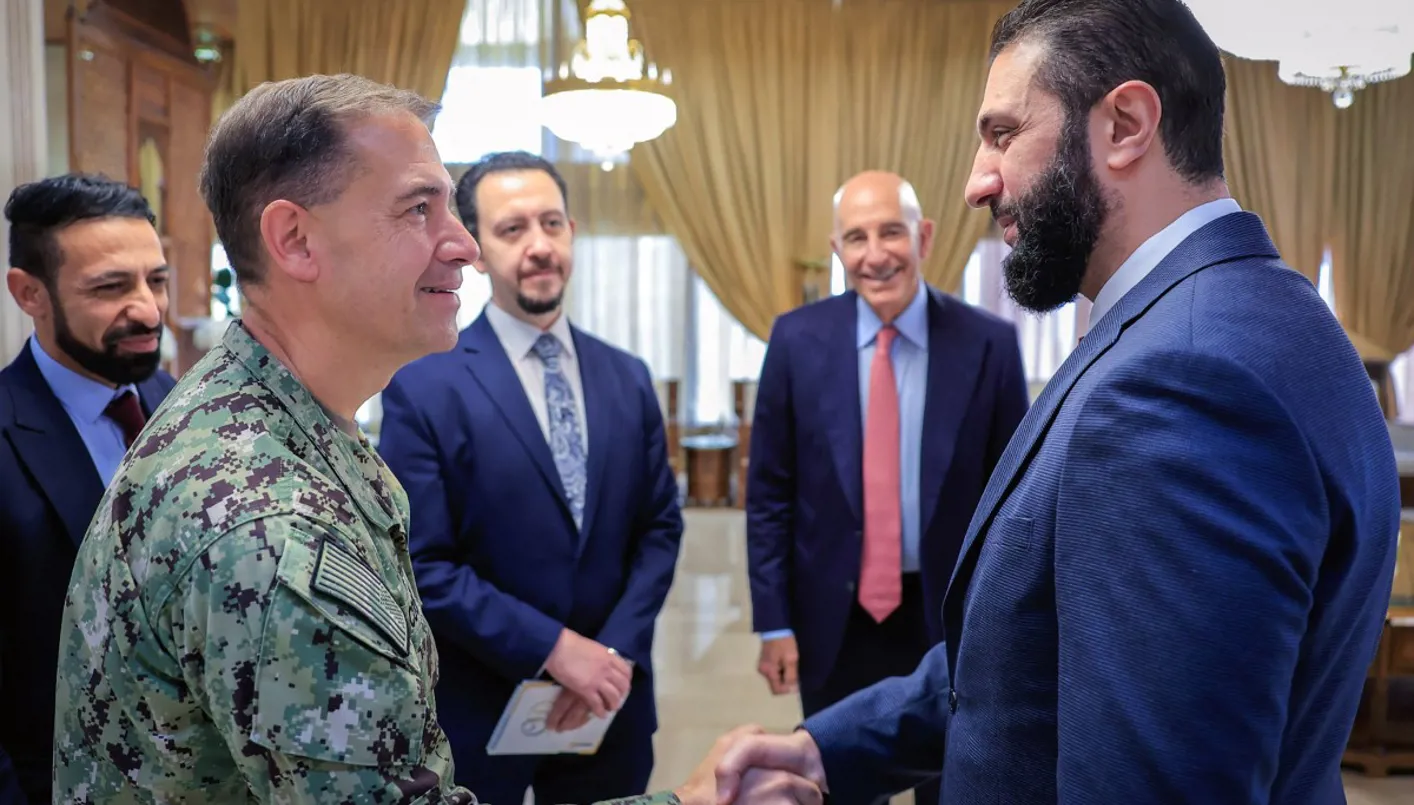
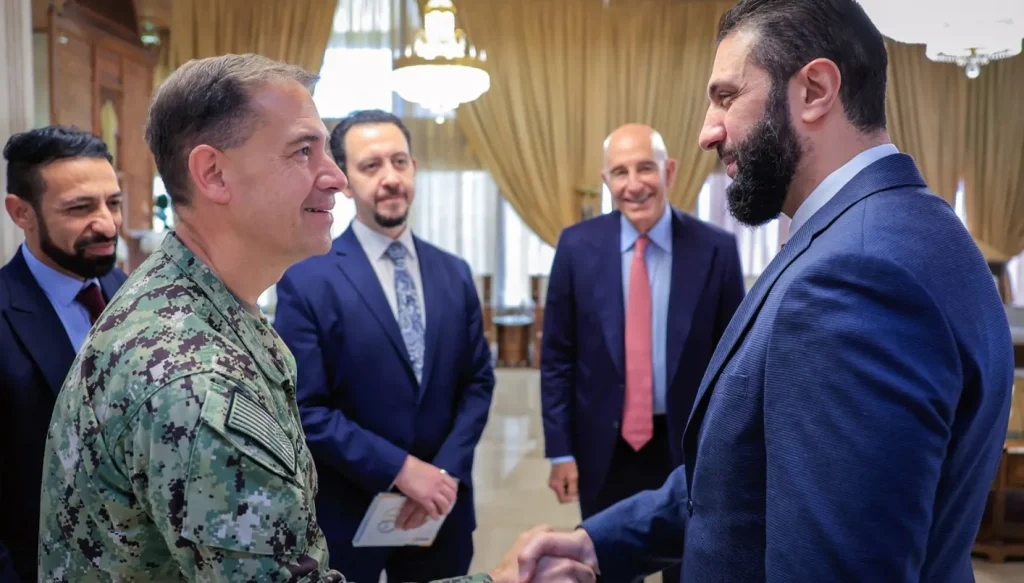
Syrian President Ahmad Al-Sharaa (right) with the US special envoy to Syria Tom Barrett (back right) and US Central Command leader Admiral Brad Cooper (left), in Damascus. (AFP)
The escalation between Damascus and the Syrian Democratic Forces (SDF) was not just a limited exchange of fire but a reflection of the core deadlock: arrangements managed on the brink of explosion, a daily tested ceasefire, and a struggle over integration between a state that does not concede and an autonomous experiment unwilling to dissolve. The fragile ceasefire following the clashes and the high-level US visit that coincided with it showed that a small disruption in the details of administration, partnership, and influence can explode the equation from within.
This did not come out of nowhere. Days before the outbreak, a political indicator emerged with news circulating that Foreign Minister Assad Al-Sheibani refused to receive Ilham Ahmed in Damascus, before a later denial stated the meeting was never scheduled. The mere spread and denial of this news reflected fragile trust and suggested that political channels became part of a messaging game and indicators of possible escalation, accompanied by mutual media campaigns on social media between supporters of both sides.
Simultaneously, field signs accumulated over about two weeks: heavy Turkish reinforcements at Qweires Airport raised suspicions and fears, compulsory conscription decisions were exploited to accuse the SDF of arbitrary arrests, raising tension in autonomous administration areas, then a drone targeted an SDF military vehicle near Deir Hafer causing injuries. These events appeared as preludes to a calculated explosion, which indeed happened with escalation initially in Deir Hafer, then closure of entrances to Sheikh Maqsoud and Ashrafieh and limited clashes ending with an agreement on a ceasefire without publishing details or conditions.
Meanwhile, civilians remained the weakest link, forced each time to bear the consequences of siege, road closures, and service interruptions.
In this climate, the US presence added a layer of ambiguity more than definitive answers. Envoy Tom Barrett spoke of “great momentum” and “an opportunity for Syrian unity,” and Mazloum Abdi confirmed “working for a peaceful and prosperous future.” However, this reassuring language did not answer the fundamental question: what unity? Under what framework? What added to the ambiguity was that Barrett usually did not move beyond the Syrian capital, so his visit to the east carried contradictory messages between warning and support.
In this context, the ceasefire stabilization came as a daily test framework, not an end to the conflict. The remaining three months until the end of the year, during which Barrett promised to form a central government representing everyone, are likely the most dangerous phase of the transitional stage, mixing fears of escalation with hopes for calm.
Behind this fragile calm, Damascus will redefine integration in a more centralized form, while the SDF seeks integration without dissolution — turning geography into spaces measured in meters rather than general maps.
Nevertheless, Damascus and the SDF do not alone determine the framework; its continuation or collapse depends on regional and international calculations: Turkey mixes direct pressure and proxy tactics to keep the SDF defensive and restrict its margin, the US maintains general red lines and allows temporary field equations, while Russia, which has recently increased its presence in the Syrian file, keeps its channels open within a broader vision not yet clear, especially after the Netanyahu-Putin understanding on the necessity of Syria’s stability.
In the near term, no comprehensive solution is in sight, but rather temporary crisis management through small steps: additional road openings, calming friction points in Aleppo and around Tishrin Dam, agreed control of deployments, while Damascus strengthens its supervision over service and financial facilities without overthrowing the remaining local administration. However, this balance is fragile and could collapse if mediations slow or parties see increased pressure as yielding greater gains at the negotiation table.

Recommended for you
Talib Al-Rifai Chronicles Kuwaiti Art Heritage in "Doukhi.. Tasaseem Al-Saba"
Exhibition City Completes About 80% of Preparations for the Damascus International Fair Launch
Al-Jaghbeer: The Industrial Sector Leads Economic Growth
Unified Admission Applications Start Tuesday with 640 Students to be Accepted in Medicine
Egypt Post: We Have Over 10 Million Customers in Savings Accounts and Offer Daily, Monthly, and Annual Returns
His Highness Sheikh Isa bin Salman bin Hamad Al Khalifa Receives the United States Ambassador to the Kingdom of Bahrain