







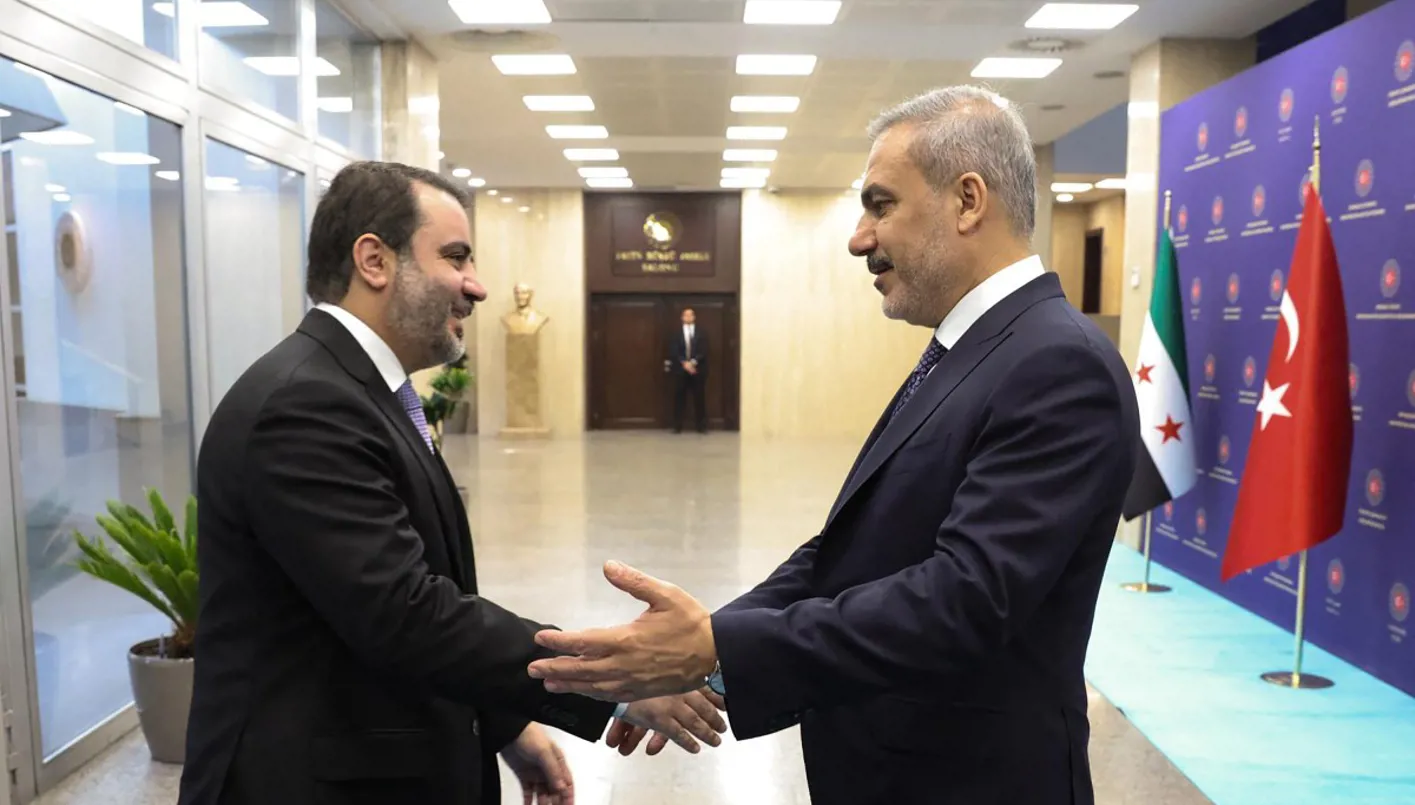
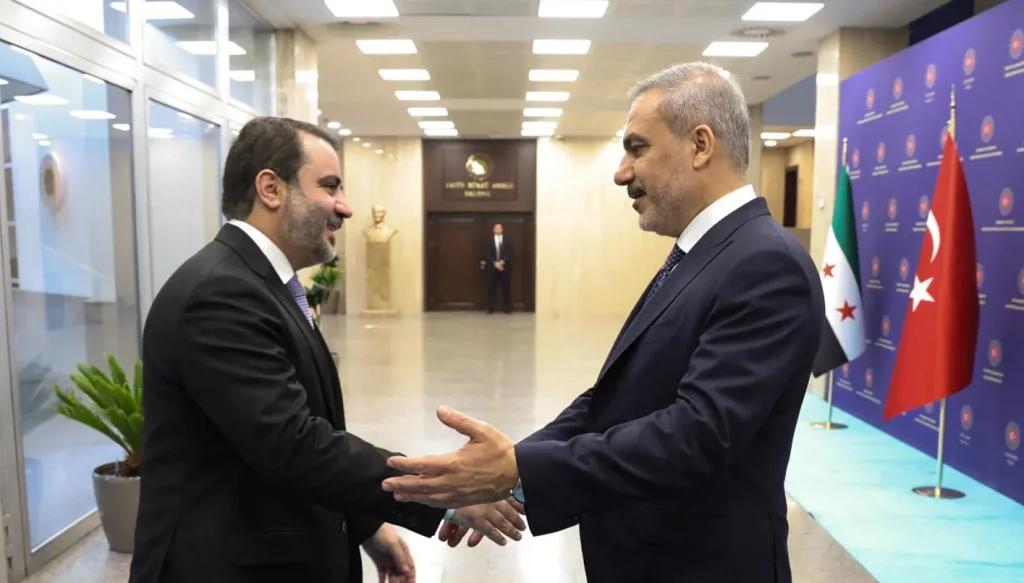
Turkish Foreign Minister Hakan Fidan shakes hands with Syrian Foreign Minister Asaad Al-Shibani in Ankara. (AFP)
Amid discussions on the Gaza file and Trump’s peace plan, Aleppo witnessed a “controlled” escalation on Monday night between Damascus-affiliated security forces and those of the Autonomous Administration in the Kurdish-majority neighborhoods of Sheikh Maqsoud and Al-Ashrafieh.
The escalation, which followed a high-level US visit to northern and eastern Syria and preceded a meeting between Autonomous Administration officials and Damascus, was followed by a brief visit by Syrian Foreign Minister Asaad Al-Shibani to Ankara, carrying dual Turkish-Syrian political and military messages.
Limited Aleppo Escalation… A Calculated Political Message
The Autonomous Administration preceded the Damascus meeting by publishing images showing the “positive atmosphere” surrounding the visit of the US delegation consisting of US envoy to Syria Tom Barrett, accompanied by US Central Command (CENTCOM) Admiral Brad Cooper, confirming Washington’s continued support for the Syrian Democratic Forces (SDF), especially the military and security wings within the US administration.
Damascus responded with escalation in Aleppo but kept the scope of clashes largely controlled, unlike previous Syrian areas such as the coast and Sweida, reinforcing the hypothesis that it was a pressure card used by the Syrian government before the Autonomous Administration delegation arrived in Damascus.
The Aleppo neighborhoods are considered a weak spot for the Autonomous Administration for several reasons:
- These neighborhoods lack any SDF presence, which withdrew according to the March 10 agreement.
- Despite the actual presence of the Autonomous Administration in the two neighborhoods, it remains fragile given that the areas are surrounded by a wide geography controlled by Damascus, with the nearest SDF-controlled area more than 50 km away.
- Damascus forces control the roads leading to the two neighborhoods, giving them the ability to impose a siege as an effective pressure tool.
Sources from the Autonomous Administration told “An-Nahar” that the Damascus meeting did not achieve real progress on the ground and did not result in any agreement signing, despite the “positive atmosphere” prevailing in the meetings.
The meeting, which did not include the US and French mediators according to “An-Nahar” sources, discussed general issues, primarily the integration of the SDF and Internal Security Forces, demands for constitutional amendments and decentralization, and practical files such as ceasefire, lifting the siege on Aleppo neighborhoods, and the return of Afrin residents.
Kurdish Accusations Against Ankara
“An-Nahar” sources indicate a convergence of views between Damascus and the Autonomous Administration regarding the integration of the SDF with US support, with emphasis on the “negative Turkish role” in this matter, while the US side appears largely focused on the Deir ez-Zor file and control of border gates.
The “negative Turkish role” insisted upon by the Autonomous Administration was also expressed by leader Badran Jia Kurd, who accused Ankara-backed “National Army” factions of not adhering to the declared truce.
Jia Kurd posted on social media that “the escalation, mobilization, and ongoing siege against the two neighborhoods (Al-Ashrafieh and Sheikh Maqsoud) confirm again that the armed factions supported by Ankara do not comply with the decisions of the interim authorities but rather implement foreign agendas that contradict Syrian national interests.”
He called on “international and regional mediators to pressure Ankara to stop its interventions in Syrian affairs and to play an active role in calming the escalation, paving the way for consensual and sustainable solutions between us and Damascus away from any external interference (…) and regional dictates and conflicts.”
Damascus Between Turkish Strictness and Pragmatic Solution
Amid these tensions, Ankara seeks to establish a new equation in northern Syria.
Recently, Turkish Foreign Minister Hakan Fidan called to “exclude the SDF from the war against ISIS,” a clear indication of Turkey’s desire to reshape the security role in northern Syria.
The United States does not yet appear ready to grant Turkey this role. Despite Turkey’s attempts to fill a potential US vacuum, it lacks the tools for stability. While speaking of fighting terrorism, it adopts rhetoric rejecting any form of Kurdish autonomous administration, putting it at odds with Washington, which recently, through Barrett, expressed openness to “sub-federal” solutions in Syria.
The Autonomous Administration, supported by broad American currents, insists that “a return to a strict centralized state is no longer possible in Syria, and decentralization is the realistic solution to preserve the country’s unity.”
This unofficial American stance contrasts with a pragmatic shift in Syrian thinking compared to Turkey’s rigid position. While Ankara demands disarming the SDF and integrating it into the Syrian army as individuals, Damascus realizes that a comprehensive military solution is impossible and that politically and economically accommodating the Kurds is the only way to avoid actual partition of the country.
The SDF forms the core of a political and military force that cannot be bypassed, and forcibly integrating it into the Syrian state would reignite conflict, while dismantling it without a regional war is almost an impossible mission.
In an article on the Washington Institute for Near East Policy website, former US envoy to Syria James Jeffrey saw the realistic solution in Syria as gradual confidence-building measures, such as handing over some Arab areas like Deir ez-Zor to joint administration, in exchange for preserving autonomy in Kurdish areas.
This proposal reflects a gradual American shift from a logic of control to one of joint administration, which could form the nucleus of a long-term political solution, even outside the framework of official Syrian state institutions.
The American bet on managing crises rather than solving them is a common denominator between Syria and Gaza. Trump seeks to use Gaza in his battle for the “Nobel Peace Prize,” while Washington continues its “strategic freeze” policy in Syria that keeps the conflict under control without settlement.
In contrast, Turkey moves as a regional power seeking a wider sphere of influence, while Damascus appears preoccupied with consolidating a more symbolic than actual presence, reflected in the joint press conference between Fidan and his Syrian counterpart through the more stringent Turkish language versus the calmer discourse of Al-Shibani.
Despite all parties speaking of political solutions, the facts on the ground suggest that “temporary stability” will remain the overarching theme for post-war Syria until larger settlements mature beyond Aleppo’s borders to a regional map redrawn from Gaza to the Euphrates.
Recommended for you
Talib Al-Rifai Chronicles Kuwaiti Art Heritage in "Doukhi.. Tasaseem Al-Saba"
Exhibition City Completes About 80% of Preparations for the Damascus International Fair Launch
Al-Jaghbeer: The Industrial Sector Leads Economic Growth
Unified Admission Applications Start Tuesday with 640 Students to be Accepted in Medicine
Egypt Post: We Have Over 10 Million Customers in Savings Accounts and Offer Daily, Monthly, and Annual Returns
His Highness Sheikh Isa bin Salman bin Hamad Al Khalifa Receives the United States Ambassador to the Kingdom of Bahrain