








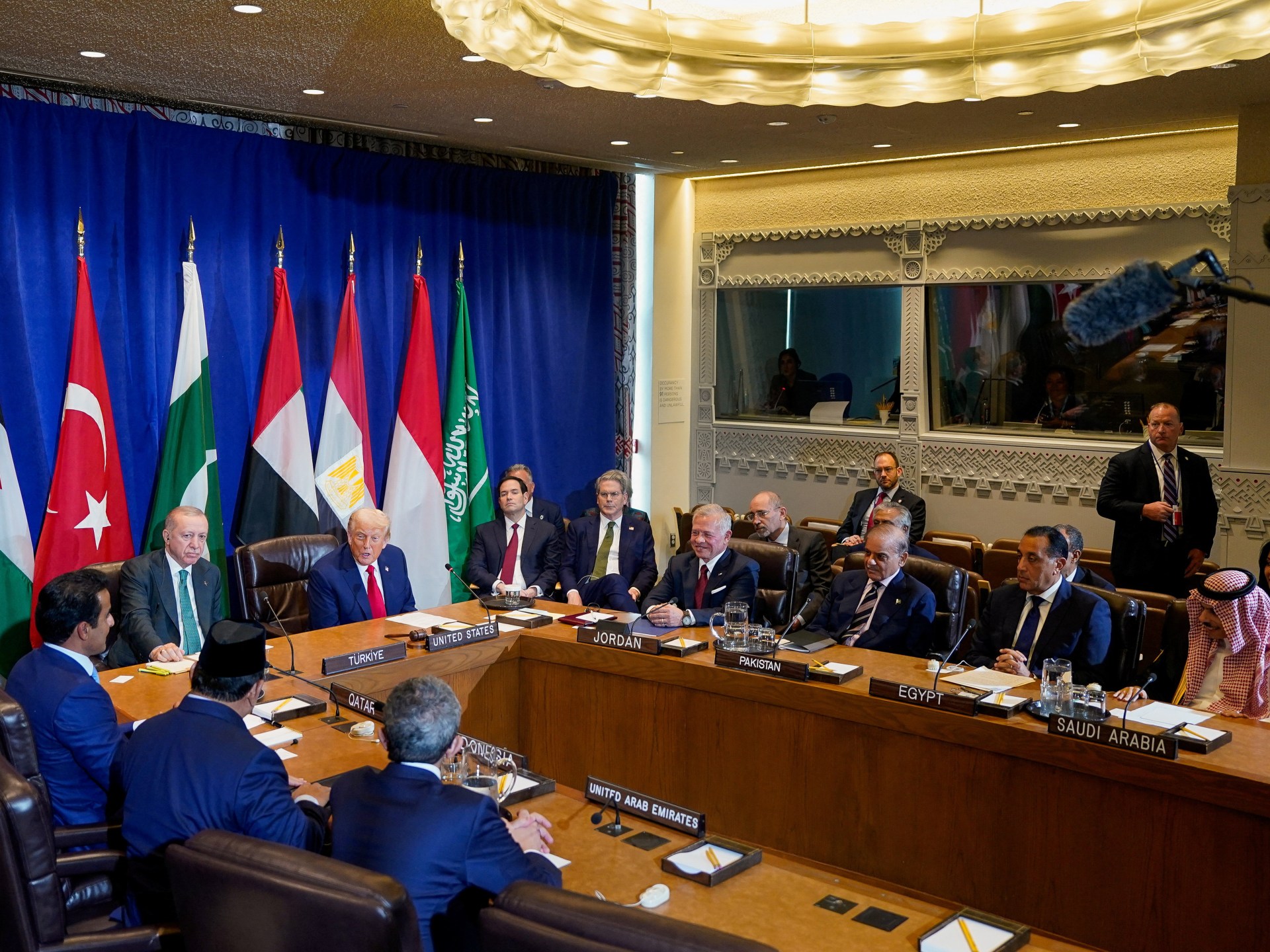
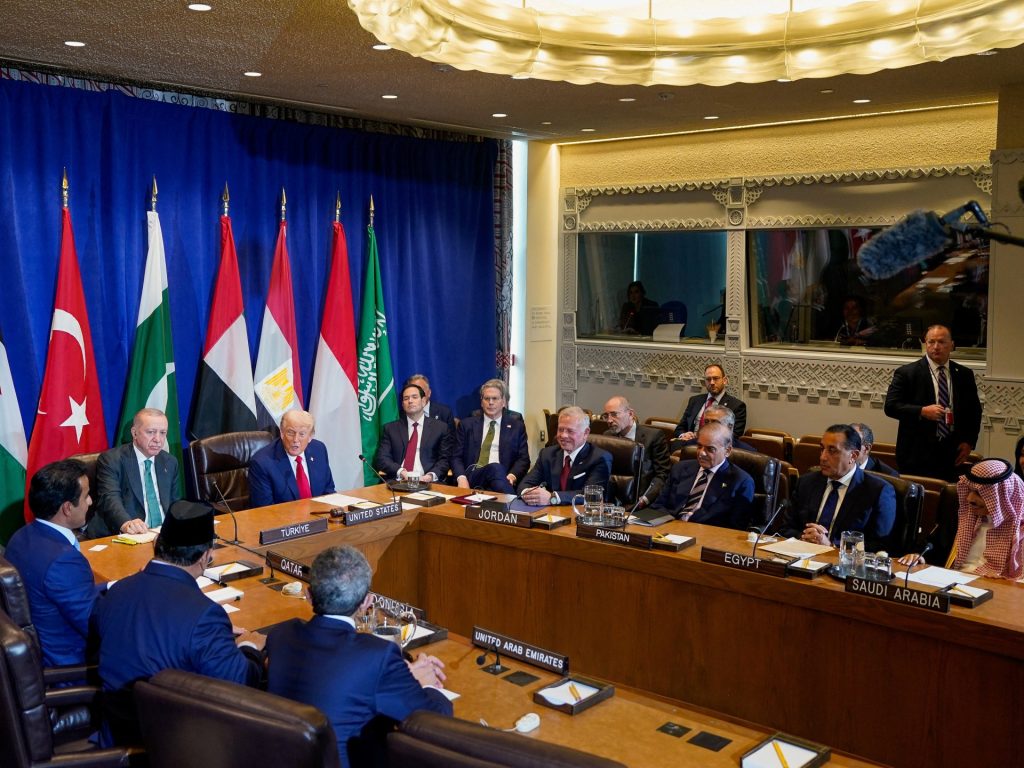
Washington – Events have accelerated since US President Donald Trump unveiled the “Plan to End the War in Gaza” on September 29, 2025, leading up to his attendance at the official signing ceremony scheduled for Monday in the Egyptian city of Sharm El-Sheikh.
Several questions arose about the significance of holding an international summit in Egypt with the participation of leaders from 20 countries, and whether this indicates the seriousness of the agreement and supports its continuation, or if it is merely a celebration of Trump himself to appease his ego after successfully achieving a ceasefire.
Trump’s swift trip to Israel and Cairo is partly a personal victory for him after the Gaza agreement he proposed and that various parties approved began implementation.
One Step
As Air Force One departed from Joint Base Andrews near Washington towards Tel Aviv, Trump told accompanying journalists that “the war is over” under the ceasefire agreement between Israel and Hamas.
Aaron Gurin, an expert at the Foundation for Defense of Democracies, known for its pro-Israel stance, disagreed with Trump’s statement that the war was over, noting that Tel Aviv and Hamas only agreed to a truce for the first phase of the 20-point US president’s plan.
In a position paper on the foundation’s website, he wrote, “There is still a need to negotiate the next phases of the ceasefire plan, including questions about whether Hamas will disarm and whether it will play a role in governing the Gaza Strip in the future. On the other hand, Israel has not yet committed to a full withdrawal from Gaza territory.”
Gurin considered that “the current ceasefire is just one step toward lasting peace. With the release of hostages, negotiations must continue to fully implement Trump’s plan, with potential sticking points between Israel and Hamas along the way.”
Ongoing talks in Egypt are likely to focus on practical next steps, and given the large trust gaps between Tel Aviv and Hamas, this will require detailed attention and focus from mediators, primarily the United States.
Since Trump and Israel expect many Arab, Islamic, and European countries to provide funding, diplomacy, and possibly security forces, these countries are presumed to have some influence in shaping the negotiation path on elements of the US president’s plan.
An Important Plan
Jacob Olidort, a former official in Trump’s first administration and an expert at the America First Policy Institute, said the plan is important, with special significance in its first phase due to Hamas agreeing to return all detainees. This represents a major shift in the war’s course, “as Hamas would have relinquished its last political lifeline, making it almost irrelevant.”
He added on the institute’s website, “Thanks to the Trump administration’s leadership, the narrative of peace has returned instead of war, and this time, with Iran and its proxies irrelevant, there is no meaningful opposition to peace now, nor an alternative.”
Fred Fleitz, an expert at the same institute, considered that “Trump’s peace plan is bold and may ultimately fail. There is work to finalize other phases of the agreement. However, it is hard to overstate the importance of Israel and Hamas agreeing to the critical first phase.”
Fleitz added, “The 20-point peace plan is a masterpiece because it gained Arab and Israeli support and provided a way to end the war with or without Hamas’s approval. If Hamas rejects it, they will have nowhere to go, and Gaza’s reconstruction and new governance will happen without them.” He affirmed that “this week’s events in the Middle East are further evidence that Trump’s second term is proving to be a truly historic presidency.”
In a post on the institute’s website, Robert Satloff, director of the Washington Institute for Near East Policy, said, “Although Trump’s entry into the White House was linked to a desire to reduce America’s commitments in the Middle East, he has now adopted a huge commitment: a peace plan that will bear his name forever.”
He added, “Reaching this stage itself is a major achievement. But ensuring effective implementation, which is not a strong point for a man of big ideas like Trump, is much harder.” Satloff considered it a mistake to think that a consulting firm or a former foreign official can fill the void that only a full US government with all its institutions can fill. This plan bears Trump’s name, not Deloitte’s or Blair’s.”
A Fundamental Task
According to Satloff, another fundamental task for Trump is to explain to the American people why their country is involved in this path. For nearly two decades, both Republican and Democratic presidents have repeatedly sought to reduce Washington’s involvement in the Middle East, yet they always found themselves at the heart of its conflicts and complex entanglements.
He continued, “Therefore, Americans deserve a clear explanation: why did a president who champions ‘America First’ decide that US interests are closely linked to the success of this peace plan? Despite internal divisions, fair-minded people on both sides of the political spectrum will encourage Trump’s success in this initiative.”
For his part, Nikolay Mladenov, former UN Special Coordinator for the Middle East Peace Process and currently an expert at the Washington Institute for Near East Policy, said, “Trump’s 20-point plan succeeded in applying US diplomatic pressure to end the war. The American leadership gave credibility to the process within the support formed by a broad Arab and Islamic coalition for its success.”
In his view, the plan not only meets urgent humanitarian needs but also forms a consensus to seek new governance in Gaza with increased regional participation.
Stephen Cook, an Arab relations expert at the Council on Foreign Relations, explained that Trump sees the hostage deal as the end, and the current challenge is to implement his 20-point plan.
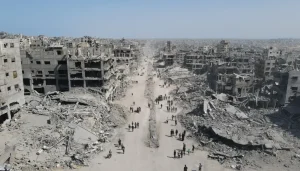
With the difficulty of quickly reaching agreements on many details related to later phases of the plan, such as Gaza governance, Israeli troop withdrawal, and Hamas disarmament, the US president did not provide details or delve into the next implementation stages, focusing instead on repeating that “everyone is very excited about this moment at the right time. This is a very special event.”
In response to a question about the possibility of visiting Gaza, Trump said he ultimately wants to visit Gaza itself but did not specify any timeline. He said, “I would be proud of that; I would like to set foot there at least.”

Recommended for you
Talib Al-Rifai Chronicles Kuwaiti Art Heritage in "Doukhi.. Tasaseem Al-Saba"
Exhibition City Completes About 80% of Preparations for the Damascus International Fair Launch
Al-Jaghbeer: The Industrial Sector Leads Economic Growth
Unified Admission Applications Start Tuesday with 640 Students to be Accepted in Medicine
Egypt Post: We Have Over 10 Million Customers in Savings Accounts and Offer Daily, Monthly, and Annual Returns
His Highness Sheikh Isa bin Salman bin Hamad Al Khalifa Receives the United States Ambassador to the Kingdom of Bahrain