








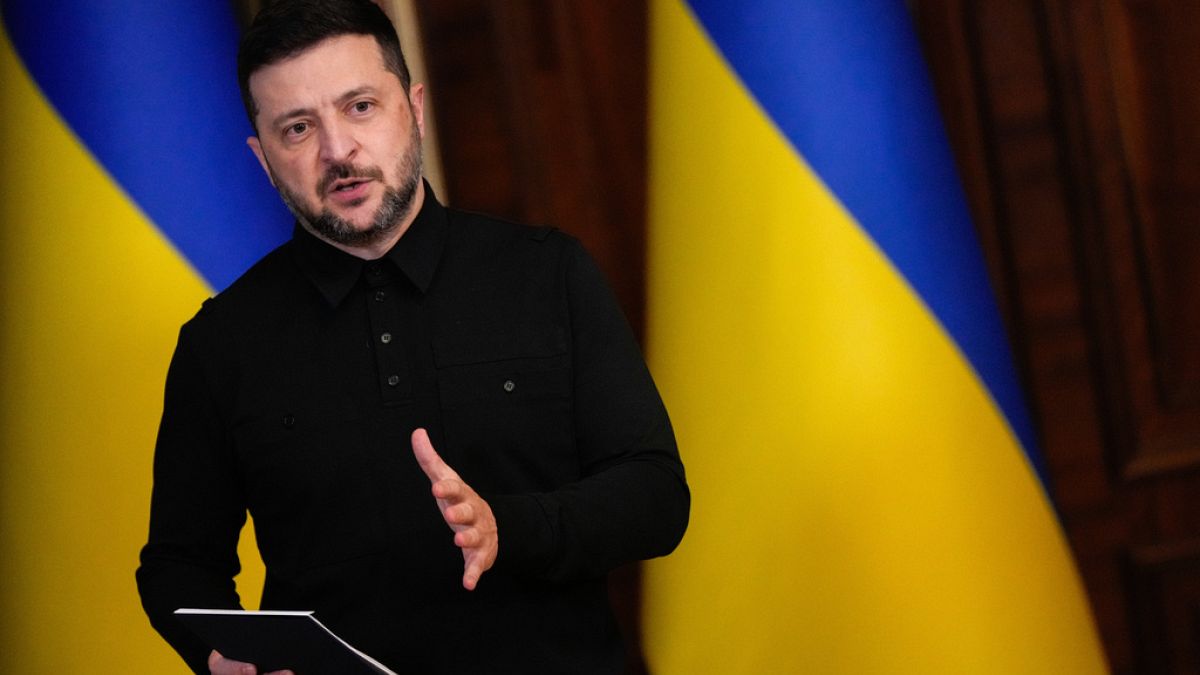
U.S. President Donald Trump revealed on Sunday that his Ukrainian counterpart Volodymyr Zelensky requested Tomahawk missiles during a phone call on Saturday as the two sides discussed new arms supplies for Kyiv.
This week, Ukrainian President Volodymyr Zelensky is visiting Washington to push military and strategic cooperation with the United States to a new level amid increasing Russian pressure on Ukraine’s infrastructure ahead of winter.
During a joint press conference in Kyiv with EU foreign policy chief Kaja Kallas, Zelensky announced his intention to meet U.S. President Donald Trump, expressing hope the meeting would take place on Friday. He said, “We need to discuss a series of measures I want to propose to the president,” without detailing them.
He indicated that his schedule in Washington would include meetings with other officials, including representatives from military companies and members of Congress, emphasizing that “the main issue will be air defense,” but also mentioning planned meetings with energy sector representatives—a more urgent matter following recent Russian attacks targeting power plants and heating networks.
The visit follows intensive communications between Zelensky and Trump, including two phone calls over the past weekend. Zelensky revealed the discussions focused on “Ukraine’s capabilities to conduct long-range strikes,” signaling Kyiv’s growing desire to expand its defensive operations.
In rare clear and sharp remarks, U.S. President Donald Trump disclosed on Sunday that Zelensky requested Tomahawk missiles during a Saturday phone call as part of seeking new weapons supplies for Kyiv.
Trump went beyond revealing the request, telling reporters aboard Air Force One: “Maybe I’ll talk to him [Putin]. Maybe I’ll say: Look, if there is no settlement in this war, I will send them Tomahawk missiles.”
A few days earlier, Zelensky said that recent Ukrainian strikes on Russian oil facilities using domestically developed long-range missiles and drones caused a severe fuel shortage in Russia, while a counterattack on the eastern front disrupted Moscow’s plan to control parts of Donetsk.
At a press conference, Zelensky explained that the new “Palianytsia” missile hit dozens of Russian military warehouses, while the “Ruta” drone targeted an offshore Russian oil platform more than 250 kilometers away, describing the operation as a “major success” for the new weapon.
During the conference, Zelensky called on the U.S. to supply his country with American-made Tomahawk missiles, capable of carrying large warheads and striking distant targets with high precision.
He noted he heard no “no” during his recent meetings with U.S. officials, adding that Washington agreed to study the matter technically.
This diplomatic escalation coincides with reports that the Trump administration approved providing Ukraine with precise intelligence enabling it to target Russian energy facilities deep in strategic territory. According to a report by The Wall Street Journal in early October, intelligence agencies and the Pentagon received official approval to provide detailed targeting data including power plants, oil refineries, and pipelines—all vital funding sources for the Russian military machine.
Alongside intelligence support, Washington is considering arming Ukraine with advanced missiles such as the Tomahawk cruise missile, which has a range of up to 1,500 miles, and Barracuda missiles with some variants reaching about 800 kilometers.
Although no final decision has been made, U.S. sources indicate the administration’s discussion is moving toward expanding offensive options available to Kyiv.
In a sign of rising tensions over the war’s future, Russian President Vladimir Putin warned on Thursday at a foreign policy forum in the Sochi resort that supplying Ukraine with Tomahawk missiles would lead to “a new phase of escalation” and cause “serious damage” to Moscow-Washington relations.
Putin’s remarks are seen as reflecting Moscow’s growing concern over a shift in the U.S. stance, especially after Trump changed his tone in late September 2025, stating he believes Ukraine can regain all its territory—a notable shift from previous positions urging Kyiv to make concessions to end the war.




Recommended for you
Al-Jaghbeer: The Industrial Sector Leads Economic Growth
Egypt Post: We Have Over 10 Million Customers in Savings Accounts and Offer Daily, Monthly, and Annual Returns
Alternative to UNIFIL Forces
Talib Al-Rifai Chronicles Kuwaiti Art Heritage in "Doukhi.. Tasaseem Al-Saba"
Exhibition City Completes About 80% of Preparations for the Damascus International Fair Launch
Trump Advisor: Disarming Hamas is Central.. Palestinian Authority to Take Over Gaza After Required Reforms