









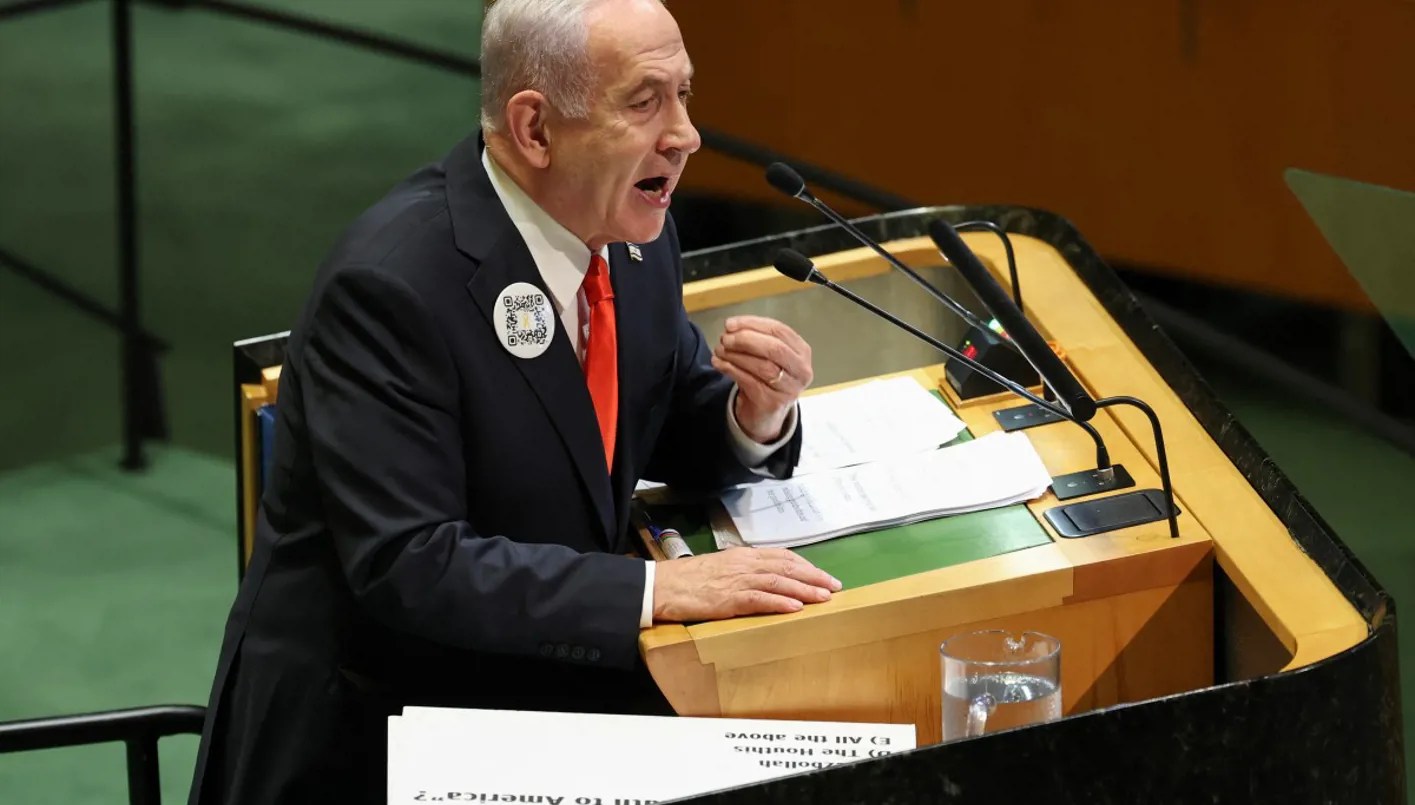
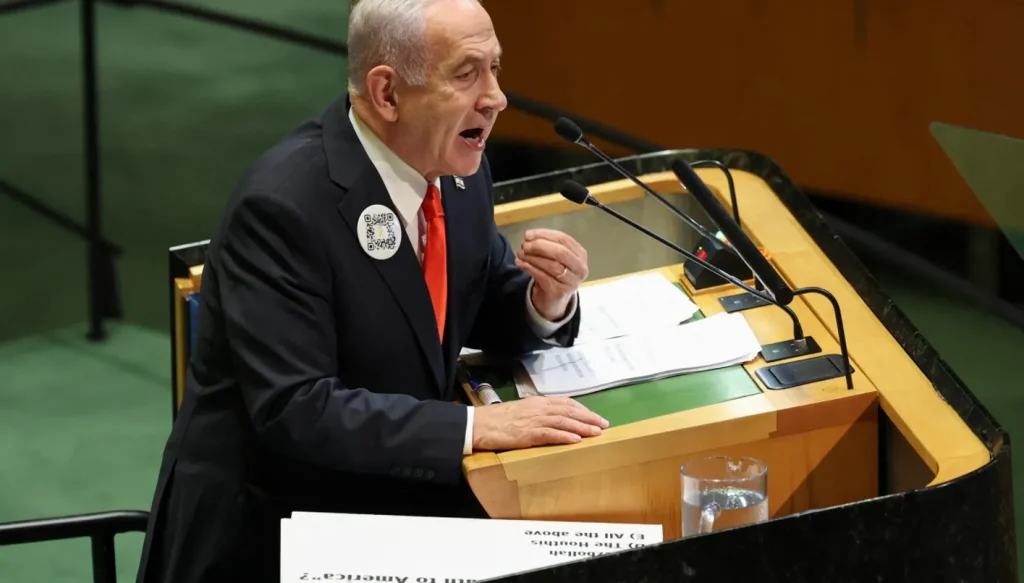
Israeli Prime Minister Benjamin Netanyahu delivers his speech at the United Nations General Assembly. (AFP)
No name stirs as much controversy in the Israeli political and security scene as Benjamin Netanyahu. For decades, his security policy, now described as “Benyaminism,” has been a focal point of polarization, especially in the way military conflicts are managed and resolved.
Is the broad military operations and the rhetoric of “absolute victory” we witness today the result of a “personal ambition” to remain in power, or is it merely a “strict and harsh application of a deep-rooted comprehensive Israeli strategy”?
This raises a fundamental question about the essential difference Netanyahu has made in Israel’s approach to its security and conflicts, whether he has deviated from the consensus of previous leaders, and whether his actions represent a tactical deviation or a radical reshaping of Israel’s security goals and objectives.
Netanyahu’s Role in Israeli Governance: The Dictatorship of 61
Israeli affairs expert Omar Jaara offers an in-depth analysis of the Israeli Prime Minister’s personality and role in the political and security scene, emphasizing that his power primarily relies on exploiting internal contradictions.
Jaara told “An-Nahar” that Netanyahu is not a “remarkable personality prime minister” but is the first in Israel’s history to form minority governments with no more than 61 seats. He believes Netanyahu’s political survival is not due to his own abilities but to the sharp contradictions among small Israeli parties.
Dependence on the Far Right
Jaara stresses that Netanyahu thrives on “contradictions among small parties,” which allowed extremist figures and parties (such as Itamar Ben-Gvir, Bezalel Smotrich, Degel HaTorah, and Yehudah HaTorah) to reach ministerial positions for the first time in their history—parties that would not have been part of any previous government.
Jaara describes the current regime as the “dictatorship of 61” (referring to the slim majority in the Knesset), granting Netanyahu relative immunity from his criminal cases and enabling him to make controversial decisions, such as appointing officials personally loyal to him rather than to state security, as happened with the appointment of the Shin Bet director (head of internal security).
The expert also considers Netanyahu’s personality not strong, as evidenced by his inability to form a stable government except after three consecutive early elections, and his resort to what he described as “buying” the number 61 to topple the previous government of Naftali Bennett, indicating political tactics based on maneuvering rather than inherent political strength.
The Difference Between Netanyahu and Founding Leaders
Jaara refers to Netanyahu’s repeated rhetoric of “absolute victory” (Nitzayon Muhlat) since October 7, noting that the Prime Minister has used this expression “more than 1000 times,” yet Israelis mock it and describe it as “empty talk.”
The Israeli affairs expert asserts that Netanyahu has not achieved “any characteristic of victory,” and that the current period is the longest and most costly in Israel’s history.
Jaara compares Netanyahu to founding and former Israeli leaders such as David Ben-Gurion, Menachem Begin, and Yitzhak Rabin, concluding that Netanyahu cannot be recorded as a “remarkable political figure,” as he “is led rather than leads,” and remains “a prisoner of Ben-Gvir and Smotrich.”
Jaara’s analysis concludes that Netanyahu’s personality “is not qualified to be a constructive figure for the State of Israel.”


Recommended for you
Talib Al-Rifai Chronicles Kuwaiti Art Heritage in "Doukhi.. Tasaseem Al-Saba"
Exhibition City Completes About 80% of Preparations for the Damascus International Fair Launch
Al-Jaghbeer: The Industrial Sector Leads Economic Growth
Unified Admission Applications Start Tuesday with 640 Students to be Accepted in Medicine
Egypt Post: We Have Over 10 Million Customers in Savings Accounts and Offer Daily, Monthly, and Annual Returns
His Highness Sheikh Isa bin Salman bin Hamad Al Khalifa Receives the United States Ambassador to the Kingdom of Bahrain