









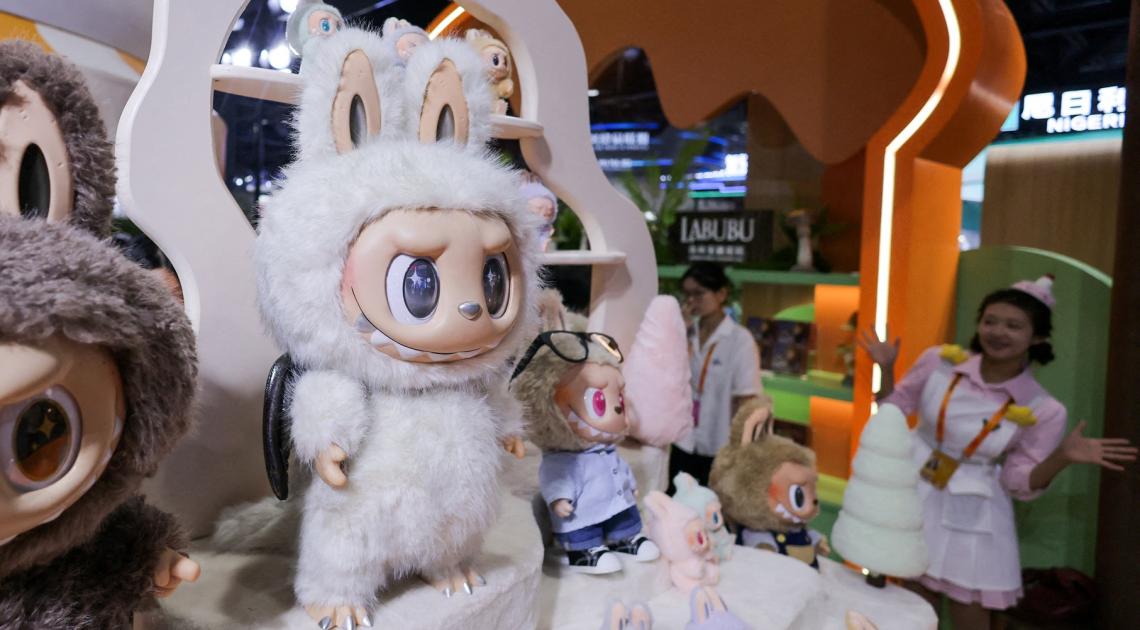
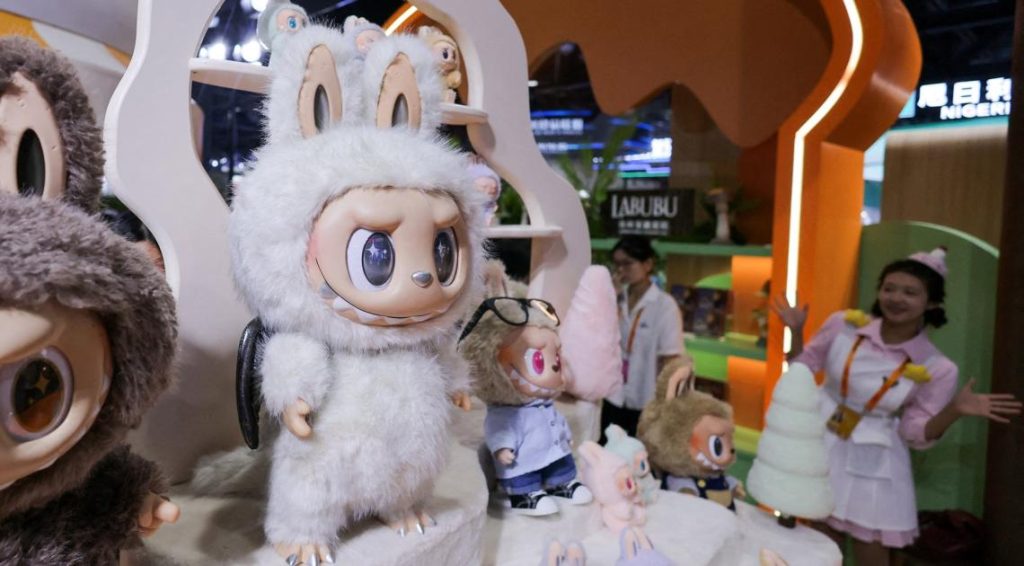
An employee points to Laobubu toys displayed at Pop Mart’s booth at the China International Fair for Trade in Services (archival/Reuters)
Laobubu’s success fuels investment and competition in the art toy sector
Insiders credit the “blind box” strategy
Si Di, CEO and co-COO of Pop Mart, told Reuters in a rare interview that the Chinese company borrows from Disney’s strategy to turn Laobubu’s massive sales into long-term success.
Pop Mart has already achieved what many thought impossible – making Laobubu the first Chinese product to attract a global audience thanks to its emotional and creative appeal, not because it offers value for money.
Now, it aims to capitalize on the art toy’s success.
Referring to Mickey Mouse, produced as a cartoon nearly a century ago, Si said: “We have learned from Disney a long time ago. In fact, Disney’s great value lies in its ability to manage intellectual property rights over the long term, even up to 100 years.”
Even as analysts question Pop Mart’s reliance on Laobubu and the company’s fate as the toy’s popularity inevitably wanes, the company still sees huge potential to develop content, entertainment, theme parks, and more character-related products – just as Disney does with its most popular IPs.
Si did not provide a timeline or investment estimate during the first interview a senior company executive has given to foreign media since 2022.
He said Pop Mart’s near-term focus was not on finding the “next big hit,” but investing in “better products, finding better collaborations, developing content, theme parks, and showcases” for Laobubu, with the ultimate goal of owning 5 to 10 patents with long-term potential similar to Laobubu.
Laobubu’s global success has driven Pop Mart’s shares listed on the Hong Kong Stock Exchange to rise nearly 200% so far this year, making Pop Mart’s value now higher than Hasbro, Mattel, and Sanrio combined.
Louis Hodart, managing partner at Mad consultancy in China, said: “Pop Mart markets a lifestyle that consumers want to be part of,” adding its profit margins rival some luxury brands. The booming Chinese art toy industry investment has also increased competitive pressure on Pop Mart, the market leader.
Estimates from Industry World, a Chinese market intelligence platform, in July indicated that revenues from the Chinese art toy market are expected to exceed 120 billion yuan ($16.85 billion) this year, representing more than 35% of the global market and maintaining double-digit growth in China.
Although Pop Mart does not break down Laobubu sales, the series it belongs to, The Monsters, accounted for nearly 35% of total revenue in the first half of this year, raising questions about the company’s dependence on this character.
Laobubu’s popularity boosted sales of other characters such as Molly, Skull Panda, and Creepy (each exceeding one billion yuan in sales in the first half), but it also sparked curiosity beyond Pop Mart’s offerings.
Roniu, 24, winner of China’s first reality TV art toy design program, said: “Thanks to Pop Mart’s success, more investors want to invest in this industry. As you can see, there are now many new companies, and definitely more and more artists trying to own intellectual property as a way to make money.”
Other major Chinese art toy retailers include Toys52 and Miniso, which traditionally relied on licensing IP from companies like Disney and Sanrio but now invest more in developing original IP and signing partnerships with art toy designers.
Zhou Junyu, head of IP at Siguworks, an art toy company working with Miniso, said: “Pop Mart paved the way for the rest of the Chinese art toy industry.”
Just as Pop Mart studied Disney, other Chinese companies studied Pop Mart. It remains unclear whether the Disney model will help it overcome increasing competition.
Morningstar analyst Jeff Chang said: “We all know Disney’s strategy, which is relatively easy to replicate generally, but its success is not.” He added: “Compared to established IP operators like Disney and Sanrio, Pop Mart still has a long way to go, and along the way, there are also execution risks.”
Three current and former Pop Mart employees said Pop Mart’s success with Laobubu was not overnight but largely due to strategic decisions made by founder and CEO Wang Ning over the past decade. They declined to be named as they were not authorized to speak to the media.
In 2010, Wang, only 23 but with a string of entrepreneurial projects, opened a trendy store in Beijing.
Within a few years, he noticed that collectible figurines accounted for a large part of revenue and decided to focus on art toys.
Wang also realized Pop Mart needed to own the IP it sold, according to former employees, which led him to Kenny Wong – designer of Molly, with her distinctive frowning face.
Wong, based in Hong Kong, initially rejected Wang’s offer in 2016 but eventually agreed to a trial collaboration.
Wong told Reuters: “During my toughest years, inventory was my biggest concern, then Wang Ning appeared. He solved my inventory problem first and sold it all quickly.” Wong handed the regional license for Molly to Pop Mart, and success continued.
Laobubu first appeared at Pop Mart in 2019.
Insiders told Reuters that Pop Mart’s “blind box” retail strategy – where consumers buy packages priced between $10 and $20 without knowing exactly which toy is inside – and its focus on characters that attract young women, a high-spending consumer group previously largely overlooked by the art toy industry, were the two main pillars of its success.
One said: “I can’t say they are completely right in this model, and that every product will be a big hit, but I think their expertise will enable them to master it better than others.”

Recommended for you
Talib Al-Rifai Chronicles Kuwaiti Art Heritage in "Doukhi.. Tasaseem Al-Saba"
Exhibition City Completes About 80% of Preparations for the Damascus International Fair Launch
Al-Jaghbeer: The Industrial Sector Leads Economic Growth
Unified Admission Applications Start Tuesday with 640 Students to be Accepted in Medicine
Egypt Post: We Have Over 10 Million Customers in Savings Accounts and Offer Daily, Monthly, and Annual Returns
His Highness Sheikh Isa bin Salman bin Hamad Al Khalifa Receives the United States Ambassador to the Kingdom of Bahrain