









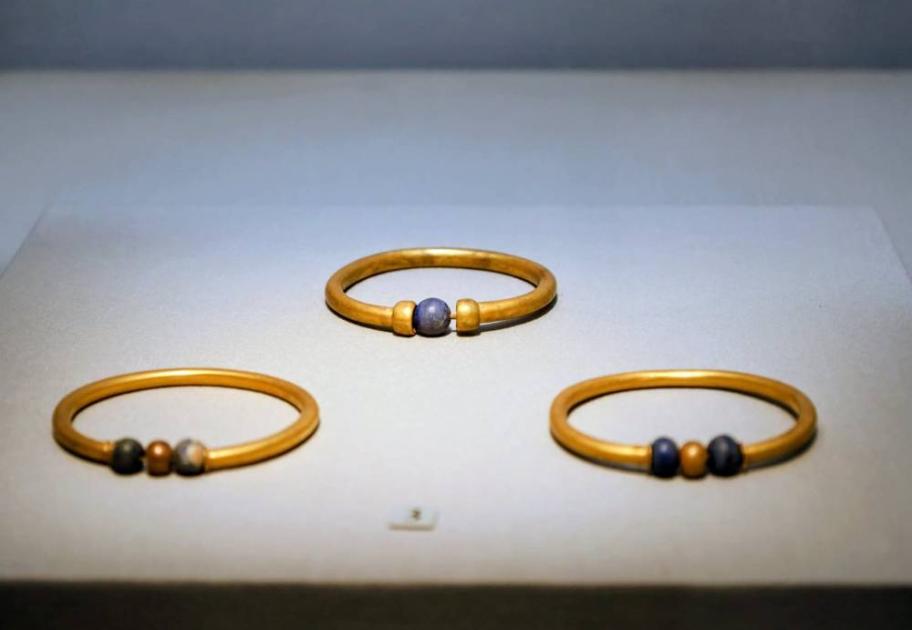
On Monday, the Technical Office of the Head of the Egyptian Administrative Prosecution Authority conducted a field inspection of the restoration laboratory at the Egyptian Museum in central Cairo, attended by the museum’s general director, the director of the Islamic Art Museum, the head of the examination committee, and several specialists.
The inspection was part of the investigation into the theft of the rare King Amenmose bracelet, where four suspects were arrested for destroying it after seizing it, including an employee at the Egyptian Museum’s restoration lab.
Details of the Disappearance Incident
The Administrative Prosecution’s media center issued a statement reporting the disappearance of a golden ancient bracelet from a steel safe inside the restoration lab. Initial investigations revealed that a restoration specialist at the museum embezzled the artifact and left her workplace with it intending to sell it.
Administrative Prosecution: The Bracelet is 3,000 Years Old
The statement confirmed that the bracelet dates back to the Third Intermediate Period, around 900 BC, made of pure gold and inlaid with a rare lapis lazuli stone. It was displayed in one of the Egyptian Museum’s halls before being deposited in the lab for preparation for an external exhibition.
Official records confirmed the lab’s receipt of the bracelet, but it was discovered that the lab lacked internal records documenting the movement of artifacts.
Examination of the Lab’s Security System
The inspection included photographing the lab, checking electronic gates for staff and visitor entry and exit, reviewing documents regulating artifact handling, and interviewing restoration department staff.
The Administrative Prosecution urgently ordered a comprehensive audit of artifact handling and security procedures at the museum, as well as a full inventory of the restoration lab, requesting investigations from relevant oversight authorities.
The prosecution confirmed that investigations are ongoing to identify security system flaws and hold responsible parties disciplinarily accountable.
Perpetrators in Police Custody
On September 16, Egyptian security authorities announced the arrest of four individuals involved in stealing the rare King Amenmose bracelet from the Egyptian Museum’s restoration lab in Cairo.
The Egyptian Ministry of Interior issued a shocking statement revealing that one suspect disposed of the ancient artifact, which dates back thousands of years to ancient Egyptian civilization, by melting it down to create new jewelry.
Egyptian Interior Ministry Statement on the Museum Theft
The statement confirmed that security agencies received a theft report on September 13, after the Egyptian Museum’s deputy director and a restoration specialist discovered the disappearance of a golden bracelet from the Late Period inside a steel safe in the restoration lab.
The investigation identified the perpetrator as a restoration specialist at the museum who stole the bracelet on September 9 during her work by taking advantage of a lapse in attention.
The suspect contacted a trader acquaintance who owns a silver shop in the Sayeda Zeinab area of Cairo, who sold it to a gold workshop owner for 180,000 EGP.
The workshop owner sold the ancient bracelet to a worker at a gold foundry for 194,000 EGP, where it was melted along with other jewelry to be reshaped.
How the Case Started
The Egyptian Ministry of Tourism and Antiquities referred the disappearance of the bracelet from the Egyptian Museum’s restoration lab in Tahrir, Cairo, to the police and public prosecution.
The ministry emphasized that its officials took the necessary legal steps and informed relevant authorities to take required measures immediately upon learning of the incident.
In an official statement, the ministry announced the formation of a specialized committee to inventory and review all items in the restoration lab, and circulated an image of the missing piece to archaeological units at Egyptian airports, land, sea, and border ports as precautionary measures.
The museum director said the missing piece is a golden bracelet with a spherical lapis lazuli bead, part of King Amenmose’s collection from the Third Intermediate Period.
The ministry concluded that the delay in announcing the incident was to ensure a suitable environment for the investigation’s progress.
How the Theft Was Discovered
Sources revealed that the rare King Amenmose bracelet theft was confirmed during a periodic inventory of the Egyptian Museum’s restoration lab collections.
Sources added that the missing artifact was preserved as part of a rare royal collection dating back to the Third Intermediate Period, which began during the 21st Dynasty of the Pharaonic era.




Recommended for you
Talib Al-Rifai Chronicles Kuwaiti Art Heritage in "Doukhi.. Tasaseem Al-Saba"
Exhibition City Completes About 80% of Preparations for the Damascus International Fair Launch
Al-Jaghbeer: The Industrial Sector Leads Economic Growth
Unified Admission Applications Start Tuesday with 640 Students to be Accepted in Medicine
Egypt Post: We Have Over 10 Million Customers in Savings Accounts and Offer Daily, Monthly, and Annual Returns
His Highness Sheikh Isa bin Salman bin Hamad Al Khalifa Receives the United States Ambassador to the Kingdom of Bahrain