









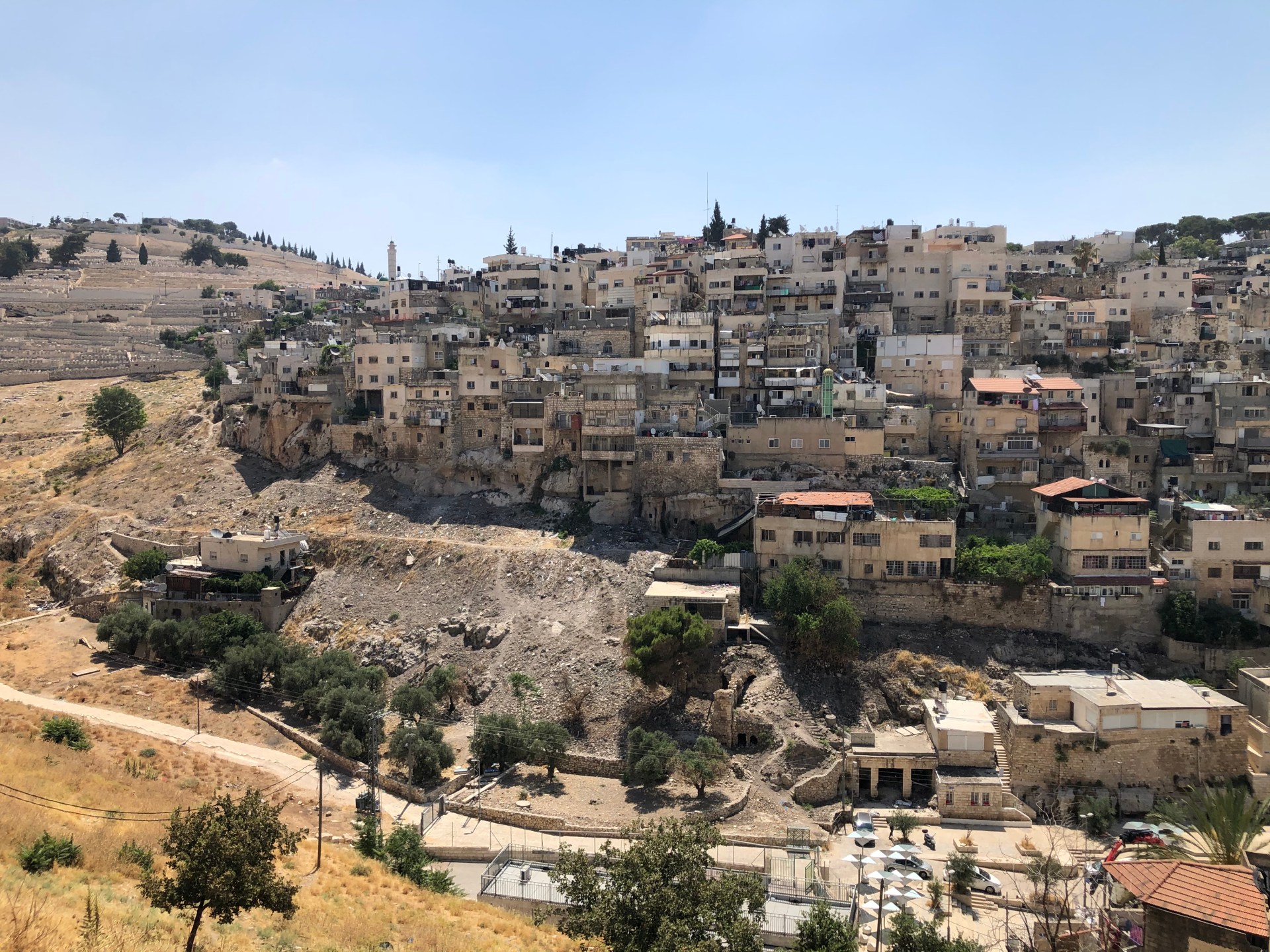
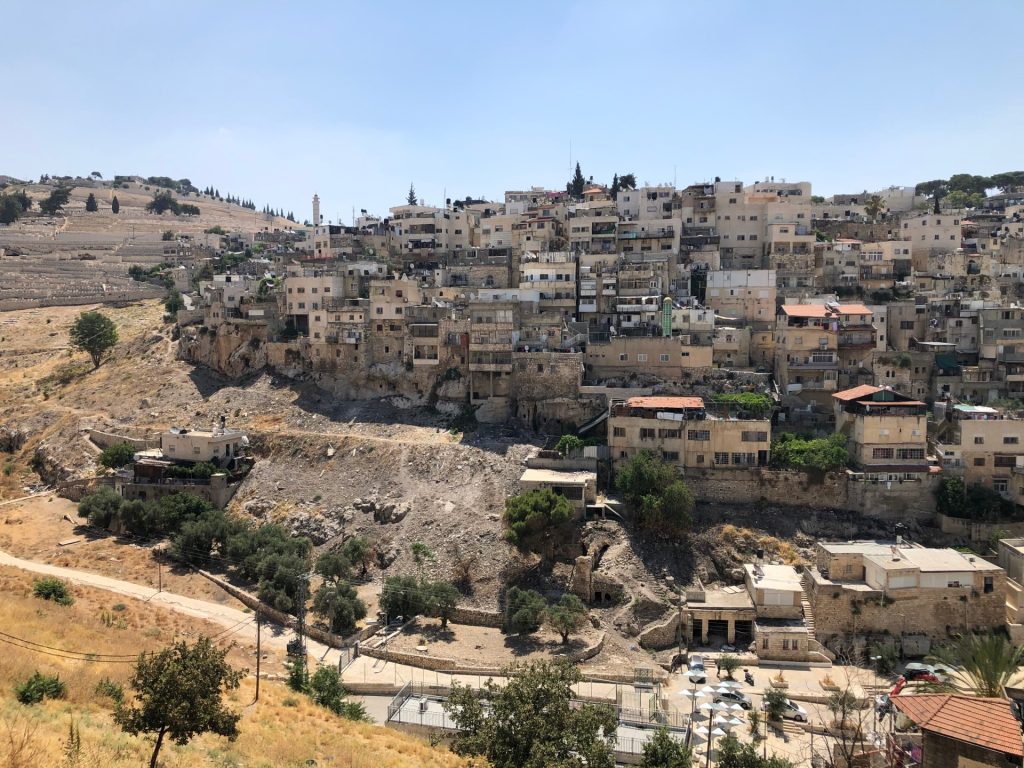
Batn al-Hawa is a neighborhood in the Jerusalem town of Silwan, located about 400 meters from the Al-Aqsa Mosque, inhabited by approximately 10,000 Palestinians. Israeli settler groups control a large area of the neighborhood’s land and properties, strengthening their control around Al-Aqsa and forming a settlement hub connected to the Ras al-Amud settlements to the east and Wadi Hilweh neighborhood to the west.
Location
Batn al-Hawa lies in the central quarter of Silwan on the slope of the Mount of Olives in the southeastern corner of Jerusalem. The distance between it and Al-Aqsa Mosque does not exceed 400 meters.
Batn al-Hawa is surrounded by Ras al-Amud settlements to the east and Wadi Hilweh neighborhood to the west. The Israeli occupation has seized much of the neighborhood’s land and properties, turning them into a large settlement outpost, thus expanding the settlement ring around Al-Aqsa Mosque.
The neighborhood is part of Silwan’s urban fabric, alongside other neighborhoods such as Wadi Hilweh, Wadi al-Rababa, Al-Bustan, and Ras al-Amud.
Historic Silwan spans approximately 5,640 dunams (one dunam equals 1,000 square meters) and contains archaeological remains from various civilizations including Greek, Canaanite, and Umayyad.
The neighborhood enjoys a Mediterranean climate characterized by hot summers and mild, rainy winters, with an average annual temperature of about 17 degrees Celsius.
Population
By the end of 2022, about 10,000 Palestinians lived in Batn al-Hawa. Since 2015, settler organizations have been using Israeli occupation courts to evict around 87 Jerusalemite families from homes built on over 5 dunams of the neighborhood’s area.
According to the neighborhood’s local committee estimates, about 37 families were forced to leave their homes due to occupation pressures between early 2017 and mid-2018.
Evictions and Displacement
Since 2015, Israeli courts have issued eviction orders against Batn al-Hawa residents based on claims by the Israeli “Ateret Cohanim” association of ownership over 5 dunams and 200 square meters of the neighborhood.
Despite the Jerusalemites’ resistance and multiple appeals, the central court rejected several objections, including appeals by the Shweiki and Odeh families and the Rajabi families in June 2025.
The Israeli court issued eviction decisions in the absence of the Jerusalemite families and their lawyers, declaring them final and non-appealable, raising concerns among residents, especially those facing similar legal situations whose cases are still pending.
The “Beit Yonatan” outpost was the first settlement outpost in Batn al-Hawa; in 2004 settlers completed building a residential building deep in the neighborhood and moved in.
Since then, settlement activity has escalated, with the number of outposts rising from 6 at the end of 2014 to about 12 by the end of 2022, at the expense of more than 20 Palestinian families who lost their homes between 2014 and 2016 alone.
The “Ateret Cohanim” association converted some seized properties into settlement centers to increase Jewish presence around Al-Aqsa Mosque. In 2017, it opened a “heritage center” in the confiscated Abu Nab family property, naming it “Beit Al-Asal,” claiming it was a synagogue for Yemenite Jews in the late 19th century.
In 2024, settlers seized about two and a half dunams of neighborhood land, claiming it as “endowment property of Yemenite Jews,” despite official documents proving ownership by the Abu Diab, Rajabi, and Saludi families.
The United Nations considers Israeli occupation practices against Jerusalemites a violation of international law, which prohibits the forced displacement of residents, discriminatory laws, or imposing occupation laws on occupied territories.
The UN Office for the Coordination of Humanitarian Affairs in the occupied Palestinian territories revealed that Israeli forces demolished about 219 buildings in East Jerusalem alone in 2024, displacing 582 Palestinians from their homes.
Ateret Cohanim Association
Founded in 1978 under the supervision of religious Zionist leaders, the Israeli association aims to promote Jewish settlement in Jerusalem, especially in the Old City and its surroundings.
“Ateret Cohanim” has been a main arm in Judaizing Jerusalem alongside other Israeli associations such as “Elad,” with broad Israeli government support enhancing its influence and real estate projects within Palestinian neighborhoods.
The association claims a large part of Batn al-Hawa was allocated since 1881 to house Jews who came from Yemen to Jerusalem, using this claim as a legal pretext to impose control over the neighborhood.
It bases its argument on the “Absentees’ Property Law” enacted by Israel in 1970, which grants Jews the right to claim what they allege were their properties in East Jerusalem before the 1948 Nakba, while Palestinians are denied a similar right to reclaim their occupied properties.
In 2002, the Israeli central court recognized “Ateret Cohanim” ownership of more than 5 dunams in Batn al-Hawa, triggering a series of legal procedures aimed at evicting Jerusalemites from their homes and lands to settle Jews there.




Recommended for you
Talib Al-Rifai Chronicles Kuwaiti Art Heritage in "Doukhi.. Tasaseem Al-Saba"
Exhibition City Completes About 80% of Preparations for the Damascus International Fair Launch
Al-Jaghbeer: The Industrial Sector Leads Economic Growth
Unified Admission Applications Start Tuesday with 640 Students to be Accepted in Medicine
Egypt Post: We Have Over 10 Million Customers in Savings Accounts and Offer Daily, Monthly, and Annual Returns
His Highness Sheikh Isa bin Salman bin Hamad Al Khalifa Receives the United States Ambassador to the Kingdom of Bahrain