








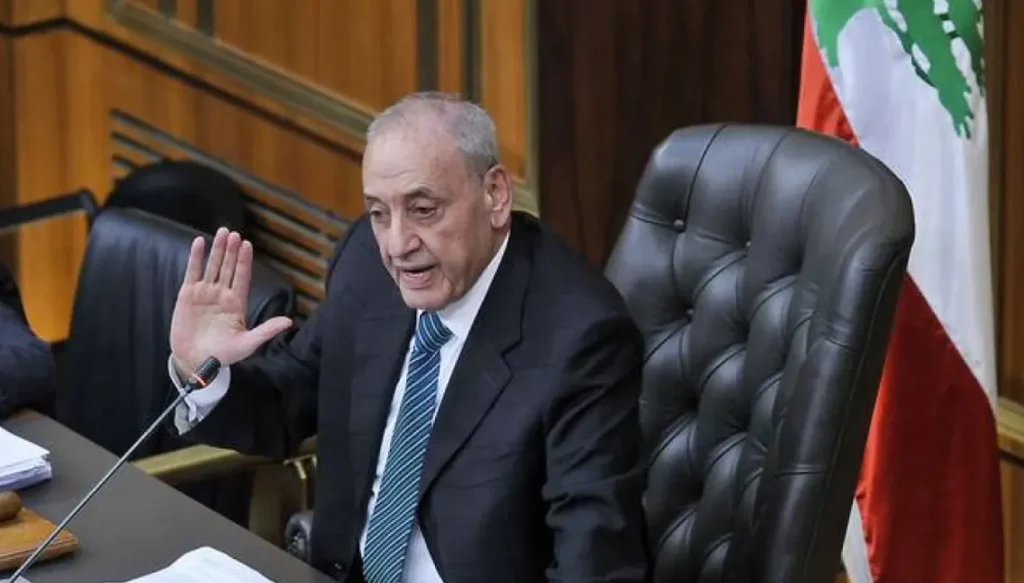
Lebanese Parliament Speaker Nabih Berri said that the recent Israeli airstrikes on the area stretching from the town of Al-Najariyeh to Al-Masila carry fiery messages specifically directed at him, coming less than 24 hours after he called on the government to allocate a budget item in the 2026 budget for the reconstruction of southern towns destroyed by Israel.
Berri told Asharq Al-Awsat newspaper that “the Israeli message to prevent reconstruction arrived quickly through the destruction of equipment and machinery used to clear rubble and rehabilitate infrastructure,” noting that Israel “chose the right time to enter into fire in the dispute” that took place between him and Prime Minister Nawaf Salam over the exclusion of the south from the budget project.
He stressed that “our insistence on rebuilding the destroyed towns and rehabilitating infrastructure is the practical response to Israel’s plan to turn border towns into a buffer zone difficult to live in.”
Berri asked: “Where is the credibility of the United States, alongside France, in sponsoring the ceasefire agreement that Lebanon has adhered to literally, while Israel continues its attacks under the watch of the international monitoring body headed by an American general?” He revealed that the south is scheduled for a new meeting of the body on the 15th of this month, questioning “what prevents it from intervening to stop Israeli violations?”
Berri pointed out that he had previously reached an agreement with US envoy Tom Breack based on “coordinated steps between Lebanon and Israel,” but the latter “returned from Tel Aviv without an answer,” which encouraged Israel – according to Berri – to “continue its attacks in the absence of American pressure to oblige it to implement the agreement.”
The parliament speaker added that Lebanon “has been and still is committed to a diplomatic solution,” asking: “Isn’t it time for Israel to withdraw? And how long will Lebanon remain on the waiting list?”
He confirmed that “the response to the Israeli message will only be through our national unity and intensifying our diplomatic movement,” stressing the need for “Lebanon to file a complaint to the Security Council against the aggression targeting its economic infrastructure to pressure it to enter into direct negotiations with Israel, which is unanimously rejected by the Lebanese.”
Berri concluded by affirming that “the Israeli fires that targeted this amount of equipment and machinery will not deter us from reconstruction, to prevent Israel from turning our frontline towns into a border strip as it was before the liberation in 2000.”



Recommended for you
Talib Al-Rifai Chronicles Kuwaiti Art Heritage in "Doukhi.. Tasaseem Al-Saba"
Exhibition City Completes About 80% of Preparations for the Damascus International Fair Launch
Al-Jaghbeer: The Industrial Sector Leads Economic Growth
Unified Admission Applications Start Tuesday with 640 Students to be Accepted in Medicine
Egypt Post: We Have Over 10 Million Customers in Savings Accounts and Offer Daily, Monthly, and Annual Returns
His Highness Sheikh Isa bin Salman bin Hamad Al Khalifa Receives the United States Ambassador to the Kingdom of Bahrain