








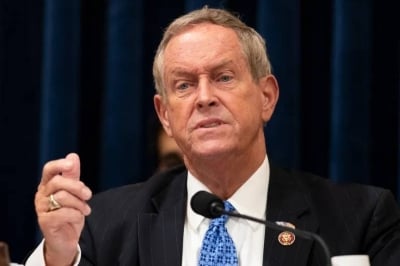
Republican US Congressman Joe Wilson announced on Friday that the Senate voted to repeal the Caesar Act sanctions imposed on Syria during the rule of the ousted regime, while Damascus welcomed what it described as a “historic step.”
Wilson thanked the US Senate in a post on X platform for approving the repeal of the Caesar Act as part of the National Defense Authorization Act, saying “harsh sanctions were imposed on a regime that fortunately no longer exists,” and confirmed that the full repeal “now depends on Syria’s success,” according to his expression.
Wilson announced on June 12 that he had introduced legislation to Congress to fully repeal the Caesar Act and its sanctions on Syria.
Meanwhile, Syrian Finance Minister Mohammad Yasir Berni considered the Senate vote on repealing the Caesar Act as “a success of Syrian diplomacy in eliminating the last and harshest American sanctions imposed on the country.”
Bernie said in a Facebook post that the next step is to align the House of Representatives (through a joint committee with the Senate) to approve the same provision in the Defense Department budget, leading to President Donald Trump signing the new budget before the end of the year, thus putting the repeal of the Caesar Act into effect.
Syrian Information Minister Hamza al-Mustafa said this vote represents “a historic moment for the new Syria and the struggles of its people.”
Al-Mustafa added in a post on X platform that repealing this law (in the upcoming phase) removes “a major obstacle on the path to stability and development,” considering this development a fruit of Syrian diplomacy and the efforts of the Syrian diaspora abroad.
At the end of June, Trump signed an executive order to end sanctions on Syria to support reconstruction and build “a Syria that does not provide a haven for terrorist organizations,” according to his statement.
The executive order did not repeal the Caesar Act passed by Congress in 2019 but legally paved the way to freeze some of its sanctions, as a US president cannot amend or suspend a law passed by Congress.
Caesar is the pseudonym of former Syrian military police photographer Farid al-Mazhan who defected from the Syrian regime in 2013, carrying with him 55,000 photos showing torture and violations in Syrian prisons.
US lawmakers introduced the “Caesar” bill in 2016 aiming to “stop the wholesale killing of the Syrian people, encourage a peaceful settlement through negotiation, and hold Syrian human rights violators accountable for their crimes.”
After discussions, Congress approved the law in both the House and Senate in December 2019, and it was signed by the US president as part of the 2020 Defense Budget Act.
The law imposed sanctions on Syrian individuals and institutions involved in war crimes and banned financial dealings with influential figures in the ousted regime of President Bashar al-Assad or those connected to him.
It also stipulated penalties for any local or foreign entity investing or dealing with Syria in sectors such as energy, aviation, construction, and banking, and targeted companies and countries supporting the Syrian regime at the time, such as Iran and Russia.




Recommended for you
Talib Al-Rifai Chronicles Kuwaiti Art Heritage in "Doukhi.. Tasaseem Al-Saba"
Exhibition City Completes About 80% of Preparations for the Damascus International Fair Launch
Al-Jaghbeer: The Industrial Sector Leads Economic Growth
Unified Admission Applications Start Tuesday with 640 Students to be Accepted in Medicine
Egypt Post: We Have Over 10 Million Customers in Savings Accounts and Offer Daily, Monthly, and Annual Returns
His Highness Sheikh Isa bin Salman bin Hamad Al Khalifa Receives the United States Ambassador to the Kingdom of Bahrain