










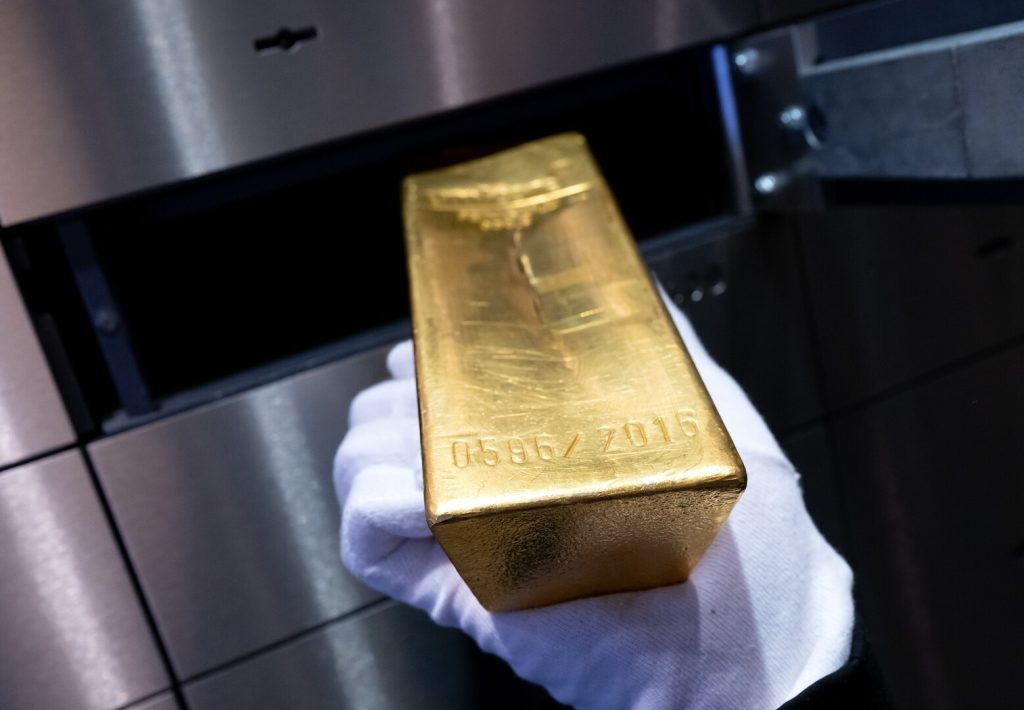
Gold futures contracts on the COMEX reached a new record on Monday, surpassing $3850 per troy ounce, marking a historic rise that reflects a volatile path for the precious metal over more than two centuries.
Since the adoption of the dollar as the United States’ unified currency, gold prices were set by government decisions. Between 1796 and 1834, the price per ounce was about $19.5 before being raised to $20.67.
After the Great Depression in 1933, US authorities banned cash gold trading and ownership by individuals, fixing its price at $35. This price later became the basis of the Bretton Woods system, which made the dollar the global reserve currency convertible to gold.
With rising US spending in the Vietnam War and economic pressures, the system began to falter. On August 5, 1971, President Richard Nixon announced the suspension of dollar-to-gold convertibility, collapsing the Bretton Woods system and opening the way for market-based gold pricing.
In May 1973, prices exceeded $100 for the first time, then stabilized around $150. However, the late 1970s saw a sharp jump due to international tensions, with the ounce surpassing $500 after the Soviet intervention in Afghanistan, reaching $711 in September 1980 (equivalent to about $2700 in 2025 prices).
During the 1980s and 1990s, prices stabilized between $300 and $400 before dropping to $250 at the start of the millennium. Even the September 11, 2001 attacks did not significantly alter the trend.
The 2007 global financial crisis brought gold back as a safe haven, surpassing $1000 in 2008 and reaching $1900 in 2011. With improved confidence in the US economy, prices fell near $1000 by 2015.
Since 2019, demand for the precious metal surged again, with central banks—especially Russia and China—becoming major buyers. During the 2020 COVID-19 pandemic, gold exceeded $2000 for the first time in history.
Since late 2023, geopolitical tensions and rising central bank reserves have fueled a new upward wave. In August 2024, prices surpassed $2500, and with Donald Trump’s return to the White House in early 2025, gold exceeded $3000, reaching the current historic level of $3850 per ounce.
Boris Krasnoginov, head of securities market analysis at Russia’s Alfa Bank, noted that the gold price rise is supported by demand from global central banks and individuals. He believes escalating geopolitical tensions could push prices to $4000 per ounce or more.
The analyst also stated, “Silver prices are much more volatile, as silver trading volumes in monetary value are about 10 times less than gold trading volumes, according to the London Bullion Market Association (LBMA) data. Considering the historical gold-to-silver ratio, a rise in silver prices to $46-47 per ounce seems entirely realistic.”



Recommended for you
Talib Al-Rifai Chronicles Kuwaiti Art Heritage in "Doukhi.. Tasaseem Al-Saba"
Exhibition City Completes About 80% of Preparations for the Damascus International Fair Launch
Unified Admission Applications Start Tuesday with 640 Students to be Accepted in Medicine
Al-Jaghbeer: The Industrial Sector Leads Economic Growth
Egypt Post: We Have Over 10 Million Customers in Savings Accounts and Offer Daily, Monthly, and Annual Returns
His Highness Sheikh Isa bin Salman bin Hamad Al Khalifa Receives the United States Ambassador to the Kingdom of Bahrain