









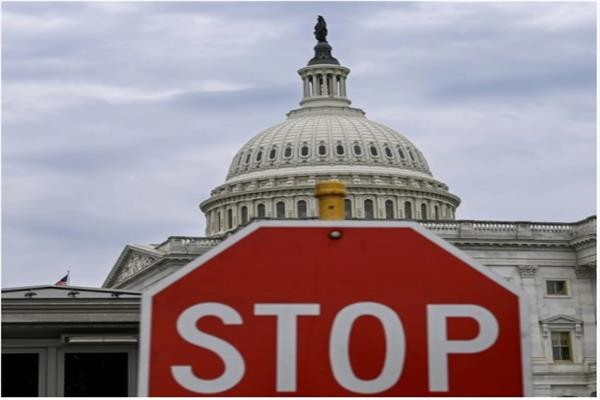
The White House announced on Friday the start of a large-scale layoff process for federal employees as President Donald Trump seeks to increase pressure on Democrats to end a government shutdown that paralyzes public services.
As the crisis enters its third week with no resolution in sight, Russ Vought, the Trump administration’s budget chief, announced on social media that the administration had begun implementing its threat to lay off some of the 750,000 public sector employees who were forced to take leave.
The Office of Management and Budget, headed by Vought, told AFP that the layoffs would be “large,” but did not provide exact numbers or details on which departments would be most affected.
Trump has repeatedly emphasized that budget cuts are a means to increase pressure on Democrats. Last week, he said he would meet with Vought to identify “the many Democratic agencies, most of which are a political hoax” that should be targeted.
Democratic minority leaders in Congress reject the threat of job cuts, considering it an intimidation attempt.
Senator Patty Murray, the leading Democrat on government funding, said, “The government shutdown does not give Trump or Vought new special powers to cause more chaos or permanently weaken essential services for the American people. The simple truth is this administration has recklessly fired and then rehired essential employees throughout the year.”
She added, “This is nothing new, and no one should be afraid of these con artists.”
A Treasury Department spokesperson told AFP that the department had begun sending layoff notices, while the Department of Health and Human Services announced it had started laying off non-essential employees “as a direct result of the government shutdown led by the Democrats.”
Education sector officials are also reducing their staff numbers, according to a source familiar with hiring decisions at the department who spoke to AFP.
Government employees who still hold their jobs face the possibility of not receiving their paychecks as the crisis is expected to continue at least until mid-next week.
Deepening the crisis, 1.3 million active-duty military personnel will not receive their due paychecks next Wednesday, an unprecedented event in any government shutdown in recent history.
Republican House Speaker Mike Johnson said at a press conference on Friday, the tenth day of the shutdown, “The mood here at the Capitol is not good; it is a gloomy day. Today is the first day federal government employees across the United States receive partial paychecks.”
Tensions between the two parties became clear this week following confrontations between Johnson and Democratic senators over the government shutdown in front of the media.
After a press conference by the Democratic leadership in the House, Republican Congressman Mike Lawler sharply criticized House Minority Leader Hakeem Jeffries for his role in the crisis.
Jeffries told Lawler to “be quiet,” and the two exchanged harsh criticisms before Jeffries later called Lawler a “malicious clown.”
The Public is Tired of the Chaos
Non-essential government operations stopped after the government funding deadline on September 30, when Democrats in the Senate repeatedly blocked a Republican resolution to reopen federal agencies.
The sticking point was Republicans’ refusal to include language extending healthcare support packages for 24 million Americans in the resolution.
With the increasing likelihood of a prolonged shutdown day by day, members of Congress hope for intervention by Republican President Donald Trump to break the deadlock.
Trump has shown little interest, focusing instead on a ceasefire agreement in Gaza and sending federal forces to suppress protests in cities governed by Democrats such as Chicago and Portland.
Jeffries said at a press conference, “The American people are tired of the chaos, crises, and confusion that Donald Trump has inflicted on the country and the Republicans’ complete control of Congress.”
The Bureau of Labor Statistics announced the postponement of the release of key inflation data scheduled for next week to October 24, despite the ongoing federal paralysis that has halted most government data releases.
The Bureau said in a statement on Friday that releasing the Consumer Price Index data aims to enable the Social Security Administration to meet legal deadlines “to ensure benefits are paid accurately and on time.”




Recommended for you
Talib Al-Rifai Chronicles Kuwaiti Art Heritage in "Doukhi.. Tasaseem Al-Saba"
Exhibition City Completes About 80% of Preparations for the Damascus International Fair Launch
Unified Admission Applications Start Tuesday with 640 Students to be Accepted in Medicine
Al-Jaghbeer: The Industrial Sector Leads Economic Growth
Egypt Post: We Have Over 10 Million Customers in Savings Accounts and Offer Daily, Monthly, and Annual Returns
His Highness Sheikh Isa bin Salman bin Hamad Al Khalifa Receives the United States Ambassador to the Kingdom of Bahrain