









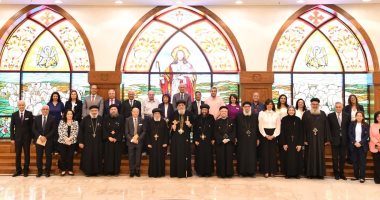
His Holiness Pope Tawadros II attended the symposium organized by the Coptic Institute for Ecclesiastical Management and Development (COPTICAD) on Sunday, titled “The Church and Partnership in Sustainable Development: Opportunities and Challenges,” held at the Papal Headquarters in Cairo. The event included participation from several metropolitans, bishops, priests, deacons, deaconesses, and experts working in social care services and community development from various dioceses, churches, and diverse Christian and national civil institutions.
This symposium is part of a series of events organized by COPTICAD to celebrate its tenth anniversary since its founding by His Holiness in 2015.
The symposium aimed to discuss the importance and ways to expand the Church’s partnership fields with stakeholders involved in sustainable development, such as associations and civil institutions, the private sector and businessmen, responsible government bodies, international development institutions and local funding agencies, and research bodies, as well as how to address challenges to consolidate the developmental vision led by His Holiness within the Church.
Participants shared positive experiences in partnership with stakeholders inside and outside the Church, the challenges faced, and the symposium concluded with practical recommendations to develop partnerships for sustainable development at the level of national policies and systems, and at the community field implementation level.
In his speech to the participants, His Holiness Pope emphasized several important points reflecting the Church’s vision for partnership in sustainable development:
- The Church has two main functions: the first is spiritual within the Church (spiritual work), and the second is social (community work outside the Church), and in both functions, the Church is engaged in serving and preserving the nation.
- Developing the capabilities of leadership cadres able to lead developmental work is an important duty due to the pivotal role of leadership in the success of partnerships for development, through training, awareness, and education.
- There are three types of cultures we need to plant in the Church: culture of volunteering (in various services inside and outside the Church), culture of donation (to support educational and developmental projects), and culture of supplication (prayer for all our projects).
His Holiness concluded the symposium with the verse: “But you be sober in all things, endure hardship, do the work of an evangelist, fulfill your ministry” (2 Timothy 4:5).



Recommended for you
Talib Al-Rifai Chronicles Kuwaiti Art Heritage in "Doukhi.. Tasaseem Al-Saba"
Exhibition City Completes About 80% of Preparations for the Damascus International Fair Launch
Unified Admission Applications Start Tuesday with 640 Students to be Accepted in Medicine
Al-Jaghbeer: The Industrial Sector Leads Economic Growth
Egypt Post: We Have Over 10 Million Customers in Savings Accounts and Offer Daily, Monthly, and Annual Returns
His Highness Sheikh Isa bin Salman bin Hamad Al Khalifa Receives the United States Ambassador to the Kingdom of Bahrain